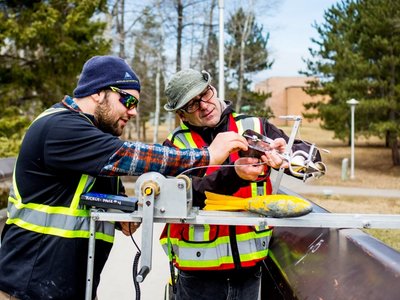
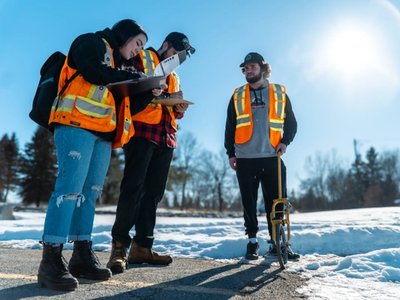
In the Forestry Technician: Ecosystem Management program, you will learn how to manage forest ecosystems through hands-on field work and co-op placements that build real-world skills.
Confederation College’s Forestry Technician: Ecosystem Management two-year co-op diploma program prepares you for a career in all areas of forestry including forest management, forest resource conservation and protection, silviculture, fish and wildlife, fire management, research support, recreation and nature interpretation.
You’ll learn how to balance the social, economic and ecological aspects of our natural resources so that our region – and our people – will continue to grow and thrive.
The skills learned in this program are transferrable across Canada and around the world. Topics include tree & shrub identification, soils & geomorphology, harvesting & wood products, forest operations, the history and culture of Canadian Indigenous Peoples, insects & disease, forest plant biology, silviculture, fire management, fish & wildlife management and geographical information systems (GIS).
Top Highlights
Program includes two mandatory paid co-op placements after the second and fourth semesters of hands-on work experience. Placements are approx. 16 weeks in duration during the summer months.
Balance of class work, field study and placements for a well-rounded education
Graduates can transfer directly into the third-year of Lakehead University’s Faculty of Natural Resource Management four-year program, to obtain a degree
Transfer credits to other related college and university programs through our articulation agreements
Learn and work in a rich and diverse boreal ecosystem!
Seamless Transition to University: Begin your academic journey at Confederation College and transfer directly into a related undergraduate degree at Lakehead University through a joint admission pathway.
Get detailed information about program requirements, courses, and student resources.
Admission Requirements
Fall
Fall (0391)
Admission Requirements for Domestic Students
Ontario Secondary School Diploma (or equivalent) with courses from the College (C), University (U), University/College (U/C), or Open (O) preparation levels with Grade 12 English (C/U) Level.
or successful completion of the Mature Student Assessment.
or successful completion of the Canadian Adult Education Credential (CAEC) or General Education Development Test (GED), prior to May 2024.
or appropriate credits from the Academic and Career Entrance program (ACE).
Other Courses Recommended
Grade 11 or 12 College or University Preparation Chemistry and Biology.
If you do not meet the entrance requirements, or if you want to earn some credits toward the Forestry Technician — Ecosystem Management diploma while exploring your career options in Technology, we encourage you to apply for the Pre-Technology-Trades program.
Student Accessibility and Essential Program Requirements
Confederation College is committed to providing an accessible and inclusive learning environment and will provide reasonable accommodations to students with disabilities in accordance with the Ontario Human Rights Code, the Accessibility for Ontarians with Disabilities Act (AODA), and College policy.
Students who require accommodations are encouraged to engage with Student Accessibility Services and are responsible for initiating and participating in the accommodation process. Accommodation is a collaborative process involving the student, Student Accessibility Services, faculty, and the Academic School. Requests for accommodation are considered on an individual basis, and the College will work with students to identify reasonable accommodations that provide equitable access to learning while maintaining the integrity of the program.
Students are expected to demonstrate the essential knowledge, skills, professional behaviours, learning outcomes, and competencies required to successfully complete their program. While the manner in which these requirements are demonstrated may be accommodated where appropriate, the essential requirements themselves must still be achieved.
For programs involving laboratories, field work, clinical placements, aviation environments, trades training, equipment operation, simulations, community placements, or other environments where health and safety are critical, accommodations must also be consistent with applicable legislation, professional standards, licensing requirements, accreditation standards, and workplace safety obligations.
In some circumstances, a requested accommodation may not be reasonable or possible where it would:
Fundamentally alter an essential program requirement, competency, or learning outcome.
Compromise the health or safety of the student or others.
Conflict with provincial or federal legislation.
Conflict with the requirements of an external regulatory, licensing, accreditation, or professional body.
Prevent the student from demonstrating competencies required for safe and effective professional practice.
Note
Where a particular accommodation cannot be provided, the College will work collaboratively with the student to identify whether an alternative accommodation can appropriately address the student’s disability-related needs while maintaining essential program requirements.
Tuition & Fees
Fees for Domestic StudentsProgram Code: 0391
Year 1
Total: $6,250.00
Fee Breakdown
Academic Fees
Total Tuition Fees:$2,740.00
Tuition Related Fees:$300.00
College Service Fee:$863.00
Health Fee:$305.00
Bus Fee:$332.00
$4,540.00
Program Fees
College Supplies:$65.00
Tools:$175.00
Boots / Uniform:$190.00
Record Check, Seminars, Courses, First Aid, Medicals:$130.00
Books & Supplies:$680.00
Co-op Fee:$470.00
$1,710.00
Year 2
Total: $5,200.00
Fee Breakdown
Academic Fees
Total Tuition Fees:$2,740.00
Tuition Related Fees:$300.00
College Service Fee:$853.00
Health Fee:$305.00
Bus Fee:$332.00
$4,530.00
Program Fees
Books & Supplies:$200.00
Co-op Fee:$470.00
$670.00
Fees for International StudentsProgram Code: 0391
Year 1
Total: $20,522.25
Fee Breakdown
Academic Fees
Total Tuition Fees:$15,540.00
Tuition Related Fees:$300.00
College Service Fee:$863.00
Health Fee:$652.25
Bus Fee:$332.00
$17,687.25
Program Fees
College Supplies:$65.00
Tools:$175.00
Boots / Uniform:$190.00
Record Check, Seminars, Courses, First Aid, Medicals:$130.00
Books & Supplies:$680.00
Co-op Fee:$470.00
$1,710.00
Ancillary Fees
Municipal Levy:$75.00
Student Fees:$300.00
Recovery Fee:$750.00
$1,125.00
Year 2
Total: $19,472.25
Fee Breakdown
Academic Fees
Total Tuition Fees:$15,540.00
Tuition Related Fees:$300.00
College Service Fee:$853.00
Health Fee:$652.25
Bus Fee:$332.00
$17,677.25
Program Fees
Books & Supplies:$200.00
Co-op Fee:$470.00
$670.00
Ancillary Fees
Municipal Levy:$75.00
Student Fees:$300.00
Recovery Fee:$750.00
$1,125.00
Note
Please note that fees are estimated and are subject to change.
Fees shown on this page are for full-time students attending the main Thunder Bay campus for Fall 2026.
Costing for Regional Campuses & Distance Education Students:
If this program is available at Regional Campuses, or to Distance Education students, see the following links for costing information.
In this course, students will be introduced to academic writing styles with a thematic focus on current issues. This course will help students to express themselves clearly and correctly in written form. Students will critically analyse assigned readings and express their thoughts. The course will also focus on the development of an academic paper utilizing the APA style of documentation.
Students will examine the characteristics of the growth and yield of forest stands and gain a thorough understanding of forest measurement sampling techniques and navigation/orientation. Students will also be introduced to surface water grab sampling and groundwater level measurements. Sampling design, sampling intensity, data collection, compilation, and analysis are emphasized.
Students learn first about scientific classification and how it applies to forest trees. The organization of tree species in Canada by morphology (external appearance) is emphasized in both lectures and laboratory sessions. The use of dichotomous keys for identification of unknown samples is practiced. In lectures, an overview of the Forest Regions in Canada is included. Silvics ('how trees grow') and some basic ecology of the major Boreal and Great Lakes - St. Lawrence forest regions follow. Traditional uses of local forest plants and trees are highlighted. Laboratory sessions use live, frozen and pressed tree foliage, twigs and fruit to help students learn to identify and name (common and scientific names) the most important species of trees in Canada, as well as local woody shrubs. An herbarium-standard plant collection, started in field school, is a major component of out-of-class work. It will include samples of Ontario Land Classification (ELC) plant species that will be reviewed in NR216 Introductory Ecology.
The student will gain the skills to identify fundamental characteristics of forest soils and sites and to classify forest ecosystems and ecosites using standard terminologies. The student will then discover how soils and site parameters affect the structure and function of forest ecosystems and how they influence forest operations including road construction, forest harvesting and silviculture. Other topics include hydrology, landform origin, description and identification.
Students will participate in a two-week field school designed to introduce them to the science of terrestrial ecosystems. Field safety, plant identification, orienteering, field soil assessment, and forest measurement concepts will be covered.
In this course, engineering technology students will be introduced to Microsoft Excel and Microsoft Word. Students will develop skills in creating polished, professional documents, format data, process numbers with formulas, or present data to find patterns of any other information that can be laid out in a grid. The course also familiarizes students with the college's data systems, including email, Blackboard, and the Local Area Network (LAN), using Windows 11 as the operating environment.
Applied Math for Technology I provides a foundation in mathematics for students in engineering technology and technician programs. Students will work with whole numbers, fractions, decimals, percentages, ratios, systems of measurements, units, and introductory algebra while solving applied problems involving variation, geometry, and right trigonometry.
This course will provide students with an introduction to the use of Geographic Information Systems (GIS) and build basic skills required by the entry level Natural Resource Technician. Topics explored will include the fundamentals of creating and managing information in a digital environment, performing common queries and analysis, and presenting information in the format of maps and reports in a professional manner. Additional topics covered in the course will include the use of Global Positioning Systems (GPS) and an introduction to the science of Remote Sensing.
The introductory course covers the planning, layout, and implementation of harvest, renewal, and tending operations. Emphasis is placed on environmental protection and the principles and approaches behind ecosystem management and forest sustainability. Students will gain an understanding of harvest methods and logging systems, including road construction and water crossing techniques. Collaborative approaches to forest management planning and the importance of forest certification are reviewed, all within the context of relevant provincial legislation. This course introduces students to forest renewal practices, spanning from forest operations prescription setting to free-growing status determination.
Basic biology of plants from the cellular level to a whole forest. Students will gain an elementary understanding of metabolic process in plants such as photosynthesis and respiration. Plant diversity and the life cycles of conifers (gymnosperms) and hardwoods (angiosperms) will be explored. The structure and function of non-woody and woody plant tissues and organs will be examined along with plant growth and genetics.
This course in basic ecology explores the biotic and abiotic elements of ecosystems, along with the chemical, geological, and biological processes that impact how an ecosystem functions. Terrestrial, freshwater, and wetland ecosystems are highlighted. Students will research and write a technical report on an environmental issue of interest to the student. Laboratory activities will include a foundational number of Ontario Ecological Land Classification plants of various forms to be learned. Winter twig identification of local native woody deciduous shrub and tree species will also be explored.
The placement is negotiated and coordinated by the Placement Office and the Program Coordinator. The procedures and regulations pertaining to this placement will be according to the College's 'CO-OP HANDBOOK FOR STUDENTS'. During this work placement, the actual duration of which will be 16 weeks, the student has the opportunity to apply his/her theory and practical skills in a full-time work situation outside of the academic environment. This will help the student in developing his/her long-term career goals. In addition to having his/her work performance evaluated by the employer, the student will complete and submit for evaluation a formal report describing the placement.
Applied Math for Technology II is a continuation of its pre-requisite course MA115. Students will further develop mathematical problem-solving techniques as applied to the different technical areas. After successful completion of this course, the student will be able to solve applications involving factoring, algebraic fractions, functions, graphing, geometry, trigonometry, and vectors.
This course is designed to broaden the participant’s perspective on contemporary natural resource issues in Canada, with an emphasis on the history and culture of Indigenous peoples. Forested lands are an essential part of life and economy in Canada. While First Nations, Metis, and Inuit communities are vastly different from each other, a close connection to the land is a commonality. They have lived on and managed the land and its forests for generations. Understanding of the past, present, and future roles of Indigenous governments in the management of their land and forests is essential for anyone planning on working on the land. The key topics of Indigenous views of land use, land claims, and the braiding of sustainable industrial development with Indigenous Knowledge into forest management are explored. Non-wood forest products and ethno-ecology are also examined.
This advanced mensuration course builds on the concepts learned in Natural Resource Measurements. Common attributes collected and the various techniques used for conducting forest inventories will be examined from the plot, stand and forest-level. Sampling designs and statistical methods for forestry-related surveys will be highlighted with a focus on understanding how sample methodology influences results. Methods to calculate forest attributes (e.g. BA, density, volume, growth and site productivity) from various sampling methods will be undertaken. An introduction to wood measurement (scaling) and it's associated manuals will be presented.
In this course, students will continue developing their GIS skills as they expand their base knowledge of cartography, map projections, coordinate systems and spatial analysis. Mobile data collection, editing of GIS information and the processing of remote sensing data will be explored. Emphasis will be placed on applying theoretical concepts to real-world natural resource applications.
This applied silviculture course covers the theory and practice of planned forest regeneration. Topics include (but are not limited to) species silvics, natural disturbance regimes, silviculture systems, site preparation, natural and artificial regeneration, seedling procurement, tending (including vegetation management and density management) and silviculture effectiveness monitoring. An emphasis is placed on how and why silviculture systems and treatments emulate natural disturbances.
This course introduces students to the study of insects and diseases that impact the quantity, quality and value of our forest resources. Insect and disease life cycle, identification, classification and strategies for controlling outbreaks are discussed. The important roles these organisms play in forest ecosystems are highlighted.
Common ground and cable based harvesting systems in Canada will be explored, with an emphasis on efficiency, products and environmental impacts. Students will be made aware of many of the products produced from managed forests. Students will also broaden their knowledge of the structure of wood and gain an ability to identify major Canadian species based on wood samples.
Effective supervisors are able to organize and motivate their staff to successfully and productively accomplish tasks and goals. Valuable employees are able to take direction and responsibility for assigned tasks as individuals and as team members. In this class, students will learn about and practice 'people management' skills, including empathic listening and self-awareness (personal assessment and development). The art of conflict resolution in the workplace will be learned and practiced (leaders and 'team players').
Fall field school for second year students involves both day trips and a stay in a camp setting. Emphasis is on a variety of silviculture topics including regeneration techniques and assessments, density management and prescription setting. Harvest operations and their associated planning activities, such as road layout and water crossings, are also presented. Forest inventory methodologies are reviewed and field measurements are undertaken for further calculations in the Forest Inventory course. Values protection and a variety of wildlife topics are also discussed.
The student will gain an understanding of fish and wildlife management policies, regulations and guidelines in Ontario and Canada. Lectures will focus on understanding wildlife-habitat relationships, habitat selection, population dynamics, and the use of forested areas as habitat for a variety of species. Labs will focus on aspect of wildlife identification including bird songs and wildlife tracks, and survey methods to estimate wildlife populations and predict impacts from management activities. As part of this course, the student will complete a term paper and deliver a presentation on the habitat needs and management of a fish or terrestrial wildlife species in Northern Ontario.
This course introduces you to the natural role of fire in forested ecosystems, and the approach and practices used in forest fire management. Principles of weather, fuel types and fire behaviour will be explored within the context of the Canadian Forest Fire Danger Rating System. The ecological effects of fire at both the stand and landscape levels will be examined as they relate to forest biodiversity and ecosystem health. Fire-related legislation and policy in Ontario will be reviewed. The use of prescribed fire as a silvicultural tool to meet land management objectives is presented.
Students will study the principles of management planning with a focus on the ideas and directions beneficial to a practicing forest technician. Beginning at a broad scale, principles applicable to many jurisdictions are discussed. Moving toward a finer operational scale, specific attention is paid to the current forest management direction applied to Crown land in Ontario. The course will consider current social, political and environmental factors, which influence the course of forest management. Building on principles encountered in FW 211 - Forest Operations and FW 312 – Silviculture, students will expand their understanding of sustainability, yield determination, basic principles of forest modeling landscape and stand level spatial constraints, road planning and layout and water crossings. Other ancillary activities such as forest compliance planning, inspection and reporting will also be examined. Students will be made aware of key guidelines such as the Landscape Guide and Stand and Site Guide.
A practical introductory course in the theory and application of photo interpretation. Scale determination, height measurement, and tree identification [using aerial photographs] will be taught [and practiced]. Each student will submit a [final] project that involves both field data collection, and the delineation of stand boundaries and inventory attributes.
This placement is negotiated and coordinated by the Placement Office and the Program Coordinator. The procedures and regulations pertaining to this placement will be according to the College's 'CO-OP HANDBOOK FOR STUDENTS'. During this work placement, the actual duration of which will be 16 weeks, the student has the opportunity to apply his/her theory and practical skills in a full-time work situation outside of the academic environment. This will help the student in developing his/her long-term career goals. In addition to having his/her work performance evaluated by the employer, the student will complete and submit for evaluation a formal report describing the placement.
The graduate has reliably demonstrated the ability to:
Conduct forest inventory surveys and field measurements to determine forest resources and values in forests and woodlots.
Assess soil characteristics, vegetation and wildlife habitats to identify their interactions within forest ecosystems.
Perform technical functions in silvicultural operations and assist in the monitoring and evaluation of the effectiveness of silvicultural practices.
Collect, analyze, interpret, and display spatial data using mapping technology and Geographical Information Systems (GIS) to contribute to forest resource management.
Contribute to sustainable forest management plans, including conservation and rehabilitation measures, taking into consideration the perspectives of a variety of stakeholders and the requirements of relevant legislation and regulations.
Identify and analyze forest diseases, pests, invasive species and other disturbance events and implement mitigation strategies to maintain and improve forest ecosystems.
Select, operate, troubleshoot and maintain tools and equipment in a variety of environmental conditions and in accordance with safety and operating standards.
Work independently and in a collaborative environment while applying effective teamwork, leadership and interpersonal skills.
Communicate technical information to a variety of stakeholders in oral, written, visual and electronic forms.
Develop strategies for ongoing professional development to enhance work performance in the forestry sector.
Graduates of the Forestry Technician - Ecosystem Management program go on to a variety of positions in government or industry. These include Resource Technician, Forest Survey Technician, Fire Ranger, Conservation Officer, Scaler, Harvesting Supervisor, Silviculture Technician, Fish and Wildlife Technician, and Park Ranger. However, this program can also provide a strong background for others living and working in the forest in areas including eco-tourism and recreation, research and academics and development of projects that have an impact on our forests.
Clicking the button will take you to a detailed dashboard with up-to-date job data tailored to your program, including salary ranges, job titles, and projected demand.
Pathways
Confederation College offers a variety of articulation agreements designed to help you advance your education and career. Whether you're coming to us from another institution or planning your next steps after completing your program, our pathways make your transition seamless and effective.
Pathway Out — Credits recognized by another institution
Lakehead University — Undergraduate Degree Programs at Lakehead University
This pathway allows students to begin a diploma at Confederation College and then apply to Lakehead University to continue into a degree program, combining hands-on learning with academic study.
Confederation College and Lakehead University offer a joint admission pathway that supports a smooth transition from diploma to degree studies.
Pathway Structure:
Students begin with a diploma program at Confederation College, focusing on applied, hands-on learning over two years
After completing their diploma, students transition to Lakehead University to pursue undergraduate degree studies
Key Features:
Combines practical, career-focused training with academic and theoretical education
Provides experience in two distinct learning environments
Prepares students with both applied skills and advanced knowledge
Admission Process:
Students who complete their diploma at Confederation College can apply directly to Lakehead University
University of New Brunswick — Bachelor of Applied Management (BAM)
Graduates from eligible 2-year or 3-year diploma programs at Confederation College can apply to enter the third year of the Bachelor of Applied Management at the University of New Brunswick, with a minimum 70% program average. Additional courses may be required.
Minimum Admission Average
70% overall program average
Entry Point
Year 3 of a 4-year degree
Institution: University of New Brunswick, Saint John, NB
Agreement Type: Memorandum of Understanding
Graduates of eligible diploma programs at Confederation College may be considered for advanced standing in the Bachelor of Applied Management (BAM).
Eligibility Requirements:
Completion of a 2-year (four-semester) or 3-year (six-semester) diploma program
Minimum overall program average of 70%
Transfer Details:
Eligible students may enter Year 3 of the 4-year BAM program
Additional courses may be required depending on the applicant’s academic background
Program Notes:
Eligible Confederation College programs are outlined in Appendix A of the Memorandum of Understanding
Students should consult the contact person for full details and program-specific requirements