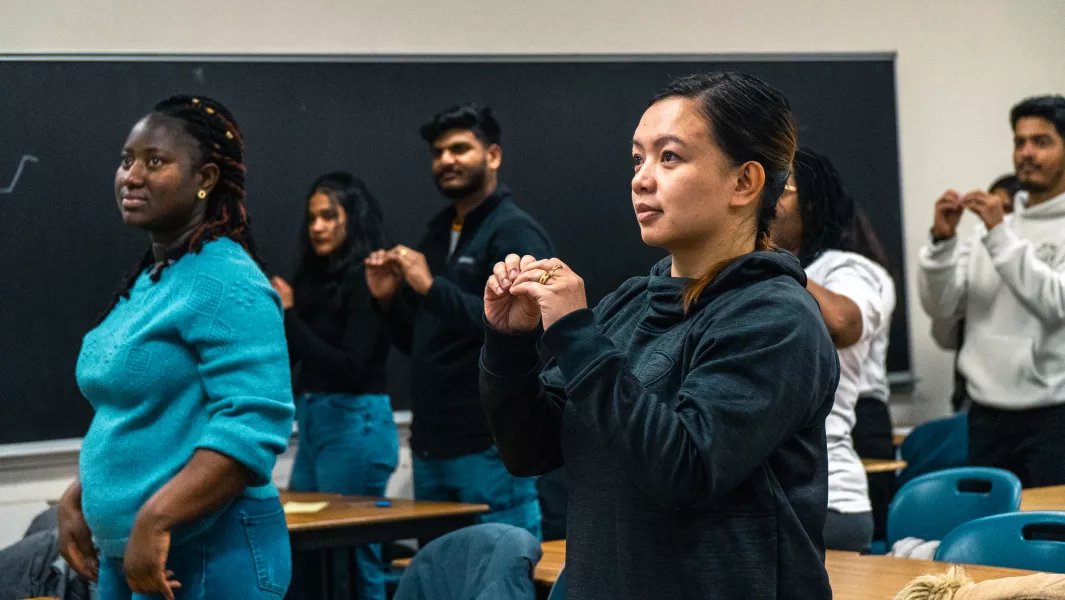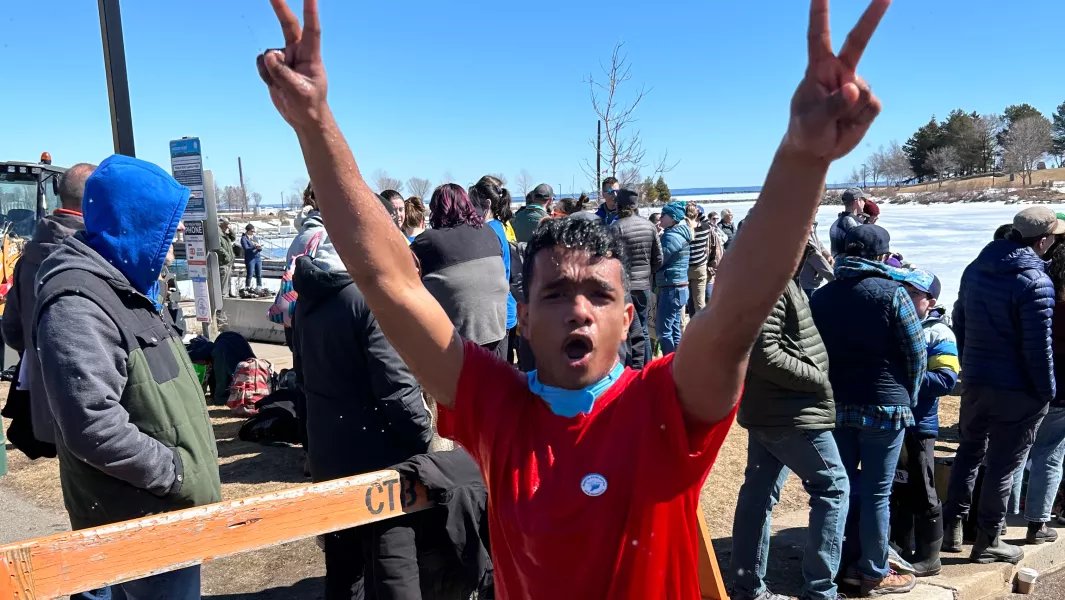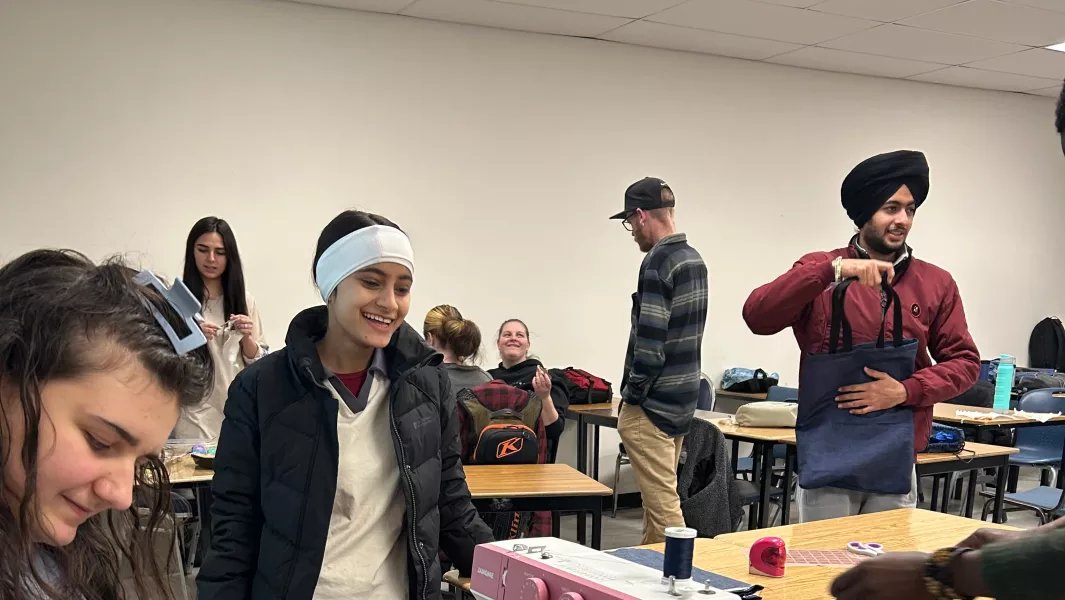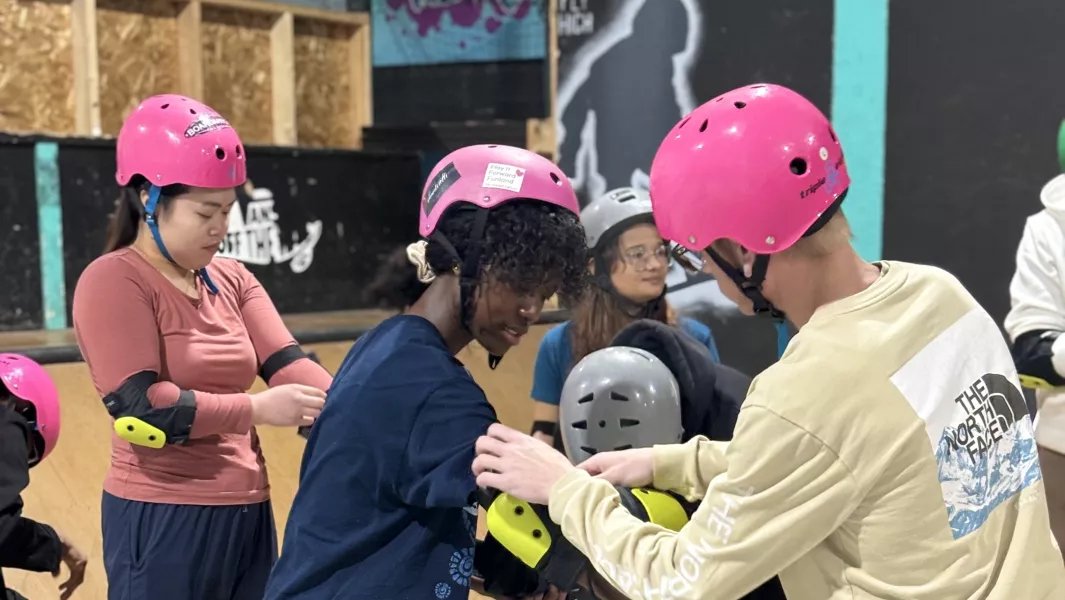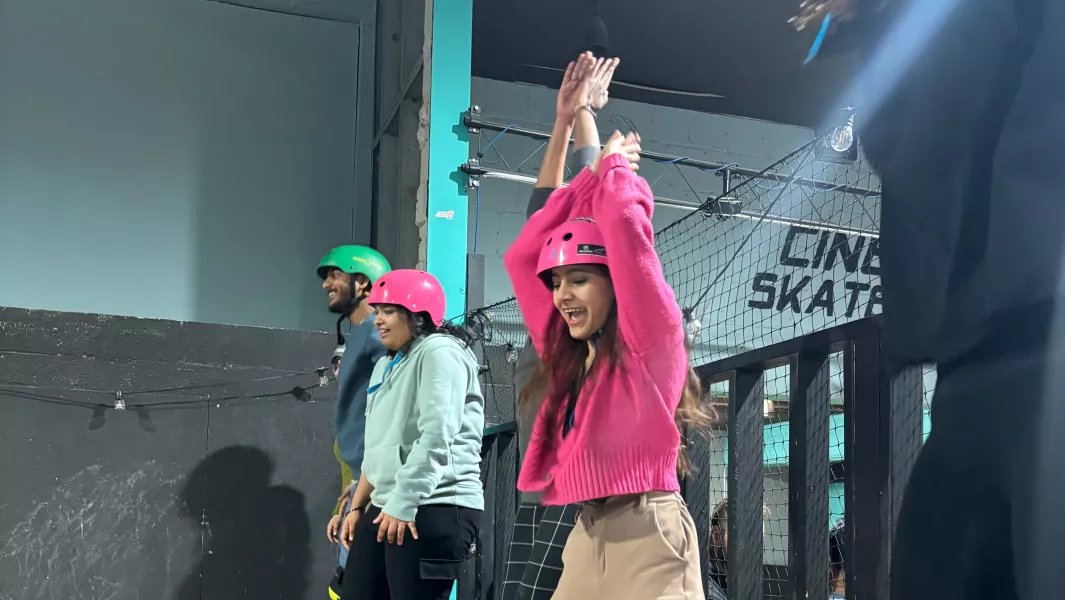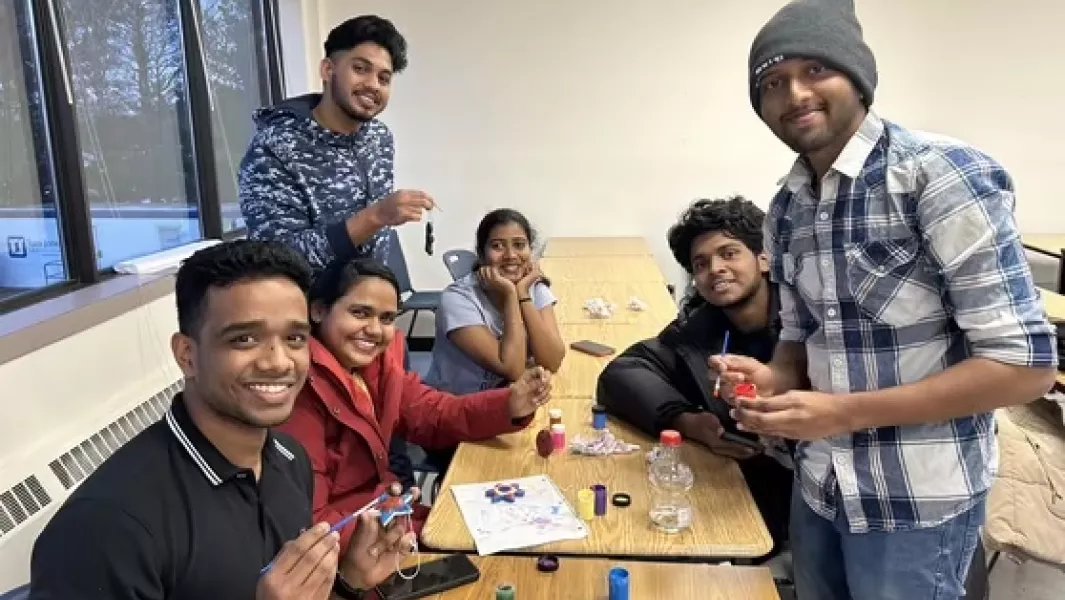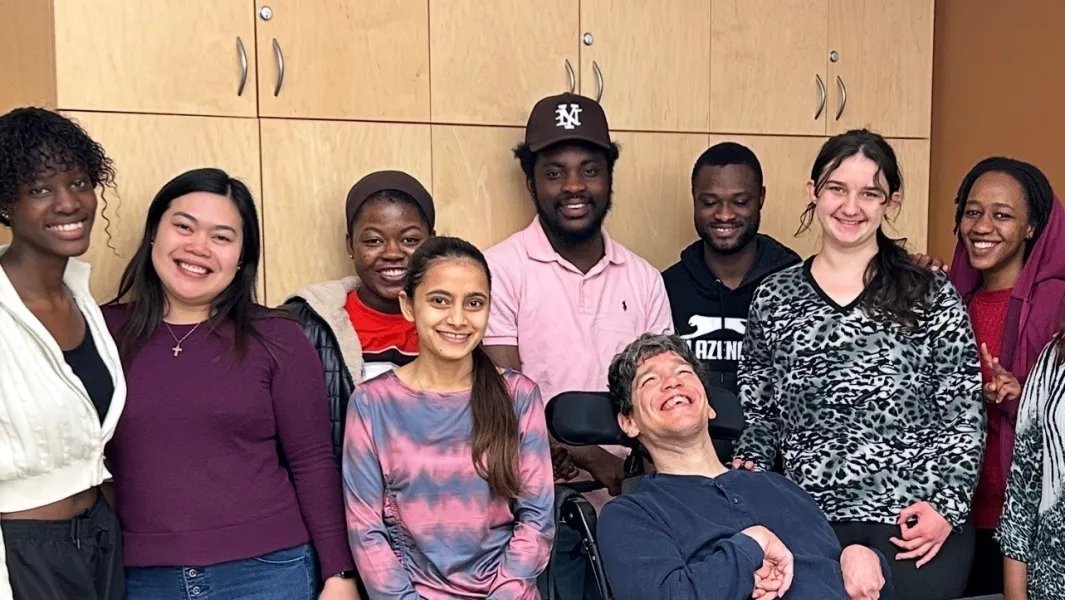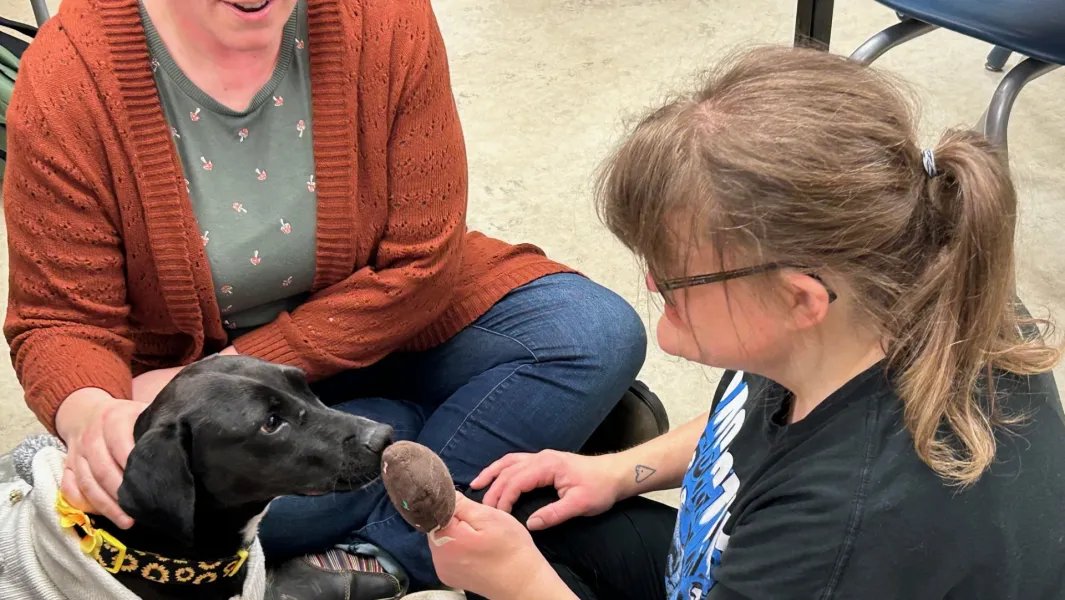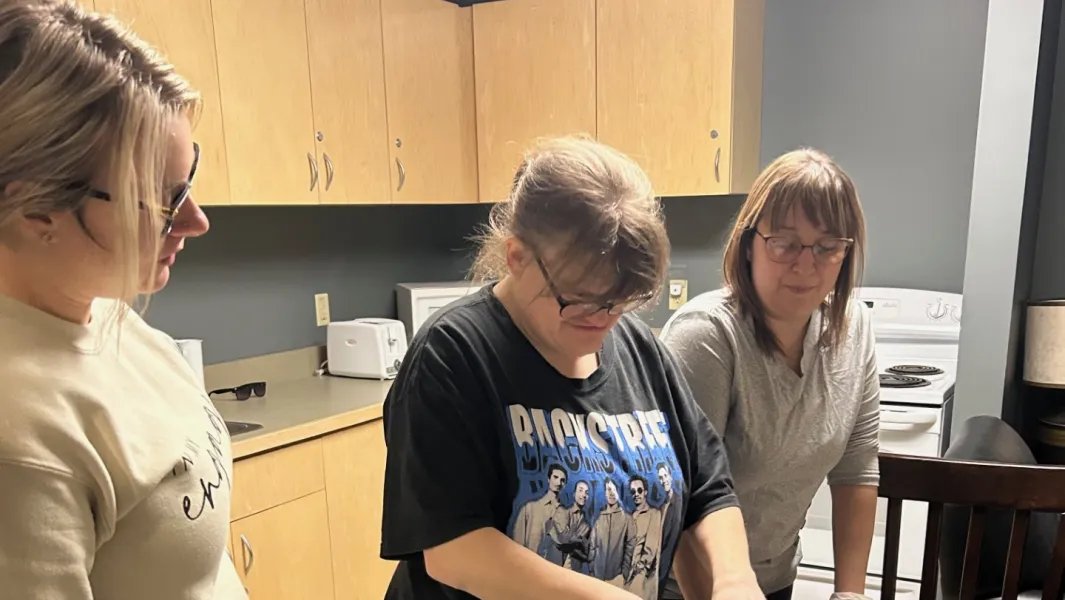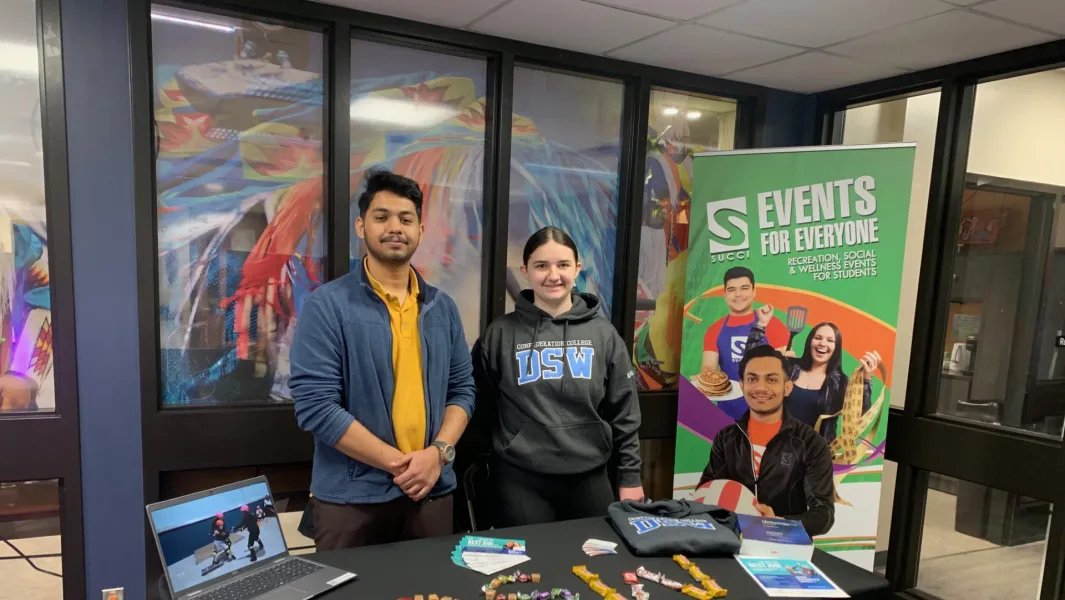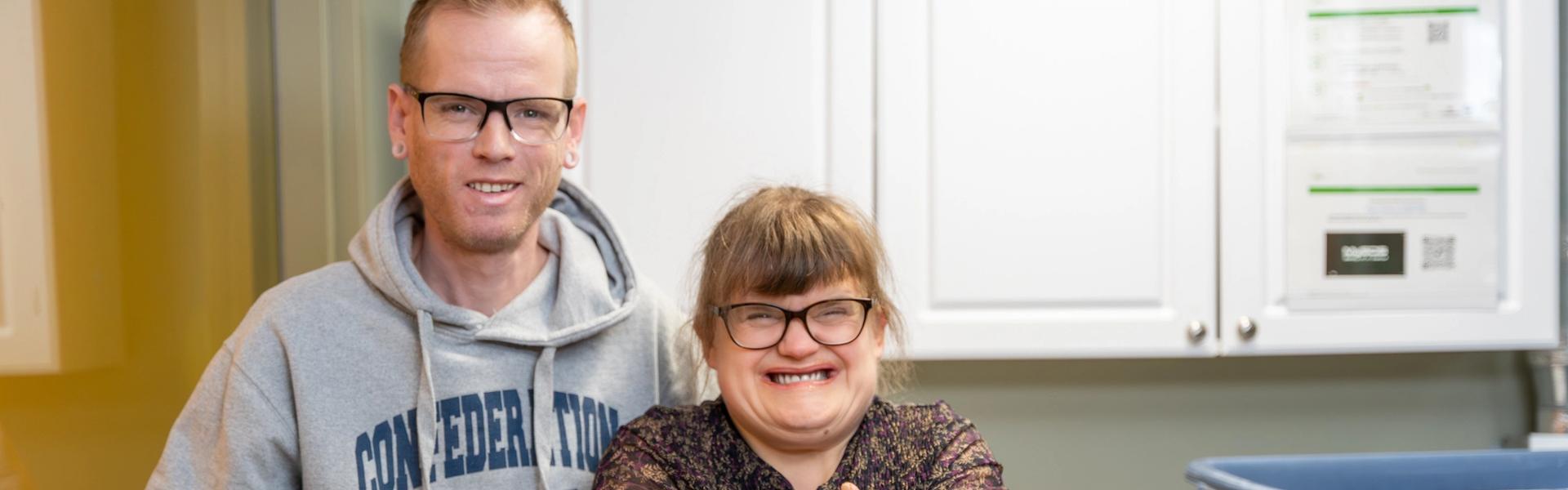
Two people standing in a laundry room, one in a Confederation College hoodie and the other giving a thumbs-up.

Ontario College Diploma

Developmental Services Worker

In the Developmental Services Worker program, you will learn how to support individuals with developmental disabilities through two supervised field placements.

CIP Code: 19.0710
PGWP Eligible
This program meets the criteria to be Post-Graduation Work Permit (PGWP) eligible as defined by Immigration, Refugees and Citizenship Canada (IRCC).

Note: PGWP eligibility does not guarantee approval. IRCC assesses all applications individually.

Program Start Options

IntakeDurationFormatCampusDomesticInternational
0139
Fall
2 years
4 semesters
Full-Time
In-Person
Thunder Bay
Domestic students accepted
International students accepted
0162
Fall
Accelerated
1 year
2 semesters
Full-Time
In-Person
Thunder Bay
Domestic students accepted
International students accepted

Do you love to work with people and want career options in your future? Do you hope to make a difference in the world? Supporting children and adults with intellectual and developmental disabilities is a great way to do just that.

Confederation College’s Developmental Services Worker program will give you the skills and experience you need to support others in living their life to the fullest. As a Developmental Services Worker student, you will learn how to provide physical, emotional, educational, recreational, and social supports to people with intellectual and developmental disabilities across the lifespan and in all facets of life.

Coursework includes study in developmental disabilities, teaching strategies, health promotion, augmentative communication and assistive technology, pharmacology, dual diagnosis, trends and issues, behavioural supports, counselling skills and community development. You will also learn through two supervised field placements. If you believe in equity, diversity, and inclusion of all people in our community, this program is for you!

Each year a number of seats will be available to people with a university degree in a related field or a community college graduate with a diploma from a human/community service program. Students must apply to ontariocolleges.ca(opens in new window) and must have a minimum GPA of 2.0 or higher average. A transcript is required. The program is composed of courses from the first and second year of the program. The duration is 2 semesters, from September to May.

Top Highlights

  • Two field placements for real-world learning experiences
  • Comprehensive knowledge and skills to support individuals in reaching their full potential
  • Hands-on practice in lab settings
  • Collaborative event planning with community partners
  • Accelerated program option for those with relevant diplomas or degrees
  • Focus on inclusion, individualization, and empowerment

Ideal Candidate Profile

  • Compassionate: Genuinely care about helping others achieve their goals
  • Adaptable: Ready to face diverse challenges and find creative solutions
  • Communicative: Skilled at interacting with people of all abilities
  • Empowering: Committed to promoting self-determination and independence

Experiential Learning

  • Interactive simulations and teaching labs
  • Two field placements: one in a community-based setting with adults, another in a school-based setting
  • Capstone projects integrating learned skills and knowledge

Contact Information

Program Files

Get detailed information about program requirements, courses, and student resources.

Choosing the DSW program at Confederation College was one of the best decisions I’ve ever made—it gave me the skills, confidence, and personal growth to succeed.

DMJ
Diya Molly John
Graduate – DSW graduate

Confederation College helped me grow not only as a student, but also as a person—thanks to inspiring professors who believed in me and guided me toward my passion for supporting others.

SG
Sandra George
Graduate 2019

The DSW program gave me the skills and experience to support student success and led me directly to my dream job helping others thrive in a college setting.

RH
Rose Hankkio
Graduate of 2006 – Integration Facilitator, Community Integration through Cooperative Education Program, Confederation College

My two years in the Developmental Services Worker program were among the best of my life—hands-on learning and supportive instructors helped me build a fulfilling, inclusive career.

KT
Kerri-Lee Turcotte
Graduate – Integration Facilitator, Community Integration Through Cooperative Education, Confederation College

The DSW program didn’t just prepare me for a career—it helped shape who I am. The support and compassion from the professors made this a life-changing experience.

ST
Sapana Tiwari
Graduate – DSW graduate

The DSW program quickly became my home. I found purpose, lifelong friendships, and a sense of belonging that made my journey unforgettable.

WK
Whitney Kajumba
Graduate – DSW graduate

Confederation College gave me the hands-on experience and guidance I needed to discover my passion for advocating for people with disabilities. It truly changed my life.

ML
Michelle Lavoie-Pintar
Graduate of 2013 – Student Support Person (SSP), Conseil scolaire de district catholique des Aurores boréales

Admission Requirements

Fall

Fall (0139)

Admission Requirements for Domestic Students

  1. Ontario Secondary School Diploma (or equivalent) with courses from the College (C), University (U), University/College (U/C), or Open (O) preparation levels with Grade 12 English (C/U) Level.
  2. or successful completion of the Mature Student Assessment.
  3. or successful completion of the Canadian Adult Education Credential (CAEC) or General Education Development Test (GED), prior to May 2024.
  4. or appropriate credits from the Academic and Career Entrance program (ACE).

Other Courses Required

  • Standard First Aid and CPR Level C.
  • Non-Violent Crisis Intervention Training completed within the first semester.
  • Immunizations and TB Skin Test up to date.
  • Physical demands (possess the physical capability to lift/move up to 22 kg).
  • Police Record Check (Vulnerable Sector Screening). Needs to be current within 3 months of starting Field Placement in January.

Admission Requirements for International Students

  1. A high school/senior secondary diploma
    Original transcripts as well as a notarized, translated copy must be provided where applicable
  2. English Proficiency
    Academic IELTS: overall 6.0, with no bands lower than 5.5.
    Click here for more information

Prerequisites

Important

Once you have "applied to the program" and have received and "accepted" an official "Offer of Admission" the following are other critical requirements that you need to plan and complete, PRIOR to your official "Program Start Date."

  1. Immunization and Communicable Disease’s Form

Alternative Pathways

If you do not meet these admission requirements, we encourage you to consider our College Access or General Arts and Science Certificate or General Arts and Science Diploma programs, or Academic and Career Entrance program (ACE); if you successfully complete one of these programs, you will be eligible to apply to programs in the Community Services area.

Fall (0162)

Admission Requirements for Domestic Students

Each year, a limited number of seats in the "Accelerated" Ontario College Diploma program will be available to qualified applicants.

  1. Degree or diploma from an accredited University or College in a related discipline.

Admission Requirements for International Students

  1. A four year degree from an accredited university or college in a healthcare related field such as Nursing or Social Work (1st class)
    a) Original transcripts as well as a notarized, translated copy must be provided where applicable
    b) No more than six backlogs/failures
  2. English Proficiency
    a) Academic IELTS: 6.5, no band lower than 6.0

Alternative Pathways

If you are interested in taking this program and do not meet the above requirements, please consider our 2-year Developmental Services Worker diploma program.

Student Accessibility and Essential Program Requirements

Confederation College is committed to providing an accessible and inclusive learning environment and will provide reasonable accommodations to students with disabilities in accordance with the Ontario Human Rights Code, the Accessibility for Ontarians with Disabilities Act (AODA), and College policy.

Students who require accommodations are encouraged to engage with Student Accessibility Services and are responsible for initiating and participating in the accommodation process. Accommodation is a collaborative process involving the student, Student Accessibility Services, faculty, and the Academic School. Requests for accommodation are considered on an individual basis, and the College will work with students to identify reasonable accommodations that provide equitable access to learning while maintaining the integrity of the program.

Students are expected to demonstrate the essential knowledge, skills, professional behaviours, learning outcomes, and competencies required to successfully complete their program. While the manner in which these requirements are demonstrated may be accommodated where appropriate, the essential requirements themselves must still be achieved.

For programs involving laboratories, field work, clinical placements, aviation environments, trades training, equipment operation, simulations, community placements, or other environments where health and safety are critical, accommodations must also be consistent with applicable legislation, professional standards, licensing requirements, accreditation standards, and workplace safety obligations.

In some circumstances, a requested accommodation may not be reasonable or possible where it would:

  • Fundamentally alter an essential program requirement, competency, or learning outcome.
  • Compromise the health or safety of the student or others.
  • Conflict with provincial or federal legislation.
  • Conflict with the requirements of an external regulatory, licensing, accreditation, or professional body.
  • Prevent the student from demonstrating competencies required for safe and effective professional practice.
Note

Where a particular accommodation cannot be provided, the College will work collaboratively with the student to identify whether an alternative accommodation can appropriately address the student’s disability-related needs while maintaining essential program requirements.

Tuition & Fees

Fees for Domestic StudentsProgram Code: 0139

Year 1
Total: $5,852.08
Fee Breakdown
Academic Fees
Total Tuition Fees:$2,740.00
Tuition Related Fees:$222.08
College Service Fee:$863.00
Health Fee:$305.00
Health Record Fee:$40.00
Bus Fee:$332.00
$4,502.08
Program Fees
College Supplies:$100.00
Record Check, Seminars, Courses, First Aid, Medicals:$300.00
Exam Fees, Certifications, Licenses, Apprentice or Business Registration:$50.00
Books & Supplies:$900.00
$1,350.00
Year 2
Total: $5,692.08
Fee Breakdown
Academic Fees
Total Tuition Fees:$2,740.00
Tuition Related Fees:$222.08
College Service Fee:$853.00
Health Fee:$305.00
Health Record Fee:$40.00
Bus Fee:$332.00
$4,492.08
Program Fees
College Supplies:$100.00
Record Check, Seminars, Courses, First Aid, Medicals:$200.00
Books & Supplies:$900.00
$1,200.00

Fees for International StudentsProgram Code: 0139

Year 1
Total: $19,864.33
Fee Breakdown
Academic Fees
Total Tuition Fees:$15,280.00
Tuition Related Fees:$222.08
College Service Fee:$863.00
Health Fee:$652.25
Health Record Fee:$40.00
Bus Fee:$332.00
$17,389.33
Program Fees
College Supplies:$100.00
Record Check, Seminars, Courses, First Aid, Medicals:$300.00
Exam Fees, Certifications, Licenses, Apprentice or Business Registration:$50.00
Books & Supplies:$900.00
$1,350.00
Ancillary Fees
Municipal Levy:$75.00
Student Fees:$300.00
Recovery Fee:$750.00
$1,125.00
Year 2
Total: $19,704.33
Fee Breakdown
Academic Fees
Total Tuition Fees:$15,280.00
Tuition Related Fees:$222.08
College Service Fee:$853.00
Health Fee:$652.25
Health Record Fee:$40.00
Bus Fee:$332.00
$17,379.33
Program Fees
College Supplies:$100.00
Record Check, Seminars, Courses, First Aid, Medicals:$200.00
Books & Supplies:$900.00
$1,200.00
Ancillary Fees
Municipal Levy:$75.00
Student Fees:$300.00
Recovery Fee:$750.00
$1,125.00

Fees for Domestic StudentsProgram Code: 0162

Year 1
Total: $5,852.08
Fee Breakdown
Academic Fees
Total Tuition Fees:$2,740.00
Tuition Related Fees:$222.08
College Service Fee:$863.00
Health Fee:$305.00
Health Record Fee:$40.00
Bus Fee:$332.00
$4,502.08
Program Fees
College Supplies:$100.00
Record Check, Seminars, Courses, First Aid, Medicals:$300.00
Exam Fees, Certifications, Licenses, Apprentice or Business Registration:$50.00
Books & Supplies:$900.00
$1,350.00

Fees for International StudentsProgram Code: 0162

Year 1
Total: $19,864.33
Fee Breakdown
Academic Fees
Total Tuition Fees:$15,280.00
Tuition Related Fees:$222.08
College Service Fee:$863.00
Health Fee:$652.25
Health Record Fee:$40.00
Bus Fee:$332.00
$17,389.33
Program Fees
College Supplies:$100.00
Record Check, Seminars, Courses, First Aid, Medicals:$300.00
Exam Fees, Certifications, Licenses, Apprentice or Business Registration:$50.00
Books & Supplies:$900.00
$1,350.00
Ancillary Fees
Municipal Levy:$75.00
Student Fees:$300.00
Recovery Fee:$750.00
$1,125.00
Note

Please note that fees are estimated and are subject to change.

Fees shown on this page are for full-time students attending the main Thunder Bay campus for Fall 2026.

Costing for Regional Campuses & Distance Education Students:

If this program is available at Regional Campuses, or to Distance Education students, see the following links for costing information.

Courses

2 intakes

Fall0139

Semester 1

DS 127

Developmental Disabilities

42 hours

This course will provide information about the history of developmental disability. Emphasis will be placed on understanding the causes of and conditions related to disability.

CS 050

College Writing

42 hours

In this course, students will be introduced to academic writing styles with a thematic focus on current issues. This course will help students to express themselves clearly and correctly in written form. Students will critically analyse assigned readings and express their thoughts. The course will also focus on the development of an academic paper utilizing the APA style of documentation.

DS 341

Health Promotion

42 hours

Students will learn a variety of health care competencies as well as the related theory for healthy living. The students will be required to demonstrate competencies through practical applications within the classroom.

DS 115

Prof. & Field Placement Prepar

42 hours

Students will examine the role of the developmental services worker in relation to field placement expectations. Policies, processes, roles, responsibilities and expectations will be examined and discussed. Community services and resources will also be explored. Note: Students will require additional mandatory training as part of the preparation process for fieldwork and in order to complete required assignments for this course.

DS 133

Pharmacology

42 hours

Students will learn a variety of pharmacology competencies, as well as the related theory for specific body systems and the drugs that affect each system. The students will demonstrate procedures for the administration of medications through practical applications within the classroom. Considerations for administering medications for individuals with a disability will be the focus.

DS 234

Applied Behavioural Analysis

42 hours

Students will explore foundational concepts in applied behaviour analysis. They will learn to assess the need for behaviour intervention as well as gain the skills required to develop and implement positive behavioural support strategies and plans across a variety of professional settings.

Semester 2

CS 223

Communications for Community Services

42 hours

In this course, students will enhance their communication skills as needed in the community services field. They will acquire the skills necessary to write memos, letters, email, informal reports and proposals and presentations that meet the professional standards in the community services field. Students will combine collaborative methods with advanced research, written and oral skills to produce and present an infographic.

DS 345

Dual Diagnosis

42 hours

Students will be provided an overview of mental health diagnoses and the interventions/treatments currently used to promote successful inclusion in the community. Students will also learn about the nature of dual diagnosis and the need for a coordinated system of supports and services for individuals with a disability.

DS 347

Person Directed Planning

42 hours

In this course, students will examine person centered and directed approaches in order to support individuals with skills to live as independently as possible. Specific best practices in planning and support will be covered.

DS 452

Field Placement I

336 hours

Students will be involved in 14 weeks of placement in community based agencies. The agency environment will provide the student with an opportunity to observe and practice the competencies required in the role of a Developmental Services Worker. Students will be in field placement three days a week with supervision from agency mentors and college advisors.

DS 129

Intervention Strategies

42 hours

Students will be provided with an understanding of the principles and applications of techniques designed to assist persons who have been labelled. The focus will be hands on learning about how to improve accessibility, along with how to modify tasks/activities for improving all aspects of daily living.

Semester 3

SS 116

Social Welfare

42 hours

In this course, students will examine historical development and current political and ideological influences on the social welfare system in Canada. This course also examines contemporary challenges being experienced by Canadians living within the social welfare system and role of the professions of Social Work and Social Service Work in assisting with addressing those challenges.

DS 343

Behavioural Support Strategies

42 hours

Students will assess, design, implement and evaluate behavioural plans when supporting individuals with challenging behaviour. Emphasis will be on the application of advanced applied behavioural analysis skills, learned in DS234 Applied Behaviour Analysis.

DS 236

Trends & Issues in Developmental Services

42 hours

This course will build on the students' knowledge of disabilities and current issues of importance in the field.

DS 349

Augmentative Communication & Assistive Technology

42 hours

Students will examine typical and atypical language development, augmentative communication, and best practices in the use of assistive technology. This course will use a blend of theory with hands on development of techniques necessary to support people at home, work or in school.

PY 063

Child Development

42 hours

This course explores life from a chronological perspective, beginning from conception, then moving through the stages of infancy, childhood, and concluding with adolescence. Each developmental period will be examined in relation to physical, motor, cognitive, social-emotional, and biological factors that affect development.

42 hours

Semester 4

DS 460

Community Development

42 hours

In this course, students will engage in the community development process by developing collaborative relationships with the disability sector to generate solutions to identified community needs. The focus will be to promote community wellbeing at a grassroots level to promote change and to advocate for quality life outcomes for individuals who have been labelled by society. Students will develop a community development project with emphasis on facilitating positive, value based attitudes to teach about inclusive practices. Students will also have opportunities for collaborative teamwork within and outside the classroom to practice the principles of community development and to act as agents of change when addressing the current social and political conditions in the disability sector.

DS 232

Field Placement II

280 hours

Students will be involved in a school based placement for 14 weeks. The school environment will provide the student with an opportunity to observe and practice the competencies that are required in the role of a Student Support Professional.

DS 238

Teaching Strategies

42 hours

Students will examine the learning needs of students with disabilities. Included for study are approaches to inclusive education and Universal Design for Learning, including instructional strategies and adaptation of activities that promote meaningful engagement and participation.

DS 456

Counselling Skills

42 hours

In this course students will be provided with the opportunity to develop basic professional "helping skills". This is an introductory course where students will learn a critical set of competencies for use in their field of practice. Students will be challenged to apply theoretical concepts in classroom role plays and skill building exercises.

42 hours
Fall0162

Semester 1

DS 133

Pharmacology

42 hours

Students will learn a variety of pharmacology competencies, as well as the related theory for specific body systems and the drugs that affect each system. The students will demonstrate procedures for the administration of medications through practical applications within the classroom. Considerations for administering medications for individuals with a disability will be the focus.

DS 127

Developmental Disabilities

42 hours

This course will provide information about the history of developmental disability. Emphasis will be placed on understanding the causes of and conditions related to disability.

DS 341

Health Promotion

42 hours

Students will learn a variety of health care competencies as well as the related theory for healthy living. The students will be required to demonstrate competencies through practical applications within the classroom.

DS 115

Prof. & Field Placement Prepar

42 hours

Students will examine the role of the developmental services worker in relation to field placement expectations. Policies, processes, roles, responsibilities and expectations will be examined and discussed. Community services and resources will also be explored. Note: Students will require additional mandatory training as part of the preparation process for fieldwork and in order to complete required assignments for this course.

DS 234

Applied Behavioural Analysis

42 hours

Students will explore foundational concepts in applied behaviour analysis. They will learn to assess the need for behaviour intervention as well as gain the skills required to develop and implement positive behavioural support strategies and plans across a variety of professional settings.

DS 236

Trends & Issues in Developmental Services

42 hours

This course will build on the students' knowledge of disabilities and current issues of importance in the field.

DS 349

Augmentative Communication & Assistive Technology

42 hours

Students will examine typical and atypical language development, augmentative communication, and best practices in the use of assistive technology. This course will use a blend of theory with hands on development of techniques necessary to support people at home, work or in school.

Semester 2

DS 452

Field Placement I

336 hours

Students will be involved in 14 weeks of placement in community based agencies. The agency environment will provide the student with an opportunity to observe and practice the competencies required in the role of a Developmental Services Worker. Students will be in field placement three days a week with supervision from agency mentors and college advisors.

DS 129

Intervention Strategies

42 hours

Students will be provided with an understanding of the principles and applications of techniques designed to assist persons who have been labelled. The focus will be hands on learning about how to improve accessibility, along with how to modify tasks/activities for improving all aspects of daily living.

DS 345

Dual Diagnosis

42 hours

Students will be provided an overview of mental health diagnoses and the interventions/treatments currently used to promote successful inclusion in the community. Students will also learn about the nature of dual diagnosis and the need for a coordinated system of supports and services for individuals with a disability.

DS 347

Person Directed Planning

42 hours

In this course, students will examine person centered and directed approaches in order to support individuals with skills to live as independently as possible. Specific best practices in planning and support will be covered.

DS 238

Teaching Strategies

42 hours

Students will examine the learning needs of students with disabilities. Included for study are approaches to inclusive education and Universal Design for Learning, including instructional strategies and adaptation of activities that promote meaningful engagement and participation.

Learning Outcomes

The graduate has reliably demonstrated the ability to:

  1. Conduct oneself in an ethical, competent and accountable manner in all professional relationships.
  2. Provide person-directed supports and services that respect and promote self-determination for people with developmental disabilities.
  3. Provide for the safety of people with developmental disabilities, self and others in compliance with all applicable legislation, regulations and standards of practice.
  4. Support health and well-being of people with developmental disabilities.
  5. Employ and adapt formal and informal strategies to support the learning of people with developmental disabilities.
  6. Provide leadership in the development of inclusive communities.
  7. Develop professional and personal plans that enhance job performance and well-being.

Meet the Program Staff

2 staff members

Careers

Graduates support people with disabilities across the lifespan in various settings in Thunder Bay and the region, including:

  • Avenue II
  • Brain Injury Services of Northern Ontario
  • City of Thunder Bay Recreation & Culture Division Inclusion Services
  • Community Living Thunder Bay
  • Dilico
  • OPTIONS northwest
  • Lakehead Public Schools
  • Superior Greenstone Association for Community Living
  • Thunder Bay Catholic District School Board
  • Lutheran Community Care Centre
  • St. Joseph’s Care Group
  • Confederation College
  • Lac des Mille Lacs Education (IR Churchill and Seventh Fire)

Roles include:

  • Student Support Professional
  • Employment Support Specialist
  • Residential/Community Support Worker
  • Independent Contractor
  • Advocate
  • Family Support Worker
See Career Opportunities

Clicking the button will take you to a detailed dashboard with up-to-date job data tailored to your program, including salary ranges, job titles, and projected demand.

Pathways

Confederation College offers a variety of articulation agreements designed to help you advance your education and career. Whether you're coming to us from another institution or planning your next steps after completing your program, our pathways make your transition seamless and effective.

Pathway Out — Credits recognized by another institution

Lakehead University — Honours Bachelor of Social Work (HBSW)

Graduates from eligible Confederation College community services programs may receive transfer credits toward Lakehead University’s Honours Bachelor of Social Work and enter Year 2, provided they meet the required academic and field placement standing.

Minimum Admission Average
Overall average of B; minimum 3.0 GPA or “P” in field placements
Entry Point
Year 2

Institution: Lakehead University, Thunder Bay, Ontario

This articulation agreement provides advanced standing into the Honours Bachelor of Social Work (HBSW) program for graduates of specific Confederation College programs.

Eligibility Requirements:

  • Graduation from one of the following programs:
    • Social Service Worker
    • Developmental Services Worker
    • Child and Youth Care
  • Minimum overall average of B
  • Minimum 3.0 GPA or “P” in field placements

Transfer Credit and Entry:

Developmental Services Worker and Social Service Worker graduates:

  • Awarded 5 full credit equivalents, including:
    • SW1100
    • 1 Group III course
  • Eligible for entry into Year 2 of the HBSW program

Child and Youth Care graduates:

  • Awarded 6 full credit equivalents, including:
    • SW1100
    • 2 Group III courses
  • Eligible for entry into Year 2 of the HBSW program

Type of Agreement: Articulation

Contacts

Lakehead University — Undergraduate Degree Programs at Lakehead University

This pathway allows students to begin a diploma at Confederation College and then apply to Lakehead University to continue into a degree program, combining hands-on learning with academic study.

Confederation College and Lakehead University offer a joint admission pathway that supports a smooth transition from diploma to degree studies.

Pathway Structure:

  • Students begin with a diploma program at Confederation College, focusing on applied, hands-on learning over two years
  • After completing their diploma, students transition to Lakehead University to pursue undergraduate degree studies

Key Features:

  • Combines practical, career-focused training with academic and theoretical education
  • Provides experience in two distinct learning environments
  • Prepares students with both applied skills and advanced knowledge

Admission Process:

  • Students who complete their diploma at Confederation College can apply directly to Lakehead University

Contacts

University of New Brunswick — Bachelor of Applied Management (BAM)

Graduates from eligible 2-year or 3-year diploma programs at Confederation College can apply to enter the third year of the Bachelor of Applied Management at the University of New Brunswick, with a minimum 70% program average. Additional courses may be required.

Minimum Admission Average
70% overall program average
Entry Point
Year 3 of a 4-year degree

Institution: University of New Brunswick, Saint John, NB

Agreement Type: Memorandum of Understanding

Graduates of eligible diploma programs at Confederation College may be considered for advanced standing in the Bachelor of Applied Management (BAM).

Eligibility Requirements:

  • Completion of a 2-year (four-semester) or 3-year (six-semester) diploma program
  • Minimum overall program average of 70%

Transfer Details:

  • Eligible students may enter Year 3 of the 4-year BAM program
  • Additional courses may be required depending on the applicant’s academic background

Program Notes:

  • Eligible Confederation College programs are outlined in Appendix A of the Memorandum of Understanding
  • Students should consult the contact person for full details and program-specific requirements

Contacts

Students at Confederation College

We're here to help

Have questions before you apply?

Not sure if this is the right fit? Our recruitment team can help you navigate admission requirements, program details, and campus life.