| MA 170 |
Technology Math I |
56 |
Expand
In this introductory course, students will gain proficiency in fundamental mathematical concepts and apply problem-solving skills required in technology programs. Course content includes fractions review, algebra fundamentals, unit conversions, algebraic operations & equations, proportion & variation, factoring, algebraic fractions, functions & graphs, systems of linear equations, geometry, trigonometry, and vectors. |
|
| MC 165 |
Microsoft Office |
28 |
Expand
In this course, engineering technology students will be introduced to Microsoft Excel and Microsoft Word. Students will develop skills in creating polished, professional documents, format data, process numbers with formulas, or present data to find patterns of any other information that can be laid out in a grid. The course also familiarizes students with the college's data systems, including email, Blackboard, and the Local Area Network (LAN), using Windows 11 as the operating environment. |
|
| MX 110 |
Applied Physics I |
28 |
Expand
This course is designed to develop an understanding of fundamental concepts and applications in basic mechanics. After successful completion of this course, the student will be able to perform unit conversions and solve problems involving motion, forces, work, and energy. Vectors will be introduced at a conceptual level. |
|
| MX 111 |
Engineering Graphics |
42 |
Expand
This course is designed to provide students with basic fundamentals of drafting and related numerical applications, line work, scales, orthographic projections, dimensioning, blueprint reading, drawing interpretation, using both hand and CAD techniques. |
|
| MX 121 |
Mechanical Practices |
42 |
Expand
The student will demonstrate safe and proper use of hand and power tools such as drill presses and grinding machines. The learner will be exposed to safe hoisting and rigging, layout methods, fasteners, the evolution of tools (with an emphasis to Northern Ontario) and rope use and care. Trade calculations and relevant shop projects will be included.
|
|
| MX 132 |
Machine Shop 1 - Theory |
14 |
Expand
This course is designed to supply theory and background to the Machine Shop 1 practical course. Students will learn trade calculations, theory, safety, and operation. Using measuring tools, layout tools, drill press’, bandsaws, and metal lathes will be covered. |
|
| MX 133 |
Machine Shop 1 - Practical |
42 |
Expand
In this course machine shop safety and procedures will be applied. Students will learn to take precise measurements with the appropriate equipment, apply trade calculations, use layout tools and techniques while learning the use of the drill press, bandsaws, and lathe. |
|
| MX 141 |
Welding Practices I |
42 |
Expand
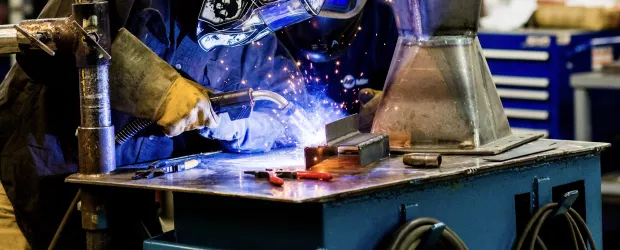
Students are introduced to safe soldering methods and welding procedures. Oxyacetylene, manual arc welding and electrode selections are covered. Types and applications of structural steels, pipes, tubing, weld layouts, and fastening techniques used in flat and horizontal welding for both manual arc welding and gas metal arc welding are discussed and practiced. |
|
| CS 050 |
College Writing |
42 |
Expand
In this course, students will be introduced to academic writing styles with a thematic focus on current issues. This course will help students to express themselves clearly and correctly in written form. Students will critically analyse assigned readings and express their thoughts. The course will also focus on the development of an academic paper utilizing the APA style of documentation. |
|