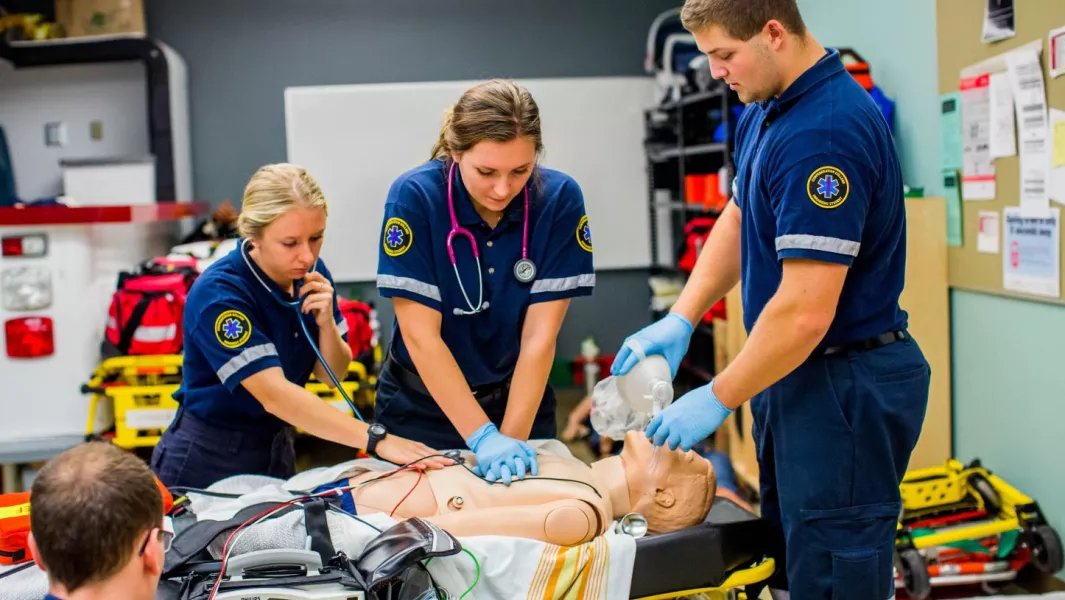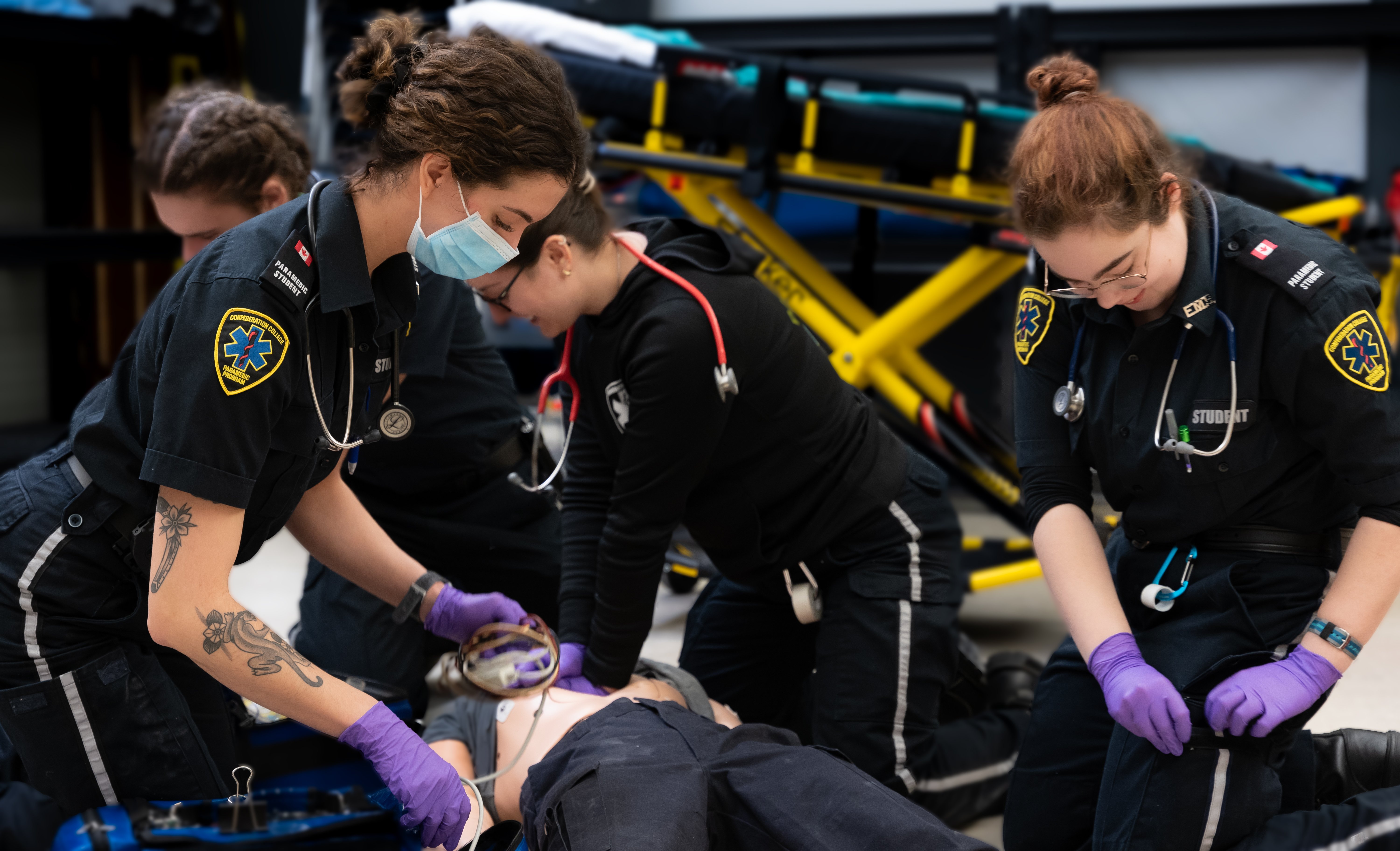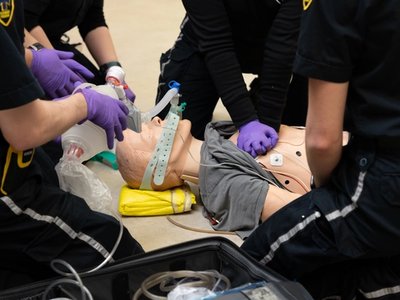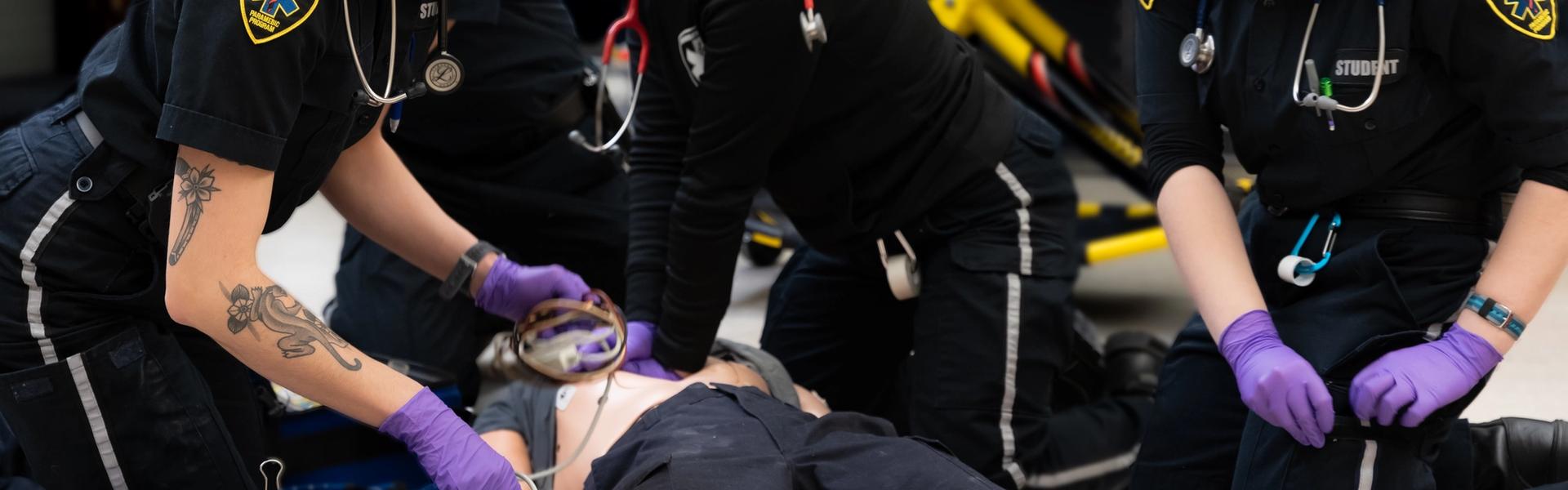
Team of paramedic trainees performing CPR and airway support in a lab setting

Ontario College Diploma

Paramedic

In the Paramedic program, you will learn how to assess and manage patients in emergency settings through simulation training and real-world field placements, preparing you to provide safe, effective care under pressure.

CIP Code: 51.0904

Program Start Options

IntakeDurationFormatCampusDomesticInternational
0694
Fall
2 years
4 semesters
Full-Time
In-Person
Thunder Bay
Domestic students accepted
International students not accepted

You Are 911: Saving Lives on the Front Lines

Become a crucial part of emergency healthcare with Confederation College's two-year Paramedic program. As a paramedic, you'll be the first responder in critical situations, providing immediate medical care and potentially saving lives. This comprehensive program prepares you to work effectively as part of an emergency health team, equipping you with the skills and knowledge to handle high-pressure situations with confidence and expertise.

Our program combines in-class learning with hands-on field experience, ensuring you're ready to provide safe and expert care from day one. You'll master essential topics including patient care theory and practice, anatomy and physiology, legal aspects of patient care, communications for paramedics, physical education, and ambulance operations. Through this balanced curriculum, you'll develop the technical skills, critical thinking abilities, and compassionate approach needed to excel in this demanding yet rewarding field.

Ontario Learn and Stay Grant Eligible

This priority program offers domestic students funding to cover tuition, compulsory fees, books, and other direct educational costs. Students commit to working in the region where they study, supporting in-demand professions in local communities.


Top Highlights

  • Real-World Experience: Gain invaluable field experience in actual medical situations, including placements outside Thunder Bay.
  • Certification Ready: Graduate eligible to write the Ministry of Health and Long-Term Care Advanced Emergency Medical Care Attendant Certification Examination (A-EMCA).
  • Career Versatility: Prepare for diverse opportunities in urban Emergency Medical Services, hospitals, government agencies, community organizations, and air ambulance services.
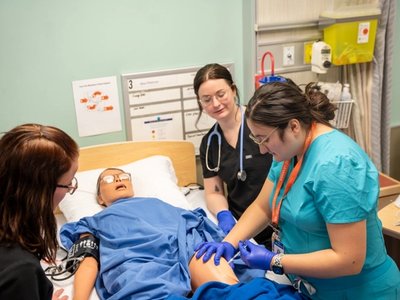
  • State-of-the-Art Training: Learn using modern equipment and simulations that mirror real-life emergency scenarios.
  • Holistic Skill Development: Develop not just medical skills, but also critical communication, decision-making, and teamwork abilities essential for success in the field.

Ideal Candidate Profile

  • Calm Under Pressure: Able to think clearly and act decisively in high-stress situations.
  • Physically Fit: Capable of performing physically demanding tasks and maintaining stamina during long shifts.
  • Empathetic: Genuinely care about helping others in their most vulnerable moments.
  • Quick Thinker: Can assess situations rapidly and make critical decisions on the spot.
  • Team Player: Work effectively with partners, other emergency responders, and healthcare professionals.

New Student Information

The following are important first day requirements. Please read carefully and in its entirety.

You must have black steel toe boots. There is to be no other colors on the boots (either all back laces or Blundstone are accepted). Our lab has heavy equipment and therefore if you do not have these you cannot be admitted to lab class. Boots must be safety NOT motorcycle boots with the work boots you must have the two symbols on them green triangle and orange Omega symbol. If these are not on these boots they will not be recognized as appropriate footwear and will have to be replaced with the proper ones. Boots must be new or near new condition (no splits, tears or metal showing). Please ensure that boots are clean and free of odor. Laces are black zippers are permitted as well as the Blundstone safety black boots — NO buckles allowed.

UNIFORMS ARE REQUIRED FOR FIRST DAY

If there is shipping delay in uniforms then the student must wear black or navy blue shirt that can be tucked into pants and wear loose fitting black or dark navy blue pants to lab, (NO tank tops or work out tops student will be asked to change to more appropriate attire for lab Health and Safety) We do have a uniform policy and pictures are included on the website to help guide you. We acquire our uniforms through Uniform Pros. They have an online order form; you can call or go in person. Again, please do this as soon as possible as they have to place bulk orders and it can take up to six weeks plus shirt preparation. Do this immediately so that you have your uniform for the first day of class.

Uniform Jackets are purchased for Second semester field placement AB 220. You do not need to purchase until semester 2

Circular crests are not acceptable they must be depicted format in the pictures provided. Epaulettes are also in black and indicated PARAMEDIC STUDENT as well. Vertical and lateral reflective striping on the pants are mandatory, horizontal is not approved by the Ministry of Labor. All of these are available at our supplier Uniform Pros and meet our uniform standard.

There are also non-mandatory uniform pieces available but there are restrictions on when they can be worn. We have arranged for the purchase of “uniform package” which includes button up shirt, pants, and a belt (specific belt is required for uniform there are two choices through uniform pros).

Uniform Pros

1018 Victoria Ave E Thunder Bay, ON P7C 1B6

(807) 622-8640 or Uniform Pros Website(opens in new window) – uniforms can be in person and by contacting store directly– there are specific Health and safety requirements for our uniforms and this provider has been approved for supply – please note that at this time our program specific requirements are not on a separate link and it is suggesting to call and speak to the store.

You are REQUIRED to have your uniform for the first day of class.

For used Books and uniforms please go to: Confederation College Paramedic Program Buy & Sell Facebook Group(opens in new window)

OTHER MANDATORY EQUIPMENT – MUST HAVE FIRST DAY

To maintain affordable cost to the student a Canadian Company has a “Student Essentials Kit”. If you have not attended our program before this is a NEW MANDATORY PURCHASE FOR FIRST DAY OF CLASS. Please allow for ordering time.

Optional Athletic Paramedic Program Shirt (used in fitness and can be worn under uniform shirts) please follow the provided link below:

Contact Information

Program Files

Get detailed information about program requirements, courses, and student resources.

Confederation College gave me the skills and education I needed to succeed as a paramedic and help people in emergency situations.

SF
Shawn Foster
Graduate of 2010 – Advanced Care Paramedic, Hastings-Quinte Paramedic Service

Confederation College gave me the confidence to reshape my life, pursue new opportunities, and believe I have the tools to succeed in anything I choose.

GK
Gary Kemp
Graduate of 2007 – Franchisee, Cash Converters Canada

Admission Requirements

Fall

Fall (0694)

Admission Requirements for Domestic Students

  1. Ontario Secondary School Diploma (or equivalent) with courses from the College (C), University (U), University/College (U/C), or Open (O) preparation levels with Grade 12 English (C/U) Level.
  2. or successful completion of the Mature Student Assessment.
  3. or successful completion of the Canadian Adult Education Credential (CAEC) or General Education Development Test (GED), prior to May 2024.
  4. or appropriate credits from the Academic and Career Entrance program (ACE).
  5. Applicants must be 18 years of age by the beginning of semester 2 of the Paramedic Program so that they can obtain a Police Vulnerable Sector Check. The Police Vulnerable Sector Check is a requirement for attending any/all hospital and field placements, which is a requirement which begins is semester 2.
  6. Applicants must have a full-G license by the beginning of semester 3 in order to participate in ambulance operations training which involves emergency vehicle driving on a closed driving course. Additionally, students are required to obtain an F class license by the beginning of semester 4 so that they can apply to work as a paramedic in the Province of Ontario. To be eligible for F-class licensing, the Ministry of Transportation Ontario (MTO) requires that candidate to have an existing full G-license.

Other Courses Required

  1. Grade 11 Math (College or University Preparation) or ACE Core Math (UM602) &
  2. Grade 11 or 12 Biology (College or University Preparation) &
  3. Grade 11 or 12 Chemistry (College or University Preparation)

Minimum final grade of 65% in each required course.

If you are currently enrolled in the required course, you must have a midterm and final mark of 65% or higher to qualify for selection/admission.

Admission Requirements for International Students

This intake is not available for international students.

Prerequisites

Important

Once you have "applied to the program" and have received and "accepted" an official "Offer of Admission" the following are other critical requirements that you need to plan and complete, PRIOR to your official "Program Start Date."

  1. Basic Life Support CPR (Annually)
  2. Standard First Aid or higher (Current)
  3. Immunizations as required under the Ambulance Act (details to be provided via email)- found in Placement Package under As a student tab on this webpage.
  4. Criminal Records Check Vulnerable Sector) - Annually
    DOWNLOAD: request letter for Criminal Records Check - Vulnerable Sector (updated: Aug. 25, 2023)(opens in new window)
  5. Obtain a valid G Drivers License
  6. N95 mask Fit Certificate
  7. Completed Placement Package

In Addition:

  1. An Ontario full Class G driver's license must be submitted by the end of second semester (June) for entry into AB 325 and AB 331 in the 3rd semester (Fall). You must have a Class "F" driver's license to be employed on ambulance, and is required upon applying for a career. Please click this link(opens in new window) for your drivers abstract required for AB325 and employment.
  2. To be eligible for participation in field placement, you must not have been convicted of any criminal offense for which you have not yet been pardoned. An unpardoned criminal record involving a conviction related to “Moral Turpitude” will result in the person not being able to participate in the field placement courses; and therefore, prevent the student from graduating. Any criminal record may adversely affect the student's ability to find employment. A recent and valid (Vulnerable Sector) criminal reference check (CRC) is therefore required to enable you to progress through this program and be current within 10 months.
Note

Any costs associated with acquiring a Criminal Reference Check (CRC), and other certificates will be the students responsibility.

Field Placement Requirements

  • Students are responsible for all costs associated with placements (such as uniforms, parking fees, transportation, accommodations, etc
  • Students are responsible for finding and making all of their arrangements for transportation, accommodations, etc

Paramedic Clinical Placements:

Confederation College reserves the right to determine the location of clinical placements based on marks and performance. External city placements costs are the students' responsibility.

MANDATORY - Requirements for Clinical/Field Placement (must be completed prior to attending placement):

  1. Paramedic Student Contact Information Sheet/Personal Data Form: image of both completed pages.
  2. Valid Canadian Drivers License: a) image of front, b) image of back.
  3. Confederation College Student Identification: a) image of front, b) image of back.
  4. Police Vulnerable Sector Check: a) must be valid within the year, b) images of all pages must clearly display the police service logo of the organization which completed the VSC, c) cannot be completed by a third party or independent service, d) only the actual VSC is considered valid documentation - receipts or "in progress" VSC are not accepted, e) Results of Finger Prints Comparison, Investigative Databank and Local Indices Results, or Vulnerable Screening must be included with the student's VSC (if a positive result is identified).
  5. CPR certification: a) image of official certificate, which must be valid within the year, b) required for entry into the 1st semester of the paramedic program: CPR Level C, Health Care Provider (HCP), or Basic Life Support (BLS) certification, c) required for entry into the 3rd semester of the paramedic program: Basic Life Support (BLS) certification.
  6. First Aid Certification: a) image of official certificate, which must be valid within 3 years of issue, b) Acceptable certifications include - Standard First Aid, Emergency First Responder (EFR), or Canadian Ski Patroller Certification.
  7. Confidentiality Agreement with Ambulance Operator: image of signed and dated document.
  8. Paramedic Program Pledge of Confidentiality/Code of Conduct: image of signed and dated document.
  9. N95 Mask Fit Test Certificate: a) must be valid within the year, b) image must state mask number, date of issue, and expiry date.
  10. Immunization and Communicable Disease's Form: a) image of all pages of documentation of current immunization, b) serology required, c) 2-step TB skin test required. IMPORTANT: the placement provider (hospital and ambulance) has the right to refuse any person from being at their site without proof of a current flu vaccination.
  11. Communicable Disease Self Declaration Form: image of signed and dated document.
  12. Influenza Acknowledgement with Official Flu Immunization Record: a) Image of Influenza Acknowledgement Form must be signed and dated, b) Image of the Flu Immunization Record must include the official receipt, date of administration, and name of health professional who performed the injection.
  13. Paramedic Student Health Status Report Communicable Disease: must include the name and signature of the reporting physician or nurse practitioner.
  14. COVID-19 Proof of Vaccinations: a) image of official MOH record of COVID-19 Vaccination # 1, b) image of official MOH record of COVID-19 Vaccination # 2.

This placement package is worth a significant mark in our program it is highly suggested that this be completed prior to the start of the school year. Student who have not completed and submitted the above documentation will NOT be allowed to attend placement and this may impacts ability to graduate from the paramedic program. Further instructions will be provided to students about uploading documents to a secure portal at the start of the school year.

Alternative Pathways

If you do not possess the necessary admission requirements (or equivalency), we encourage you to consider our Pre-Health Sciences-Pathway to Certificates and Diplomas program which will provide the necessary preparation to apply to this program. Completion of the Pre-Health Sciences-Pathway to Certificates and Diplomas program does not guarantee admission to the Paramedic Program in a subsequent year. A minimum 65% mark must be maintained in each semester in the Pre-Health Sciences-programs to meet the admission requirements to the Paramedic program.

Student Accessibility and Essential Program Requirements

Confederation College is committed to providing an accessible and inclusive learning environment and will provide reasonable accommodations to students with disabilities in accordance with the Ontario Human Rights Code, the Accessibility for Ontarians with Disabilities Act (AODA), and College policy.

Students who require accommodations are encouraged to engage with Student Accessibility Services and are responsible for initiating and participating in the accommodation process. Accommodation is a collaborative process involving the student, Student Accessibility Services, faculty, and the Academic School. Requests for accommodation are considered on an individual basis, and the College will work with students to identify reasonable accommodations that provide equitable access to learning while maintaining the integrity of the program.

Students are expected to demonstrate the essential knowledge, skills, professional behaviours, learning outcomes, and competencies required to successfully complete their program. While the manner in which these requirements are demonstrated may be accommodated where appropriate, the essential requirements themselves must still be achieved.

For programs involving laboratories, field work, clinical placements, aviation environments, trades training, equipment operation, simulations, community placements, or other environments where health and safety are critical, accommodations must also be consistent with applicable legislation, professional standards, licensing requirements, accreditation standards, and workplace safety obligations.

In some circumstances, a requested accommodation may not be reasonable or possible where it would:

  • Fundamentally alter an essential program requirement, competency, or learning outcome.
  • Compromise the health or safety of the student or others.
  • Conflict with provincial or federal legislation.
  • Conflict with the requirements of an external regulatory, licensing, accreditation, or professional body.
  • Prevent the student from demonstrating competencies required for safe and effective professional practice.
Note

Where a particular accommodation cannot be provided, the College will work collaboratively with the student to identify whether an alternative accommodation can appropriately address the student’s disability-related needs while maintaining essential program requirements.

Tuition & Fees

Placement Pass

Confederation College has partnered with Placement Pass to provide a dedicated portal to upload your medical and non-medical requirements to achieve placement clearance. This fee includes full support from the Placement Pass team to review your required documents, unlimited questions and support from a nurse-led team, access to orientation drop-in support sessions, secure document storage for 7 years. More information on Placement Pass will be provided through email for those students who are confirmed in the program.

  • Year 1 Cost: $65 + tax
  • Year 2 Cost: $32.50 + tax

Fees for Domestic StudentsProgram Code: 0694

Year 1
Total: $8,340.00
Fee Breakdown
Academic Fees
Total Tuition Fees:$2,740.00
College Service Fee:$863.00
Health Fee:$305.00
Health Record Fee:$40.00
Bus Fee:$332.00
$4,280.00
Program Fees
Field Trip Fee:$50.00
College Supplies:$400.00
Tools:$500.00
Boots / Uniform:$610.00
Record Check, Seminars, Courses, First Aid, Medicals:$415.00
Exam Fees, Certifications, Licenses, Apprentice or Business Registration:$425.00
Books & Supplies:$1,610.00
Parking Fee:$50.00
$4,060.00
Year 2
Total: $5,900.00
Fee Breakdown
Academic Fees
Total Tuition Fees:$2,740.00
College Service Fee:$853.00
Health Fee:$305.00
Health Record Fee:$40.00
Bus Fee:$332.00
$4,270.00
Program Fees
College Supplies:$200.00
Tools:$200.00
Boots / Uniform:$300.00
Record Check, Seminars, Courses, First Aid, Medicals:$460.00
Exam Fees, Certifications, Licenses, Apprentice or Business Registration:$75.00
Books & Supplies:$345.00
Parking Fee:$50.00
$1,630.00
Note

Please note that fees are estimated and are subject to change.

Fees shown on this page are for full-time students attending the main Thunder Bay campus for Fall 2026.

Costing for Regional Campuses & Distance Education Students:

If this program is available at Regional Campuses, or to Distance Education students, see the following links for costing information.

Courses

1 intake

Fall0694

Semester 1

AB 107

Patient Care Theory I

56 hours

The major emphasis of this course is placed on the responsibilities of the student in assessing, managing and transporting patients in stabilized conditions, emergency situations and situations that may become emergencies. Students will learn the assessment, pathophysiological processes and management of various medical and traumatic problems that may afflict pre-hospital patients.

AB 113

Anatomy & Physiology I

42 hours

This course is a general introduction to the structures and physiology that make up the human body. It provides the paramedic student with the basis for subsequent study of pathophysiology and patient care procedures.

AB 115

Physical Education

42 hours

This course is designed to provide the student with a general and job-specific level of fitness, enabling the student to meet the physical requirements of a Paramedic. Emphasis will be placed on cardiovascular fitness, strength, flexibility as well as safe lifting practices and an introduction to mental health wellness. Students will also benefit from the development, implementation, and monitoring of a personal training program. Additional components include the promotion of a healthy lifestyle, highlighting nutrition and stress management through physical activity and structured exercise.

CS 050

College Writing

42 hours

In this course, students will be introduced to academic writing styles with a thematic focus on current issues. This course will help students to express themselves clearly and correctly in written form. Students will critically analyse assigned readings and express their thoughts. The course will also focus on the development of an academic paper utilizing the APA style of documentation.

SY 180

Exploring Human Diversity

42 hours

In this course, students will study diversity from an anti-oppression and social justice framework. Students will explore how elements of race, class, gender, sexuality, disability and age have been transformed into systems of oppression and privilege. Various forms of stereotyping, prejudice, discrimination and racism, as they relate to the division of cultures and classes in society, will be examined. Students will develop diversity competency skills and will explore strategies to create socially inclusive and equitable environments; skills that are in demand in today's workplace.

AB 118

Medico-Legal Aspect Patient Care

28 hours

This course is designed to provide the student with the ability to apply relevant legislation and regulations enacted by Provincial and Federal Governments. The student will focus upon the accountability and responsibility of his/her own behaviours, by concentrating upon the legalities governing his/her professional duties. The student will understand his/her role as an advocate for patient rights to dignity, privacy, confidentiality, and consent/non consent to treatment.

AB 119

Communication for Paramedics I

42 hours

In this course, students will develop their oral and written communication skills. Students will learn medical terminology, the principles of accurate report writing, patient interview techniques and practice effective listening and communication skills. Students will also gain the knowledge and the ability to assess, plan and intervene appropriately and effectively regarding operational communication, interprofessional collaboration and patient interactions.

AB 122

Paramedic Patient Care Skills Lab I

56 hours

In this course, the student will acquire the skills required to perform patient assessments and perform patient care in accordance with Basic Life Support Patient Care Standards. The student will apply those skills for the provision of basic emergency care in various simulated laboratory settings. This course will provide students with the skills required to assess and manage patients in more complex scenarios in Semesters II and III.

Semester 2

AB 208

Patient Care Theory II

56 hours

This course is a continuation of Patient Care Theory I. The major emphasis of this course is placed on the responsibilities of the student in assessing, managing and transporting patients in stabilized conditions, emergency situations and situations that may become emergencies. Students will learn the assessment, pathophysiological processes and management of various medical and traumatic problems that may afflict pre-hospital patients including all Advanced Life Support Directives.

AB 212

Pathophysiology in Emergency Medical Care

42 hours

This course is designed for students who have a general understanding and working knowledge of the structure and function of the human body. Students will study how and why a disease develops and progresses across all spans of life from conception to death. The focus will be on pathophysiology of diseases and situations requiring emergency medical care.

AB 216

Communication for Paramedics II

42 hours

This course is designed to strengthen and refine students' skills in the communicating effectively, in both oral and written format, in the field of paramedicine. This course emphasizes paramedic-specific communication, conducting patient interviews, and Ambulance Call Report (ACR) completion. This course will also guide the student to be a confident and capable paramedic team leader who utilizes Crew Resource Management strategies to effectively run a team of paramedics and allied first responders. The student will also learn professional advocacy, resume and cover letter preparation, as well as strategies to protect personal safety during emergency medical service responses.

AB 218

Physical Education II

28 hours

This course is designed to further develop and maintain physical fitness attained in AB 115. During this second semester, students will participate in individually designed training programs as well as work to promote back care, correct posture, and employ proper biomechanics and safe techniques when lifting, positioning, and transporting simulated patients. Additionally, there will be a focus on leadership and teamwork as it pertains to performing the job of a Paramedic.

AB 214

Anatomy & Physiology II

42 hours

This course is the second part of a two-part anatomy and physiology course for Paramedics. It is a continuation of study of structures and physiology that make up the human body. Running concurrently with pathophysiology and patient care skills lab II, it supports the learning within each of these courses.

AB 222

Paramedic Patient Care Skills Lab II

56 hours

In this course, the student will acquire the skills necessary to perform specific assessment and pre-hospital care interventions to victims of trauma and medical crises. The student will also learn how to recognize patient complications while on scene and during transport, and adopt strategies to minimize their impact on the patient. At the end of this course, the student will be able to demonstrate the ability to perform assessments, skills, and interventions related to the following patient conditions: adult cardiac arrest and post resuscitation care, anaphylaxis, respiratory emergencies, trauma and medical emergencies, acute pulmonary edema, suspected myocardial infarction, cardiac ischemia and hypoglycemia. The expectation is that the student will integrate theory and knowledge they have gained in past Paramedic Program courses, as they begin to care for more complex patient types.

AB 221

Resiliency Training for Paramedics

28 hours

In this course, the student will learn about, and build upon, resiliency skills which will be used in their future practice as a paramedic. The student will learn about stress, performance anxiety, and how to preserve their mental health while operating as a member of a front-line emergency team. Additionally, strategies for maintaining peak performance under pressure will be discussed. Critical incident management, stress injuries, and Post Traumatic Stress Disorder will be explored as will peer support and suicide prevention. Ultimately, this course prepares the student to learn positive coping skills and to have maximum career longevity as a Primary Care Paramedic.

42 hours

Semester 3

AB 321

Patient Care Theory III

56 hours

The major emphasis of this course is placed on the responsibilities of the paramedic in assessing, applying the pathophysiological processes, managing and transporting patients in stabilized conditions, and responding to situations that have or may become environmental, pediatric, obstetric or gynecological emergencies. This course is a continuation of Patient Care Theory II.

AB 325

Ambulance Operations

28 hours

This course emphasizes techniques necessary to ensure driver and vehicle readiness for emergency service. Utilizing classroom and in-vehicle situations, students will acquire the skills required to operate a commercial vehicle, maintain emergency vehicles, prepare and safely operate an emergency vehicle, and drive defensively. The techniques required to work effectively with other emergency response personnel will be emphasized throughout the course. This course requires the student to have a current and valid Class 'G' license prior to the first day of class.

AB 327

Pharmacology for Paramedics

28 hours

This course is designed for the paramedic student to develop skill, proficiency and understanding of common prescription, over-the counter, and Primary Care Paramedic scope of practice medications. Learning will be based around drug classifications and indications, pharmacokinetics and pharmacodynamics, drug safety and dosage calculations, and legal responsibilities of the paramedic during drug administration. Advanced Care Paramedic scope of practice medications will also be explored.

AB 329

Advanced Skills for Primary Care Paramedics

42 hours

This course provides the student with the knowledge and skills of a Primary Care Paramedic with Autonomous IV training. Building on Medical Directives learned in the second semester, the student will learn how to safely and effectively provide intravenous therapy and IV medications to simulated ill and injured patients. This course will also teach the knowledge and skills for a Primary Care Paramedic with Autonomous IV training to function as a partner to an Advanced Care Paramedic. Leadership, teamwork and professionalism will be emphasized in a learning environment that focuses on practical skills and scenarios.

AB 322

Patient Care Skills Lab III

56 hours

This course is a continuation of Patient Care Skills Lab II. In this course the student will acquire the skills necessary to perform specific assessment and pre-hospital care inventions to HALO (High-Acuity, Low Occurrence) patient types. This will include management of environmental, pediatric, obstetric and neonatal emergencies. The student will learn how to recognize complications of these patient conditions and manage them on scene or during transport, minimizing their impact on patient condition. At the end of the course, the student will also be able to demonstrate skills related to the following situations: heat stroke/exhaustion, burns, aquatic and hypothermia emergencies. Infectious disease and hazardous material protocols will also be taught during this course.

AB 318

Physical Education III

28 hours

This course is designed to further develop and maintain physical fitness attained in AB 115 and AB 218. During this third semester, the focus will be on Paramedic physical-testing preparedness so that the student will feel confident and prepared when applying for Paramedic positions that require physical testing. These tests include, but are not limited to, Physical Abilities Testing (ARCON), and the Ottawa Paramedic Physical Abilities Testing (OPPAT). There will also be a continued focus on the biomechanics of safe lifting and moving of patients, as well as leadership and teamwork.

AB 432

Paramedic: Hospital Clinical

42 hours

Students will apply theoretical and practical concepts of previous courses through observation and participation in various selected hospital clinical areas. Students will gain an understanding of the role of hospital staff in the continuing care of pre-hospital patients. This clinical experience will provide opportunities for the Paramedic student to see the influence of pre-hospital care as part of the greater continuum of patient care. It provides a supervised opportunity for assessments and skills development with a key member of a health care team. The following clinical areas may be utilized: Intensive Care Unit (ICU), Coronary Care Unit (CCU), Recovery Room, Emergency Department (ED), Labour and Delivery – Nursery, Pediatrics Unit, and St. Joseph’s Care Group Safe Sobering Site. Any patient care provided by the Paramedic student will be performed under the direct supervision of a Hospital Clinical Guide assigned to the clinical area, with additional oversight by a Confederation College Hospital Clinical Instructor.

Semester 4

AB 434

Paramedic: Ambulance Field Placement

432 hours

This course provides the student with a concentrated period of ambulance field experience to further develop the ability to assess and meet the needs of the patient. Under the direct supervision of a paramedic preceptor crew, the student will review, participate in, and analyze emergency situations, which will form a basis for entry to professional paramedic practice.

AB 437

Paramedic Leadership and Professionalism

28 hours

This course prepares the student to function as ethical, reflective, and professional Primary Care Paramedic clinicians while developing foundational leadership and teaching skills required for their future role as a paramedic field preceptor. Emphasis is placed on professional conduct, ethical decision-making, communication, emotional intelligence, conflict management, wellness, reflective practice, and preceptorship readiness within the paramedic practice environment.

42 hours

Learning Outcomes

The graduate has reliably demonstrated the ability to:

  1. Communicate and interact effectively and appropriately with patients and others.
  2. Assess patients using relevant theory and practices and in compliance with current legislation, regulations, standards, and best practice guidelines.
  3. Establish patients’ treatment and transport priorities based on assessment findings.
  4. Implement preventive and therapeutic patient management strategies to maintain and promote patients’ well-being in compliance with current legislation, regulations, standards, and best practice guidelines.
  5. Integrate and perform delegated controlled medical acts in a simulated, clinical, and field setting.
  6. Evaluate in an ongoing manner the effectiveness of patient management strategies used and adapt or change strategies to provide optimal care for patients.
  7. Report and document patient information completely, accurately, and in a timely manner, in compliance with current legislation, regulations, standards, and applicable policies and procedures in a simulated, clinical, and/or field setting.
  8. Ensure personal safety and contribute to the safety of partners, patients, and others.
  9. Ensure the operational safety and preparedness of an ambulance and its equipment and operate an ambulance-type vehicle in a simulated setting.
  10. Collaborate with a broad range of personnel such as first responders, paramedics, emergency services personnel, health care professionals, and other allied health care workers.
  11. Integrate and meet legal, ethical, and professional responsibilities while providing optimal care for patients.

Meet the Program Staff

2 staff members

Careers

Graduates of the Paramedic program are prepared for diverse roles, including:

  • Primary Care Paramedic in Land Ambulance Services
  • Emergency Department Technician in Hospitals
  • Medical First Responder in Fire Departments
  • Health and Safety Officers in Government Agencies
  • Medical Services Provider in the Private Sector
  • Community Paramedic in Rural and Remote Areas
  • Advanced training options can include Advanced Care Paramedic, Critical Care Paramedic, and Community Paramedicine
See Career Opportunities

Clicking the button will take you to a detailed dashboard with up-to-date job data tailored to your program, including salary ranges, job titles, and projected demand.

Pathways

Confederation College offers a variety of articulation agreements designed to help you advance your education and career. Whether you're coming to us from another institution or planning your next steps after completing your program, our pathways make your transition seamless and effective.

Pathway Out — Credits recognized by another institution

University of New Brunswick — Bachelor of Applied Management (BAM)

Graduates from eligible 2-year or 3-year diploma programs at Confederation College can apply to enter the third year of the Bachelor of Applied Management at the University of New Brunswick, with a minimum 70% program average. Additional courses may be required.

Minimum Admission Average
70% overall program average
Entry Point
Year 3 of a 4-year degree

Institution: University of New Brunswick, Saint John, NB

Agreement Type: Memorandum of Understanding

Graduates of eligible diploma programs at Confederation College may be considered for advanced standing in the Bachelor of Applied Management (BAM).

Eligibility Requirements:

  • Completion of a 2-year (four-semester) or 3-year (six-semester) diploma program
  • Minimum overall program average of 70%

Transfer Details:

  • Eligible students may enter Year 3 of the 4-year BAM program
  • Additional courses may be required depending on the applicant’s academic background

Program Notes:

  • Eligible Confederation College programs are outlined in Appendix A of the Memorandum of Understanding
  • Students should consult the contact person for full details and program-specific requirements

Contacts

Students at Confederation College

We're here to help

Have questions before you apply?

Not sure if this is the right fit? Our recruitment team can help you navigate admission requirements, program details, and campus life.