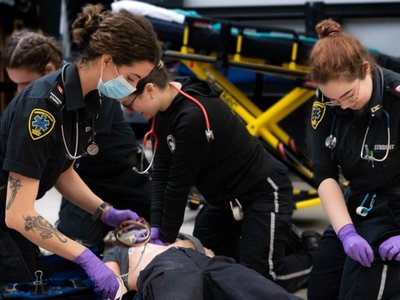
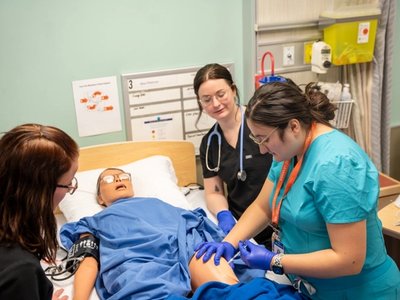
In the Advanced Care Paramedic program, you will learn how to deliver emergency medical care through intensive hands-on lab simulations and clinical placements.
Elevating Emergency Care: From Response to Advanced Intervention
Are you a certified Primary Care Paramedic ready to expand your scope of practice and make an even greater impact on patient care? Confederation College's Advanced Care Paramedic program takes your skills to the next level, enhancing your ability to ease pain and suffering in critical situations.
Built upon the foundation of Primary Care Paramedic education, this program sharpens your critical thinking during high-level emergencies, broadens your Controlled Medical Act skill base, and hones your ability to perform under pressure. Upon completion, you'll be prepared for specialized training in urban, flight, and tactical paramedic communities.
Top Highlights
Scaffolded Learning: Strong foundation in theory, skill proficiency, and immersive simulation.
Personalized Attention: Small class size (10 students max) with a 5:1 student-instructor ratio in labs.
Hands-On Experience: 158 hours of clinical experience at Thunder Bay Regional Health Sciences Center.
Real-World Practice: 432 ambulance field placement hours with Superior North Emergency Medical Services.
Flexible Learning: Classroom schedule allows maintaining employment while in the program.
Ideal Candidate Profile
Experienced: A certified Primary Care Paramedic seeking to advance your skills.
Critical Thinker: Able to make quick, informed decisions in high-pressure situations.
Adaptable: Ready to handle a wide range of complex medical emergencies.
Leadership-Oriented: Capable of leading interdisciplinary teams for optimal patient care.
Committed: Dedicated to continuous learning and professional growth in paramedicine.
New Student Information
Uniform Pros
1018 Victoria Ave E Thunder Bay, ON P7C 1B6
(807) 622-8640 or Uniform Pros Website(opens in new window) – uniforms can be in person and by contacting store directly– there are specific Health and safety requirements for our uniforms and this provider has been approved for supply – please note that at this time our program specific requirements are not on a separate link and it is suggesting to call and speak to the store.
You are REQUIRED to have your uniform for the first day of class.
or Primary Care Paramedic Diploma from an accredited program at a Canadian college.
or Ambulance and Emergency Care Certificate.
Also Required:
Copy of Paramedic Ontario College Diploma or Primary Care Paramedic Diploma from an accredited program at a Canadian College or Ambulance Emergency Care Certificate.
Copy A-EMCA or Equivalent.
Letter of employment from EMS service confirming applicants have minimum 1000 hours OR will have 1000 hours of Ambulance Field experience upon commencement of program
Letter of certification under Base Hospital Medical Authority
Copy of valid driver’s license
A minimum score of 70% on the Pre-Admissions Exam
Date for Pre-Admissions Exam will be provided once all application requirements are met
Document Submission:
Confederation College- Atten: Admissions Department 1450 Nakina Drive Thunder Bay, ON P7B 0E5 Email: admissions@confederationcollege.ca Fax: 807.473.3731
This intake is not available for international students.
Prerequisites
Important
Once you have “applied to the program” and have received and “accepted” an official “Offer of Admission” the following are other critical requirements that you need to plan and complete, PRIOR to your official “Program Start Date.”
Basic Life Support CPR (Annually)
Standard First Aid or higher (Current)
Immunizations as required under the Ambulance Act (details to be provided via email)- found in Placement Package under As a student tab on this webpage.
To be eligible for participation in field placement, you must not have been convicted of any criminal offense for which you have not yet been pardoned. An unpardoned criminal record involving a conviction related to “Moral Turpitude” will result in the person not being able to participate in the field placement courses; and therefore, prevent the student from graduating. Any criminal record may adversely affect the student's ability to find employment. A recent and valid (Vulnerable Sector) criminal reference check (CRC) is therefore required to enable you to progress through this program and be current within 10 months.
Note
Any costs associated with acquiring a Criminal Reference Check (CRC), and other certificates will be the students responsibility.
Field Placement Requirements
Students are responsible for all costs associated with placements (such as uniforms, parking fees, transportation, accommodations, etc
Students are responsible for finding and making all of their arrangements for transportation, accommodations, etc
Confederation College reserves the right to determine the location of clinical placements based on marks and performance. External city placements costs are the students' responsibility.
MANDATORY - Requirements for Clinical/Field Placement (must be completed prior to attending placement):
Paramedic Student Contact Information Sheet/Personal Data Form: image of both completed pages.
Valid Canadian Drivers License: a) image of front, b) image of back.
Confederation College Student Identification: a) image of front, b) image of back.
Police Vulnerable Sector Check: a) must be valid within the year, b) images of all pages must clearly display the police service logo of the organization which completed the VSC, c) cannot be completed by a third party or independent service, d) only the actual VSC is considered valid documentation - receipts or "in progress" VSC are not accepted, e) Results of Finger Prints Comparison, Investigative Databank and Local Indices Results, or Vulnerable Screening must be included with the student's VSC (if a positive result is identified).
CPR certification: a) image of official certificate, which must be valid within the year, b) required for entry into the 1st semester of the paramedic program: CPR Level C, Health Care Provider (HCP), or Basic Life Support (BLS) certification, c) required for entry into the 3rd semester of the paramedic program: Basic Life Support (BLS) certification.
First Aid Certification: a) image of official certificate, which must be valid within 3 years of issue, b) Acceptable certifications include - Standard First Aid, Emergency First Responder (EFR), or Canadian Ski Patroller Certification.
Confidentiality Agreement with Ambulance Operator: image of signed and dated document.
Paramedic Program Pledge of Confidentiality/Code of Conduct: image of signed and dated document.
N95 Mask Fit Test Certificate: a) must be valid within the year, b) image must state mask number, date of issue, and expiry date.
Immunization and Communicable Disease's Form: a) image of all pages of documentation of current immunization, b) serology required, c) 2-step TB skin test required. IMPORTANT: the placement provider (hospital and ambulance) has the right to refuse any person from being at their site without proof of a current flu vaccination.
Communicable Disease Self Declaration Form: image of signed and dated document.
Influenza Acknowledgement with Official Flu Immunization Record: a) Image of Influenza Acknowledgement Form must be signed and dated, b) Image of the Flu Immunization Record must include the official receipt, date of administration, and name of health professional who performed the injection.
Paramedic Student Health Status Report Communicable Disease: must include the name and signature of the reporting physician or nurse practitioner.
COVID-19 Proof of Vaccinations: a) image of official MOH record of COVID-19 Vaccination # 1, b) image of official MOH record of COVID-19 Vaccination # 2.
This placement package is worth a significant mark in our program it is highly suggested that this be completed prior to the start of the school year. Student who have not completed and submitted the above documentation will NOT be allowed to attend placement and this may impacts ability to graduate from the paramedic program. Further instructions will be provided to students about uploading documents to a secure portal at the start of the school year.
Tuition & Fees
Placement Pass
Confederation College has partnered with Placement Pass to provide a dedicated portal to upload your medical and non-medical requirements to achieve placement clearance. This fee includes full support from the Placement Pass team to review your required documents, unlimited questions and support from a nurse-led team, access to orientation drop-in support sessions, secure document storage for 7 years. More information on Placement Pass will be provided through email for those students who are confirmed in the program.
Year 1 Cost: $65 + tax
Note
Please note that fees are estimated and are subject to change.
Fees shown on this page are for full-time students attending the main Thunder Bay campus for Fall 2026.
Costing for Regional Campuses & Distance Education Students:
If this program is available at Regional Campuses, or to Distance Education students, see the following links for costing information.
Semester 1 (Fall): 2 days per week, two 8-hour in-class days.
Semester 2 (Winter): 3 days per week, two 8-hour in-class days, one 8 or 12-hour hospital placement day.
Semester 3 (Spring): 4 days per week, 12-hour day and night shifts, followed by 4 rest days.
Starts in Fall. Program code 0684.
Semester 1
AP 190
Advanced Patient Care Theory I
56 hours
In this course, the learner will expand on their basic and advanced life support knowledge. Emphasis will be placed on pathophysiology, advanced assessment, and diagnostics. The learner will develop advanced assessments and critical thinking which will allow them to integrate treatment plans based on patient presentations.
In this course, the learner will demonstrate an advanced assessment approach and intervention skills required to perform as an advanced care paramedic. The learner will develop clinical decision-making skills through various simulated scenarios in a controlled, lab-class setting.
In this course, the learner will perform, and master skills considered to be within the scope of practice of an advanced care paramedic. This course will involve precise evaluation of each advanced life support skill to ensure the learner can perform skills at a competent advanced care level.
In this course, the learner will build upon the existing knowledge base from their primary care paramedic education. This includes basic and advanced theories of pharmacology, which encompasses but is not limited to, pharmacokinetics, pharmacodynamics, medical math calculation/conversions and all pharmacological treatments used by advanced care paramedics. There will be an emphasis on meeting the standards as outlined in the most current version of the Ontario Provincial Medical Directives.
In this course, the learner will evaluate research evidence and apply it to paramedicine practice. Research findings will be presented in a variety of different formats, using technology, visual, verbal, practical and written format. Emphasis will be placed on the critical thinking assessments and involve producing an independent study that is research based.
In this course, emphasis will be placed on the newly acquired responsibilities of assessing, managing, and transporting patients in emergent situations. The learner will develop diverse assessment techniques and learn to modify their approach based on various patient presentations including, but not limited to, neonatal, pediatric, adult, and special patient populations.
In this course, the learner is required to demonstrate advanced assessments and intervention skills. Critical thinking will allow for differential diagnosis while formulating a treatment plan. This includes, but is not limited to, transport decisions, communication with Base Hospital physicians, hospital staff, establishing a patient's chief complaints and perform continuous assessment and continued intervention plans at the advanced care paramedic level. The expectation is that the learner will be able to formulate a plan of care based upon the knowledge acquired in Semester 1 and Semester 2. This course is skill and simulation based.
Advanced Care Documentation and Professional Standards
42 hours
In this course, the learner will develop an understanding for professional and medical-legal issues unique to the advanced care paramedic. Roles and responsibilities of the advanced care paramedic will be discussed as they pertain to moral, legal and ethical issues. This will include professional crew resource management communication as well as advanced care documentation standards.
In this course, the learner will complete clinical rotations in various patient care settings mainly acute care hospital. The learner will be required to complete clinical competencies while being overseen by various health care professions, including, but not limited to, physicians, registered nurse, respiratory therapists, and midwives.
In this course, the learner will perform, and master skills considered in the scope of practice for an advanced care paramedic. This course involves precise evaluation of each advanced life support skill as it pertains to obstetrical, neonatal, pediatrics and special patient populations. The learner will also have to demonstrate skills from AP 192 Advanced Skills Lab I.
In this course, the learner will apply knowledge and skills obtained throughout all previous educational courses for the advanced care paramedic. The advanced care paramedic learner will practice under the supervision of an advanced care paramedic preceptor. A demonstration of competence as outlined in the NOCP competency profile for the paramedic practitioner. The requirement for field placement completion is 432 hours or more depending on the competencies that are achieved. This must take place in an urban paramedic service deemed to be acceptable by the Confederation College Advanced Care Paramedic Program Coordinator.
The graduate has reliably demonstrated the ability to:
Interact professionally with patients and others, adhering to relevant provincial and federal legislation and codes of conduct.
Collaborate with a broad range of personnel such as employers, Primary Care Paramedics, Critical Care Paramedics, Communications Officers, firefighters, police officers, physicians, allied health professionals and others.
Lead an interdisciplinary team to ensure optimal patient care.
Provide complete and accurate reports, in compliance with current legislation, regulations, standards and established policies and procedures.
Analyze patient assessment findings critically, and infer a provisional diagnosis, using relevant theory and practices and complying with current legislation, regulations, standards, best practices and established policies and procedures.
Evaluate patient condition continuously, anticipating changes and adapting interventions to provide safe and optimal care.
Justify an intervention plan in accordance with ACP Medical Directives, best practices, evidence-based medicine, and clinical findings.
Perform basic and advanced life support skills safely and competently, including controlled medical acts, in accordance with established standards and Medical Directives.
Employ preventative and therapeutic interventions, while maintaining safety of self and others, to promote optimal well-being of the patient, in compliance with current legislation, regulations, standards and established policies and procedures.
Formulate strategies for self-evaluation and for improving proficiency in the practice of paramedicine.
Meet the Program Staff
2 staff members
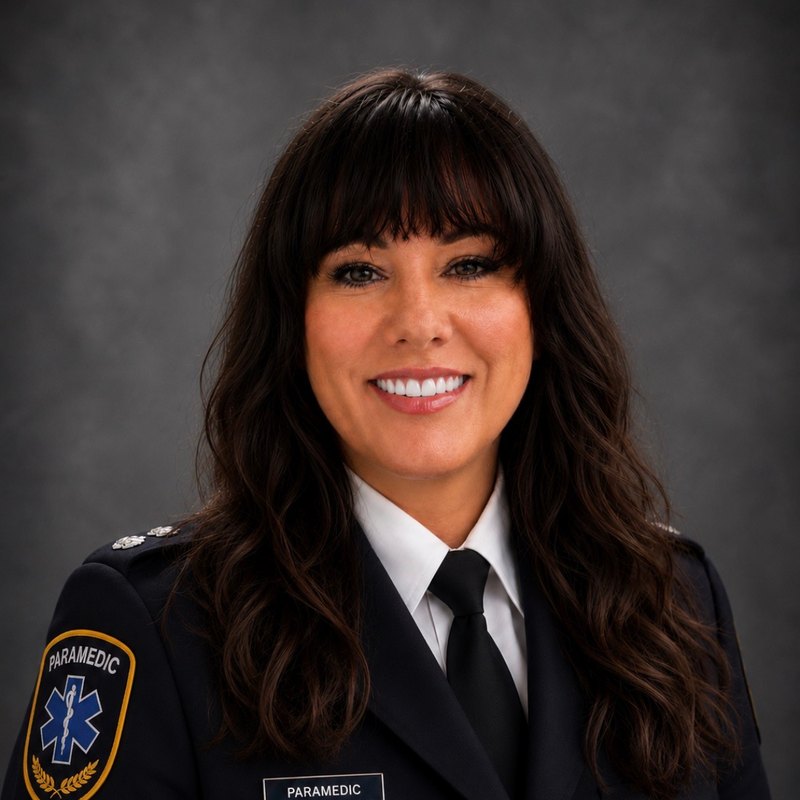
Prof.Tanis Miller
she/her
ACP, A-EMCA
ACP Program Coordinator & Primary Care Paramedic Program Faculty
Clicking the button will take you to a detailed dashboard with up-to-date job data tailored to your program, including salary ranges, job titles, and projected demand.
Pathways
Confederation College offers a variety of articulation agreements designed to help you advance your education and career. Whether you're coming to us from another institution or planning your next steps after completing your program, our pathways make your transition seamless and effective.
Student Accessibility and Essential Program Requirements
Confederation College is committed to providing an accessible and inclusive learning environment and will provide reasonable accommodations to students with disabilities in accordance with the Ontario Human Rights Code, the Accessibility for Ontarians with Disabilities Act (AODA), and College policy.
Students who require accommodations are encouraged to engage with Student Accessibility Services and are responsible for initiating and participating in the accommodation process. Accommodation is a collaborative process involving the student, Student Accessibility Services, faculty, and the Academic School. Requests for accommodation are considered on an individual basis, and the College will work with students to identify reasonable accommodations that provide equitable access to learning while maintaining the integrity of the program.
Students are expected to demonstrate the essential knowledge, skills, professional behaviours, learning outcomes, and competencies required to successfully complete their program. While the manner in which these requirements are demonstrated may be accommodated where appropriate, the essential requirements themselves must still be achieved.
For programs involving laboratories, field work, clinical placements, aviation environments, trades training, equipment operation, simulations, community placements, or other environments where health and safety are critical, accommodations must also be consistent with applicable legislation, professional standards, licensing requirements, accreditation standards, and workplace safety obligations.
In some circumstances, a requested accommodation may not be reasonable or possible where it would:
Fundamentally alter an essential program requirement, competency, or learning outcome.
Compromise the health or safety of the student or others.
Conflict with provincial or federal legislation.
Conflict with the requirements of an external regulatory, licensing, accreditation, or professional body.
Prevent the student from demonstrating competencies required for safe and effective professional practice.
Note
Where a particular accommodation cannot be provided, the College will work collaboratively with the student to identify whether an alternative accommodation can appropriately address the student’s disability-related needs while maintaining essential program requirements.
We use cookies to analyze site traffic and measure how our advertising performs. By accepting, you consent to the use of analytics and advertising cookies. See our privacy policy.