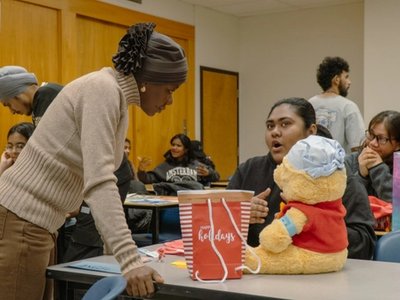
In the Social Service Worker program, you will learn how to help people navigate challenges by practising real-world support skills in supervised community placements.
Social service work is a diverse field with one core purpose: helping people. If you're passionate about making a difference in your community and supporting individuals facing various challenges, Confederation College's Social Service Worker program is your gateway to a rewarding career.
Our comprehensive program equips you with essential knowledge and skills in social welfare, mental health, interpersonal effectiveness, communications, addictions, and applied professional practice. Through a combination of classroom learning and hands-on work placements, you'll gain practical experience and start building your professional résumé before graduation.
Learn to leverage community resources and your own abilities to create meaningful change in people's lives across various population groups, from children to seniors.
Top Highlights
Professional Recognition: Graduates can apply for membership with the Ontario College of Social Workers and Social Service Workers
Diverse Experience: Work with all population groups, from young children to senior citizens
Broad Skill Set: Gain experience in many different areas of social service work
Flexible Options: Available as an accelerated program for those with a related college diploma or university degree
Real-World Application: Reinforce classroom learning with valuable work placements
Ideal Candidate Profile
Compassionate: Genuinely care about improving others' lives
Empathetic: Able to understand and share the feelings of others
Patient: Comfortable working with individuals facing various challenges
Communicative: Skilled at listening and expressing ideas clearly
Resilient: Ready to handle emotionally demanding situations
Program Continuation Criteria
Minimal Grade Requirements for Continuation: To proceed into a subsequent semester and to graduate, the student must have a minimum 60% grade in all previous semester courses. NOTE: A significant number of field placement agencies require students to be at least 19 years of age in order to offer full professional responsibilities. Those under age 19 could have their field placement options limited.
Volunteer Hours: Prior to completion of first year and to be eligible to proceed to second year, during first year the student must complete 30 hours of volunteer community service in the area of human services or community development. Hours completed prior to coming in the program and/or community services hours obtained as part of secondary school requirements do not qualify. If uncertain about possible volunteer opportunities, the student should consult with the Program Coordinator.
Standard CPR / First Aid Certification: Prior to completion of first year, the student is required to obtain a Standard First Aid with Level C CPR certification. Information about training can be obtained through the Canadian Red Cross or St. John's Ambulance websites.
The Social Service Worker program at Confederation College exceeded my expectations. The combination of education, supportive faculty, and hands-on placements gave me the skills, knowledge, and confidence to enter the field prepared for success. I was even offered a position through my first placement before graduating.
The following 2 intakes share the same admission requirements:
Fall (0107)Fall (0107)
Admission Requirements for Domestic Students
Ontario Secondary School Diploma (or equivalent) with courses from the College (C), University (U), University/College (U/C), or Open (O) preparation levels with Grade 12 English (C/U) Level.
or successful completion of the Mature Student Assessment.
or successful completion of the Canadian Adult Education Credential (CAEC) or General Education Development Test (GED), prior to May 2024.
or appropriate credits from the Academic and Career Entrance program (ACE).
This intake is not available for international students.
Prerequisites
Important
Once you have “applied to the program” and have received and “accepted” an official “Offer of Admission” the following are other critical requirements that you need to plan and complete, PRIOR to your official “Program Start Date.”
Immunization and TB Skin Test - Students continuing on to second year and placement must have their immunization up to date as well as a current two-step TB skin. To Immunization and Communicable Disease’s Form
First Aid CPR - Students are required to obtain level “C” First Aid/CPR certification before entering their second year. Red Cross or St John’s Ambulance are two organizations that offer this certification
Criminal Record Check (Police Record Check) - To be eligible for participation in second year field placement of the Social Services Worker program, a student must not have been convicted of any criminal offense for which the student has not yet been pardoned. An unpardoned criminal record could result in the student not being able to participate in field placement courses and therefore prevent the student from graduating. A recent and valid criminal reference check (CRC) is therefore required to enable the student to progress through this program.
Note
Procedures and regulations for obtaining criminal record search documents are controlled by the RCMP and the Government of Canada. These procedures and regulations may change at any time without notification. Confederation College will endeavour to notify students of any changes when they come to our attention. As of March 1, 2011 the following reflects the current procedures and regulations of the RCMP with regard to Vulnerable Sector Verifications.The RCMP identified a means to enhance vulnerable sector checks to make the searches more rigorous. In the interest of public safety, the enhancements were quickly implemented to protect vulnerable members of society. As a result of the enhancement, a Vulnerable Sector Verification now requires the submission of fingerprints whenever the gender and date of birth of an applicant match to an existing pardoned sex offender record. This is not an accusation of criminality, but a requirement for a thorough verification to confirm identity and protect personal privacy. This process will take at least four months. Any costs associated with acquiring a Criminal Reference Check (CRC) will be the responsibility of the student applicant.
Alternative Pathways
If you do not meet these admission requirements, we encourage you to consider our College Access or General Arts and Science Certificate or General Arts and Science Diploma programs, or Academic and Career Entrance program (ACE); if you successfully complete one of these programs, you will be eligible to apply to programs in the Community Services area.
The following 2 intakes share the same admission requirements:
Fall (0154)Fall (0154)
Admission Requirements for Domestic Students
Degree or diploma from an accredited university or college in the field of Psychology, Sociology, Women’s Studies, Gerontology or equivalent, or a community college graduate with a diploma from a human service program.
Students must take SS116 Social Welfare as a pre-entry requirement and achieve a C grade in order to proceed to the fall semester.
This intake is not available for international students.
Prerequisites
Important
Once you have “applied to the program” and have received and “accepted” an official “Offer of Admission” the following are other critical requirements that you need to plan and complete, PRIOR to your official “Program Start Date.”
Immunization and TB Skin Test - Students continuing on to second year and placement must have their immunization up to date as well as a current two-step TB skin. To Immunization and Communicable Disease’s Form
First Aid CPR - Students are required to obtain level “C” First Aid/CPR certification before entering their second year. Red Cross or St John’s Ambulance are two organizations that offer this certification
Criminal Record Check (Police Record Check) - To be eligible for participation in second year field placement of the Social Services Worker program, a student must not have been convicted of any criminal offense for which the student has not yet been pardoned. An unpardoned criminal record could result in the student not being able to participate in field placement courses and therefore prevent the student from graduating. A recent and valid criminal reference check (CRC) is therefore required to enable the student to progress through this program.
Note
Procedures and regulations for obtaining criminal record search documents are controlled by the RCMP and the Government of Canada. These procedures and regulations may change at any time without notification. Confederation College will endeavour to notify students of any changes when they come to our attention. As of March 1, 2011 the following reflects the current procedures and regulations of the RCMP with regard to Vulnerable Sector Verifications.The RCMP identified a means to enhance vulnerable sector checks to make the searches more rigorous. In the interest of public safety, the enhancements were quickly implemented to protect vulnerable members of society. As a result of the enhancement, a Vulnerable Sector Verification now requires the submission of fingerprints whenever the gender and date of birth of an applicant match to an existing pardoned sex offender record. This is not an accusation of criminality, but a requirement for a thorough verification to confirm identity and protect personal privacy. This process will take at least four months. Any costs associated with acquiring a Criminal Reference Check (CRC) will be the responsibility of the student applicant.
Alternative Pathways
If you are interested in taking this program and do not meet the above requirements, please consider our 2-year Social Service Worker diploma program.
Courses
2 intakes
Starts in Fall. Program code 0107.
Semester 1
SS 115
Interpersonal Effectiveness
42 hours
In this course, students will examine the nature of interpersonal communication, how it is influenced by perception and how it gives rise to the creation of the self. It deals with the nature of emotions and how they are communicated. It looks at verbal and nonverbal communication, listening, communication climates, the nature of friendships, intimate relationships, and how to manage conflict in relationships.
In this course, students will examine historical development and current political and ideological influences on the social welfare system in Canada. This course also examines contemporary challenges being experienced by Canadians living within the social welfare system and role of the professions of Social Work and Social Service Work in assisting with addressing those challenges.
In this course, students will be introduced to academic writing styles with a thematic focus on current issues. This course will help students to express themselves clearly and correctly in written form. Students will critically analyse assigned readings and express their thoughts. The course will also focus on the development of an academic paper utilizing the APA style of documentation.
In this course, students will be introduced to the field of social service work practice through an exploration of the history, key concepts, and theoretical perspectives of the profession. This course also examines the regulatory body and the relationship between the values, the Code of Ethics, and the professional standards governing the profession. The importance of anti-oppressive practice in social service work is highlighted through an examination of social structures, forms of oppression and their impact on people`s ability to access resources.
In this course, students will examine structural violence, and its affects on individuals, families, groups and communities. Students will learn how to identify and respond to various types of violence using an anti oppressive lens. Students will apply a trauma-informed approach to the screening, assessing, reporting and intervention for both victims and offenders. Students will examine possible solutions and strategies to address violence.
In this course students will examine the importance and the complexities associated with the concept of "family". Students will analyze the role family in society, the challenges families face and the implications for the profession of Social Service Work. Students will also gain the knowledge and skills necessary to assess and provide guidance to families in need of support from a strengths perspective.
This course will introduce students to the field of Sociology. Students will develop a general understanding of sociological perspectives by focusing on the basic concepts of sociology. Topics examined include, culture, socialization, sexuality, inequality, crime, deviance, education, religion, gender, media, globalization and the environment. Furthermore, students will be able to use basic sociological terminology and apply the major sociological perspectives to current social systems in Canada.
In this course students will develop the knowledge and skills necessary for working with individuals, families and communities experiencing substance misuse and abuse. The primary focus of this course will be examining students own values and beliefs towards people who abuse substances. Students will learn how the complexities and myths of addictions effect societal perceptions, laws and legislation and resources offered for substance abuse.
In this course, students will enhance their communication skills as needed in the community services field. They will acquire the skills necessary to write memos, letters, email, informal reports and proposals and presentations that meet the professional standards in the community services field. Students will combine collaborative methods with advanced research, written and oral skills to produce and present an infographic.
In this course, students will examine and integrate the roles, functions and skills employed in community practice to strengthen the well-being of community. This course will also explore the unique factors related to community practice in northern, rural and Indigenous communities.
In this course, students will have the opportunity to develop the counselling skills needed in a professional 'helping' relationship. This course will provide students with an opportunity to apply the theoretical concepts and core skills needed to develop and maintain therapeutic relationships and guide clients through the change process.
In this course, students will learn about the major mental illnesses occurring in children and adults. This course will introduce students to the personal and structural issues confronting people who have mental illnesses. Students will explore the historical, political and legal context of mental health practices in Canada. Students will also examine pharmacological and psychosocial interventions for individuals using a recovery based model.
In this course, students will examine the principles of case management in providing services and supports to individuals, families and communities. The roles, functions and skills employed by case managers throughout the planned change process will be explored. Unique practice techniques from an Indigenous perspective will also be examined.
This course introduces the student to the world of psychology by highlighting human behaviour and mental processes at the individual level. Students will learn why people do and think the way they do from a variety of perspectives and how psychological principles apply to everyday life situations. This introductory course provides a strong foundation for other courses in psychology.
In this course, students will be able to observe and practice their knowledge and skills in a social service-related agency practice. Students will work under the supervision of a professional staff person, have the opportunity to observe social services procedures and practices, and take part in developing professional relationships with clients based on the profession's values and ethics. The student is guided and evaluated by an agency supervisor and a faculty supervisor; who work together to provide a constructive learning experience for the student. Students will also be expected to maintain a record of their placement activities through the submission of a learning plan, reflective journals and other documentation. Students will participate in a monthly seminar where they will discuss challenges and opportunities that arise in field practice, and integrate learning acquired from academic courses with practical experiences. The seminar component transitions the student to professional Social Service Worker and highlights what is required to be successful in the field.
In this course, students will deepen their understanding of social service work with groups. Social service workers are required to work with groups in almost all practice settings. Whether the "group" is a case conference, team meeting, research focus group, community meeting, or group therapy, social services workers are required to understand group dynamics and know how to facilitate group process. This course will provide an opportunity to learn and practice specific skills necessary to promote effective group functioning. It is designed to help students further develop skills and comfort in various group dynamics, group development, analysis, facilitation, and evaluation.
In this course, students will gain an understanding of some of the major theories that underlie the practice of social service work. Students will examine the core beliefs and values that govern the ethical practice of generalist social service work. Students will have the opportunity to review relevant literature of interventions for clients to be used in multiple practice settings. Students will examine the concept of critical thinking, and how it applies to social service work practice.
This course is the second field placement for the student, which gives further opportunity to integrate knowledge, values and skills in a practical social service-related environment. The student is assigned to work within an agency four days per week, for the semester. Relationships with clients and skill development will be more advanced and broader than the first placement. Student will demonstrate the ability to relate to a variety of clients and/or client groups. The student will demonstrate positive functioning as part of the social service team. Plans for future professional growth will be explored.
In this course, students will explore the challenges experienced by a range of diverse populations in Canada. Students will integrate the Generalist Perspective and Anti-Oppressive Practice in their role as Social Service Workers in assisting and supportive diverse populations including: children and youth in the child welfare system; women; persons living with disabilities; older persons; immigrants and refugees; and, sexual and gender diversity of persons.
In this course, students will gain an understanding of some of the major theories that inform the practice of social service work. Students will have the opportunity to review relevant literature of interventions for clients to be used in multiple practice settings. Students will examine and critique each theory from an anti-oppressive lens.
In this course, students will examine the nature of interpersonal communication, how it is influenced by perception and how it gives rise to the creation of the self. It deals with the nature of emotions and how they are communicated. It looks at verbal and nonverbal communication, listening, communication climates, the nature of friendships, intimate relationships, and how to manage conflict in relationships.
In this course, students will be able to observe and practice their knowledge and skills in a social service-related agency practice. Students will work under the supervision of a professional staff person, have the opportunity to observe social services procedures and practices, and take part in developing professional relationships with clients based on the profession's values and ethics. The student is guided and evaluated by an agency supervisor and a faculty supervisor; who work together to provide a constructive learning experience for the student. Students will also be expected to maintain a record of their placement activities through the submission of a learning plan, reflective journals and other documentation. Students will participate in a monthly seminar where they will discuss challenges and opportunities that arise in field practice, and integrate learning acquired from academic courses with practical experiences. The seminar component transitions the student to professional Social Service Worker and highlights what is required to be successful in the field.
In this course, students will be introduced to the field of social service work practice through an exploration of the history, key concepts, and theoretical perspectives of the profession. This course also examines the regulatory body and the relationship between the values, the Code of Ethics, and the professional standards governing the profession. The importance of anti-oppressive practice in social service work is highlighted through an examination of social structures, forms of oppression and their impact on people`s ability to access resources.
In this course, students will examine structural violence, and its affects on individuals, families, groups and communities. Students will learn how to identify and respond to various types of violence using an anti oppressive lens. Students will apply a trauma-informed approach to the screening, assessing, reporting and intervention for both victims and offenders. Students will examine possible solutions and strategies to address violence.
In this course, students will gain an understanding of some of the major theories that underlie the practice of social service work. Students will examine the core beliefs and values that govern the ethical practice of generalist social service work. Students will have the opportunity to review relevant literature of interventions for clients to be used in multiple practice settings. Students will examine the concept of critical thinking, and how it applies to social service work practice.
In this course, students will gain an understanding of some of the major theories that inform the practice of social service work. Students will have the opportunity to review relevant literature of interventions for clients to be used in multiple practice settings. Students will examine and critique each theory from an anti-oppressive lens.
This course is the second field placement for the student, which gives further opportunity to integrate knowledge, values and skills in a practical social service-related environment. The student is assigned to work within an agency four days per week, for the semester. Relationships with clients and skill development will be more advanced and broader than the first placement. Student will demonstrate the ability to relate to a variety of clients and/or client groups. The student will demonstrate positive functioning as part of the social service team. Plans for future professional growth will be explored.
In this course students will develop the knowledge and skills necessary for working with individuals, families and communities experiencing substance misuse and abuse. The primary focus of this course will be examining students own values and beliefs towards people who abuse substances. Students will learn how the complexities and myths of addictions effect societal perceptions, laws and legislation and resources offered for substance abuse.
In this course, students will have the opportunity to develop the counselling skills needed in a professional 'helping' relationship. This course will provide students with an opportunity to apply the theoretical concepts and core skills needed to develop and maintain therapeutic relationships and guide clients through the change process.
The graduate has reliably demonstrated the ability to:
Develop respectful and collaborative professional and interpersonal relationships that adhere to professional, legal, and ethical standards aligned to social service work.
Record information accurately and communicate effectively in written, digital, verbal and nonverbal ways, in adherence to privacy and freedom of information legislation, in accordance with professional and workplace standards.
Integrate a practice framework within a service delivery continuum, addressing the needs of individuals, families and communities at micro, mezzo, macro and global levels, and work with them in achieving their goals.
Plan and implement accessible and responsive programs and services, recognizing the diverse needs and experiences of individuals, groups, families and communities, and meeting these needs.
Examine current social policy, relevant legislation, and political, social, historical, and/or economic systems and their impacts for individuals and communities when delivering services to the user/client.
Develop strategies and approaches that support individual clients, groups, families and communities in building the capacity for self-advocacy, while affirming their dignity and self-worth.
Work from an anti-oppressive, strengths-based practice, recognizing the capacity for resilience and growth of individuals and communities when responding to the diverse needs of marginalized or vulnerable populations to act as allies and advocates.
Develop strategies and approaches to implement and maintain holistic self-care as a member of a human service profession.
Work with individuals, groups, families and their communities to ensure that service provider strategies promote social and economic justice, and challenge patterns of oppression, discrimination and harassment, and sexual violence with clients, coworkers and communities.
Develop the capacity to work with the Indigenous individual, families, groups and communities while respecting their inherent rights to self-determine, and to identify and address systemic barriers that produce ill-effects, developing appropriate responses using approaches such as trauma informed care practice.
Clicking the button will take you to a detailed dashboard with up-to-date job data tailored to your program, including salary ranges, job titles, and projected demand.
Pathways
Confederation College offers a variety of articulation agreements designed to help you advance your education and career. Whether you're coming to us from another institution or planning your next steps after completing your program, our pathways make your transition seamless and effective.
Pathway Out — Credits recognized by another institution
Lakehead University — Honours Bachelor of Social Work (HBSW)
Graduates from eligible Confederation College community services programs may receive transfer credits toward Lakehead University’s Honours Bachelor of Social Work and enter Year 2, provided they meet the required academic and field placement standing.
Minimum Admission Average
Overall average of B; minimum 3.0 GPA or “P” in field placements
Entry Point
Year 2
Institution: Lakehead University, Thunder Bay, Ontario
This articulation agreement provides advanced standing into the Honours Bachelor of Social Work (HBSW) program for graduates of specific Confederation College programs.
Eligibility Requirements:
Graduation from one of the following programs:
Social Service Worker
Developmental Services Worker
Child and Youth Care
Minimum overall average of B
Minimum 3.0 GPA or “P” in field placements
Transfer Credit and Entry:
Developmental Services Worker and Social Service Worker graduates:
Awarded 5 full credit equivalents, including:
SW1100
1 Group III course
Eligible for entry into Year 2 of the HBSW program
Child and Youth Care graduates:
Awarded 6 full credit equivalents, including:
SW1100
2 Group III courses
Eligible for entry into Year 2 of the HBSW program
Lakehead University — Undergraduate Degree Programs at Lakehead University
This pathway allows students to begin a diploma at Confederation College and then apply to Lakehead University to continue into a degree program, combining hands-on learning with academic study.
Confederation College and Lakehead University offer a joint admission pathway that supports a smooth transition from diploma to degree studies.
Pathway Structure:
Students begin with a diploma program at Confederation College, focusing on applied, hands-on learning over two years
After completing their diploma, students transition to Lakehead University to pursue undergraduate degree studies
Key Features:
Combines practical, career-focused training with academic and theoretical education
Provides experience in two distinct learning environments
Prepares students with both applied skills and advanced knowledge
Admission Process:
Students who complete their diploma at Confederation College can apply directly to Lakehead University
Student Accessibility and Essential Program Requirements
Confederation College is committed to providing an accessible and inclusive learning environment and will provide reasonable accommodations to students with disabilities in accordance with the Ontario Human Rights Code, the Accessibility for Ontarians with Disabilities Act (AODA), and College policy.
Students who require accommodations are encouraged to engage with Student Accessibility Services and are responsible for initiating and participating in the accommodation process. Accommodation is a collaborative process involving the student, Student Accessibility Services, faculty, and the Academic School. Requests for accommodation are considered on an individual basis, and the College will work with students to identify reasonable accommodations that provide equitable access to learning while maintaining the integrity of the program.
Students are expected to demonstrate the essential knowledge, skills, professional behaviours, learning outcomes, and competencies required to successfully complete their program. While the manner in which these requirements are demonstrated may be accommodated where appropriate, the essential requirements themselves must still be achieved.
For programs involving laboratories, field work, clinical placements, aviation environments, trades training, equipment operation, simulations, community placements, or other environments where health and safety are critical, accommodations must also be consistent with applicable legislation, professional standards, licensing requirements, accreditation standards, and workplace safety obligations.
In some circumstances, a requested accommodation may not be reasonable or possible where it would:
Fundamentally alter an essential program requirement, competency, or learning outcome.
Compromise the health or safety of the student or others.
Conflict with provincial or federal legislation.
Conflict with the requirements of an external regulatory, licensing, accreditation, or professional body.
Prevent the student from demonstrating competencies required for safe and effective professional practice.
Note
Where a particular accommodation cannot be provided, the College will work collaboratively with the student to identify whether an alternative accommodation can appropriately address the student’s disability-related needs while maintaining essential program requirements.
We use cookies to analyze site traffic and measure how our advertising performs. By accepting, you consent to the use of analytics and advertising cookies. See our privacy policy.