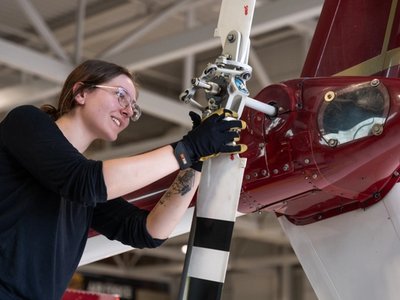
In the Aviation — Flight Management program, you will learn how to operate aircraft safely and independently through hands-on flight training and advanced simulator practice.
Flying has been a dream of yours for years. Why not make a career of it?
You can, with Confederation College’s Aviation - Flight Management advanced diploma program. Your private pilot flight training begins the first week of the first semester right from our hangar at the Thunder Bay International Airport. You’ll also receive training on some of the most advanced simulators available, learning to react to many situations in different weather scenarios.
From your first flight through to your graduation, we give you all the skills you need to land your first aviation job. Our veteran flight instructors at Confederation College’s state-of-the-art Aviation Centre of Excellence (ACE) will give you a solid foundation for a long and successful career.
Top Highlights
You’re flying in the first semester
Learn and work in our dedicated Aviation Centre of Excellence (ACE) building, located at the Thunder Bay International Airport
13 aircraft
Three flight simulators
Industry-based instruction — you learn the skills required to work as a commercial pilot
Upon Graduation
With our guidance and your dedication, you will earn:
Written private pilot exam: you will write the Transport Canada PPAER at the end of Semester 1, paving the way towards your first license.
Private Pilot License flight test: you will earn your TC PPL as part of your journey towards a rewarding career.
Written commercial pilot exam: you will write the TC CPAER at the end of Semester 4, moving closer toward your ultimate goal.
Written instrument rating exam: you will write the TC INRAT at the end of Semester 4, which you can use to further your flight training.
Commercial Pilot License flight test: a TC CPL is required by all those who wish to make a career of flying.
Written two-crew exam: you will write the Transport Canada IATRA at the end of Semester 5, which you will need to work in a two-crew or cruise relief pilot role.
What to expect
2.5-Year Advanced Diploma – Length of Program
Our target is for students to complete all flight training within 21 months (5 continuous semesters). However, students should be prepared for the possibility that flight training duration may extend up to 2.5 years due to variability in individual flight training progression and the potential for uncontrollable factors.
Who can apply?
Candidates who meet our academic program requirements, are a Canadian citizen or Permanent Resident and can hold a Transport Canada Category 1 Medical Certificate are invited to apply. Check the TC website at for an approved examiner in your area(opens in new window).
This program is highly competitive, so it’s important to note a few important dates.
Early October: access to the online college application becomes available for programs beginning in the following academic year.
February 1st: apply on or before this date in order to receive equal consideration for admission to programs starting the following fall.
May 1st: applicants must confirm their acceptance of an offer of admission by this date. Log in to your ontariocolleges.ca account to confirm your offer. Only those who receive an offer will hear from the college.
Highly competitive?
Because our program is subsidized (no extra fees for your flight training), we get quite a bit of interest from potential students. We can receive over *350 applications and will accept between *30 & *60 students, depending on the year. High grades in math, English and physics will help your chances of getting accepted. The lowest grades for the last few years were *85%.
*These figures change from year-to-year and are approximate.
Whether you’ve been out of school for a while and want a refresher, or you just don’t have all the requirements needed, Pre-Technology can help by allowing you to upgrade your skills and prepare for your future learning.
The Flight Management program gave me more than flying skills—it provided real-world industry experience and a strong foundation for a successful aviation career.
CT
Chris Thorpe
Graduate of 2011 – Pilot, Dash-8 Q-400, Air Canada Jazz
You can’t get closer to aviation training than being right on an airport, learning in class and then flying the same day. The program’s hands-on experience and strong industry reputation helped set me up for a successful career.
Ontario Secondary School Diploma (or equivalent) with courses from the College (C), University (U), University/College (U/C), or Open (O) preparation levels with Grade 12 English (C/U) Level.
or successful completion of the Mature Student Assessment.
or successful completion of the Canadian Adult Education Credential (CAEC) or General Education Development Test (GED), prior to May 2024.
or appropriate credits from the Academic and Career Entrance program (ACE).
Other Courses Required
Grade 11 Mathematics (M or U) or Grade 12 Mathematics (C or U), or equivalent, or ACE Core Math (UM602)
To be considered in the final selection, applicants are required to complete:
A valid Transport Canada Category 1 Medical Certificate is required by August 21st. Please note that it can take a few months (or longer in some cases) to process, and we strongly suggest that you have your medical completed before applying to this program. Check the Transport Canada website(opens in new window) for an approved examiner in your area.
Be aware that this is a seven day/week program, including a summer semester.
Other Courses Recommended
Physics Grade 11 or 12 (Strongly Recommended)
Note
Applicants are strongly encouraged to take the required courses in Grade 11 and/or during the first semester. If they are currently enrolled in the required course, the first semester mid-term mark will be used. If the applicant is not taking the required course until the second semester, the applicant will be given a minimum grade as long as the transcript indicates registration in the required course.
This intake is not available for international students.
Alternative Pathways
If you do not possess the Grade 12 Mathematics for College Technology (MCT4C) course or equivalent, we recommend that you consider our Pre-Technology-Technology/Aviation program, which will provide the necessary preparation to enter a technology program.
Student Accessibility and Essential Program Requirements
Confederation College is committed to providing an accessible and inclusive learning environment and will provide reasonable accommodations to students with disabilities in accordance with the Ontario Human Rights Code, the Accessibility for Ontarians with Disabilities Act (AODA), and College policy.
Students who require accommodations are encouraged to engage with Student Accessibility Services and are responsible for initiating and participating in the accommodation process. Accommodation is a collaborative process involving the student, Student Accessibility Services, faculty, and the Academic School. Requests for accommodation are considered on an individual basis, and the College will work with students to identify reasonable accommodations that provide equitable access to learning while maintaining the integrity of the program.
Students are expected to demonstrate the essential knowledge, skills, professional behaviours, learning outcomes, and competencies required to successfully complete their program. While the manner in which these requirements are demonstrated may be accommodated where appropriate, the essential requirements themselves must still be achieved.
For programs involving laboratories, field work, clinical placements, aviation environments, trades training, equipment operation, simulations, community placements, or other environments where health and safety are critical, accommodations must also be consistent with applicable legislation, professional standards, licensing requirements, accreditation standards, and workplace safety obligations.
In some circumstances, a requested accommodation may not be reasonable or possible where it would:
Fundamentally alter an essential program requirement, competency, or learning outcome.
Compromise the health or safety of the student or others.
Conflict with provincial or federal legislation.
Conflict with the requirements of an external regulatory, licensing, accreditation, or professional body.
Prevent the student from demonstrating competencies required for safe and effective professional practice.
Note
Where a particular accommodation cannot be provided, the College will work collaboratively with the student to identify whether an alternative accommodation can appropriately address the student’s disability-related needs while maintaining essential program requirements.
Tuition & Fees
Fees for Domestic StudentsProgram Code: 0313
Year 1
Total: $11,466.00
Fee Breakdown
Academic Fees
Total Tuition Fees:$5,756.00
Tuition Related Fees:$675.00
College Service Fee:$863.00
Health Fee:$305.00
Bus Fee:$332.00
$7,931.00
Program Fees
Field Trip Fee:$500.00
Tools:$650.00
Boots / Uniform:$500.00
Record Check, Seminars, Courses, First Aid, Medicals:$100.00
Exam Fees, Certifications, Licenses, Apprentice or Business Registration:$885.00
Books & Supplies:$900.00
$3,535.00
Year 2
Total: $6,941.00
Fee Breakdown
Academic Fees
Total Tuition Fees:$3,836.00
College Service Fee:$853.00
Health Fee:$305.00
Bus Fee:$332.00
$5,326.00
Program Fees
Field Trip Fee:$500.00
Record Check, Seminars, Courses, First Aid, Medicals:$100.00
Exam Fees, Certifications, Licenses, Apprentice or Business Registration:$715.00
Books & Supplies:$300.00
$1,615.00
Note
Please note that fees are estimated and are subject to change.
Fees shown on this page are for full-time students attending the main Thunder Bay campus for Fall 2026.
Costing for Regional Campuses & Distance Education Students:
If this program is available at Regional Campuses, or to Distance Education students, see the following links for costing information.
This introductory course will develop the fundamental aircraft handing techniques, knowledge, and attitudes required for the student to safely fly their first solo circuit fight. This foundation will then be built upon with the student transitioning into performance take-offs and landings.
This is an introductory ground school course which exceeds the Transport Canada minimum requirements for private pilot ground school. In this course students will study the subjects of Air Law, Navigation, Meteorology, and General Knowledge as they prepare to write the Transport Canada Private Pilot Licence exam (PPAER)
In this course, students will be introduced to academic writing styles with a thematic focus on current issues. This course will help students to express themselves clearly and correctly in written form. Students will critically analyse assigned readings and express their thoughts. The course will also focus on the development of an academic paper utilizing the APA style of documentation.
In this introductory course students explore various light aircraft systems. Students gain a practical knowledge of the systems, their operation, and approved procedures. The operations portion of this course introduces aircraft handling, safety considerations, company procedures, emergency handling, and our safety management system.
This course introduces students to the fundamental principles of flying and how they will relate to flight training. This includes a mixture of theory to support flight basics, and procedures to apply while completing specified training maneuvers as outlined in the Flight Training Manual and the Pilot Operating Handbook.
This course applies the principles of practical math and physics to solve problems related to aviation navigation and flight planning. Students will also practice performing mental calculations to aid in proficient decision-making.
This course is designed to prepare a student for a downed aircraft situation under various scenarios. Focus will be primarily on extreme cold temperature conditions of winter in Northern Canada. Students will be taught essentials necessary for survival until rescue arrives. The course consists of classroom training, plus two outdoor exercises and a weekend outdoor overnight survival exercise.
This course is the continuation of flight training from the first solo flight to the successful completion of the college proficiency flight test, and the accompanying Transport Canada flight test for the Private Pilot licence.
The course is designed to expand the students' understanding of Navigation, Meteorology, Flight Instruments and operational procedures. The student is introduced to additional navigational techniques, navigational resources, private pilot flight test standards and in-depth practical emergency scenarios.
This course continues to develop fundamental theory and procedures to assist flight training for the private pilot licence. Students will continue to examine and discuss the flight maneuvers from the Flight Training Manual and Pilot Operating Handbook that were not introduced in AF 103.
Advanced technology as found on modern aircraft will be introduced, including instrumentation, GPS displays, and autopilots. Avionics equipment, operation and applications will be reviewed and practiced. Services available to pilots will be investigated. Integration of Foreflight into flight procedures will be examined and applied.
This course is designed to increase awareness and understanding of the human factors involved in the aviation industry. It does this in two ways: It examines the human factors involved in risk and the different levels of risk management. It also examines the factors that affect the human body such as stress, fatigue, medications, etc. and how they pertain to a pilot's performance in an aircraft. The students will also explore pilot decision making, with an introduction into risk management and crew resource management. They will investigate how the decisions made by pilots directly relate to flight performance and safety, and how a pilot should use all the resources available to them to make an informed decision. This course provides students an opportunity to examine their personal attitudes, values, and behaviours in order to minimize the possibility of aviation occurrences. This will be compared to the view of pilots by industry, and what the actual expectations / responsibilities are.
In this course, students will be introduced to the concepts of wellness and provided practical strategies for developing and maintaining a healthy lifestyle. Through theory, practical fitness training, and self-evaluation, students will address nutrition, healthy sleep habits, stress management, and personal responsibility for their own health and wellness. The students will develop strategies to implement effective fitness programs to assist them in preventing injury and disease while maintaining occupational health standards.
This course commences commercial flight training. The student receives advanced training that will build upon their private pilot knowledge and skills in an effort to further their development towards a commercial pilot standard. Crew resource management, pilot decision making, professionalism, flying abilities and flight planning will be enhanced through dual, solo and mutual navigation exercises ranging from uncontrolled to high-density aerodromes. In addition, students will safely transition to a Cessna 172 model not used primarily for previous private pilot training, while also demonstrating a working knowledge of the differences in aircraft models (NXi, S, G1000) with respect to systems, speeds, and limitations.
This course prepares the student with skills and knowledge they need to be successful through their third flying semester which is largely solo and cross-country time. Students will familiarize themselves with Confederation College’s entire fleet of aircraft, college policies and safety practices, cross-country flight planning and considerations, and their own capabilities. Focus will be placed on decision-making and a high sense of self discipline.
In this course, students are engaged in an examination of Indigenous cosmology(s), knowledge(s), and world view(s) as they intertwine with the land. By centering the influence of the land on Indigenous worldviews, and through a self-reflective process, we aim to cultivate a holistic understanding of contemporary perspectives on identity, self-determination, and worldviews. This course will examine Indigenous narratives, oral traditions, language, culture, and storytelling traditions, including the relationships between human beings, the land, and spiritual dimensions. By inviting reflection and introspection, students will gain insights into the complexities of their own cultural backgrounds and their relationships with the land.
This course will provide the learner with an enhanced understanding of aircraft systems, engines, structures, flight controls and instrumentation in both simple and complex aircraft. AF412 provides the learner with a thorough foundation in turbine engines and their operation.
IFR ground school will introduce the requirements of instrument flight as they pertain to General Operating and Flight Rules. An understanding of instrument flying and the associated rules and procedures are important for all pilots to understand. Students will be required to successfully complete the Transport Canada INRAT exam as part of the course.
This is a flight training course subsequent to the summer flight training. Night training begins early in the semester and continues throughout. Advanced instrument training along with commercial level airwork and navigation continues in this semester and will further enhance the competence of the students, working towards the Transport Canada commercial flight test.
This ground school course will prepare the student to write the Transport Canada CPAER exam, Commercial Pilot Licence – Aeroplane. It will introduce new material and expand on knowledge and skills obtained in pre-and co-requisite courses. Subjects will include Licensing Requirements, Canadian Aviation Regulations, Airframes, Engines and Systems, Meteorology, Flight Instruments, Navigation, Flight Operations, Human Factors, Aerodynamics and Theory of Flight.
This course continues to re-enforce the fundamentals of flight procedures and techniques, while also introducing more complex commercial level flight exercises. Students will examine and discuss advanced flight manoeuvres from the Flight Training Manual and Pilot Operating Handbook, in order to excel in the flight training environment.
Safety Management Systems (SMS) and Threat and Error Management (TEM)
14 hours
In this course, students build onto the skills and abilities they developed in AF 205: Pilot Decision Making and Human Factors by applying safety concepts onto human performance. The principles, necessity, and functions of a safety management system (SMS), as they relate to all aviation operators, will be examined. Students participate in a safety management system and explore industry-wide safety culture and Transport Canada regulations regarding SMS. Threat and error management (TEM) is also applied to practical scenarios which provides students the opportunity to gain skills in workload and risk management.
This course examines commercial air carrier operations in Canada. 701, 702, 703, 704, and 705 operators and their structures will be discussed. Appropriate Canadian Aviation Regulations, Transport Canada training requirements, and company operations will be covered. This course is designed to assist the student in the transition from academics into the operational aviation industry. Students will complete assignments to increase their knowledge of the regulations and current aviation issues as well as participate in exercises to improve their awareness of employer expectations and customer service.
In this course, students will enhance their interpersonal and intercultural communication skills oriented to aviation professionals. The course emphasizes the importance of clear and concise oral and written communication. Emphasis is placed on communication styles, emotional intelligence, conflict resolution, workplace diversity and intercultural communication to increase overall professional effectiveness.
The focus of this course is the investigation and understanding of instrument flying, with reference to commercial air carrier flight operations (CAR's series 700). Students will examine IFR rules and procedures, consider weather criteria, and apply the contents of the Canada Air Pilot to various scenarios.
This course will prepare the student to write the Transport Canada IATRA (Aeroplane Type Rating for Two-Crew or Cruise Relief Pilot) exam. It will introduce new material, and confirm and expand on knowledge and skills obtained in pre-and co-requisite courses covering information outlined in the TC IATRA Study & Reference Guide. Subjects will include Licensing/Testing Requirements, Air Law & Procedures, Airframes, Engines, Propellers & Systems, Meteorology, Flight instruments, Navigation, Radio Communications & Navigation Aids, Flight Operations, Theory of Flight and Human Factors.
This course will give the student a base of knowledge of the operation environment that can be expected upon entering the workforce, from both a safety and a human factor perspective.
This course will serve as an introduction to the instructional techniques as they relate to the Transport Canada Flight Instructor Rating as well as provide a foundation for aviation leadership. A leader is someone whose ideas and actions influence the thoughts and behaviors of others. An instructor, a line pilot, a Training Captain, and a Chief Pilot can all be leaders. For the potential flight instructor and those wishing to become involved in company training, various types of learners will be explored, as well as the leadership skills required to best support students and fellow pilots.
The flight training in this semester is to prepare the students for their commercial flight test. Instrument training is completed as well as the night flying. Flight training exercises are practiced to exceed the performance criteria established in the Transport Canada Commercial Flight Test Guide.
In this course, students will learn about the role of the pilot in the business of aviation and understand the role and hands-on influence a pilot has on economic efficiency towards the operation of aircraft that will help airlines regardless of size achieve their business objectives and remain competitive.
A continuation of Health and Wellness 1, this course builds on the concepts of wellness and provides further strategies for maintaining a healthy lifestyle. practical fitness training will further develop cardiovascular health, muscular endurance and core strength. The student will develop mechanisms for stress management, substance abuse awareness and injury prevention in personal and occupational environments.
The graduate has reliably demonstrated the ability to:
Operate an aircraft independently and proficiently through all phases of the flight as outlined by Transport Canada.
Select and use relevant terminology, technologies, and strategies to communicate effectively with all functional divisions within an aerospace industry, airline, or flight operations.
Implement and participate in a Safety Management System (SMS) to create an industry-wide safety culture.
Use Crew Resource Management (CRM), Threat and Error Management (TEM), and Pilot Decision Making (PDM) skills to maintain safe and efficient operations.
Exhibit a professional and ethical attitude towards the pilot profession including a desire to maintain the highest professional standards with a positive attitude towards lifelong learning.
Complete all work in accordance with Canadian Aviation Regulations (CARS), aircraft operating procedures, and company policies and procedures.
Apply operational and administrative initiatives to ensure economic growth and sustainability within the aviation industry.
Our graduates have great success finding employment in northwestern Ontario, as well as major (international) airlines, medevac and charter operations, scheduled services, flight instruction and the Canadian Armed Forces.
Clicking the button will take you to a detailed dashboard with up-to-date job data tailored to your program, including salary ranges, job titles, and projected demand.
Pathways
Confederation College offers a variety of articulation agreements designed to help you advance your education and career. Whether you're coming to us from another institution or planning your next steps after completing your program, our pathways make your transition seamless and effective.
Pathway Out — Credits recognized by another institution
University of New Brunswick — Bachelor of Applied Management (BAM)
Graduates from eligible 2-year or 3-year diploma programs at Confederation College can apply to enter the third year of the Bachelor of Applied Management at the University of New Brunswick, with a minimum 70% program average. Additional courses may be required.
Minimum Admission Average
70% overall program average
Entry Point
Year 3 of a 4-year degree
Institution: University of New Brunswick, Saint John, NB
Agreement Type: Memorandum of Understanding
Graduates of eligible diploma programs at Confederation College may be considered for advanced standing in the Bachelor of Applied Management (BAM).
Eligibility Requirements:
Completion of a 2-year (four-semester) or 3-year (six-semester) diploma program
Minimum overall program average of 70%
Transfer Details:
Eligible students may enter Year 3 of the 4-year BAM program
Additional courses may be required depending on the applicant’s academic background
Program Notes:
Eligible Confederation College programs are outlined in Appendix A of the Memorandum of Understanding
Students should consult the contact person for full details and program-specific requirements