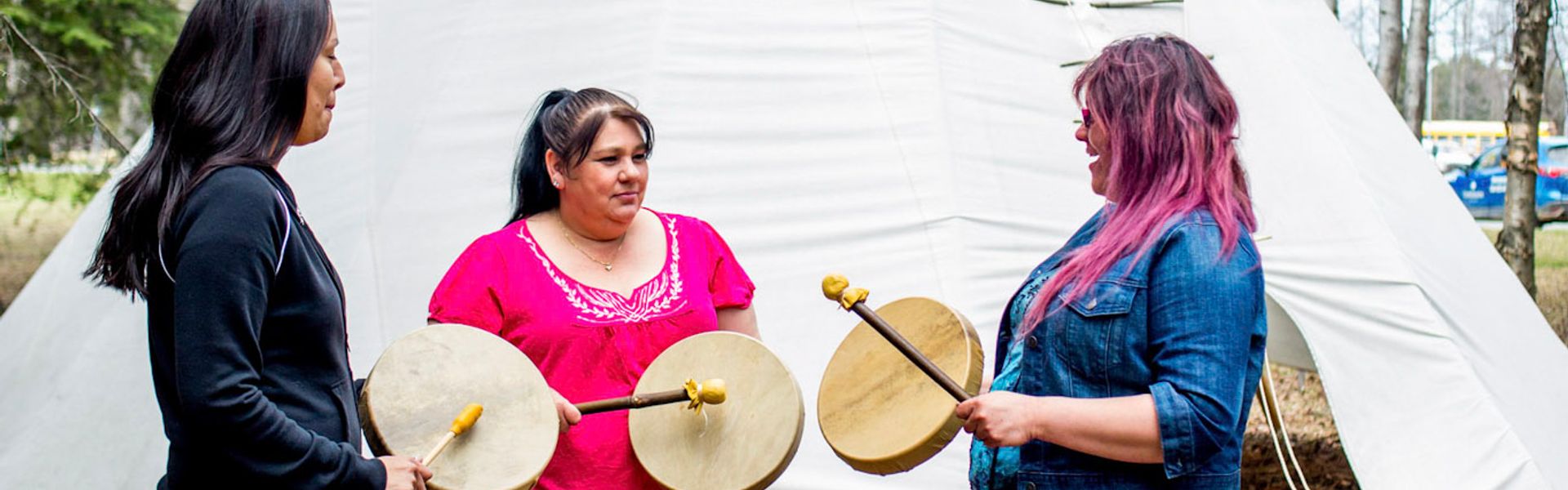
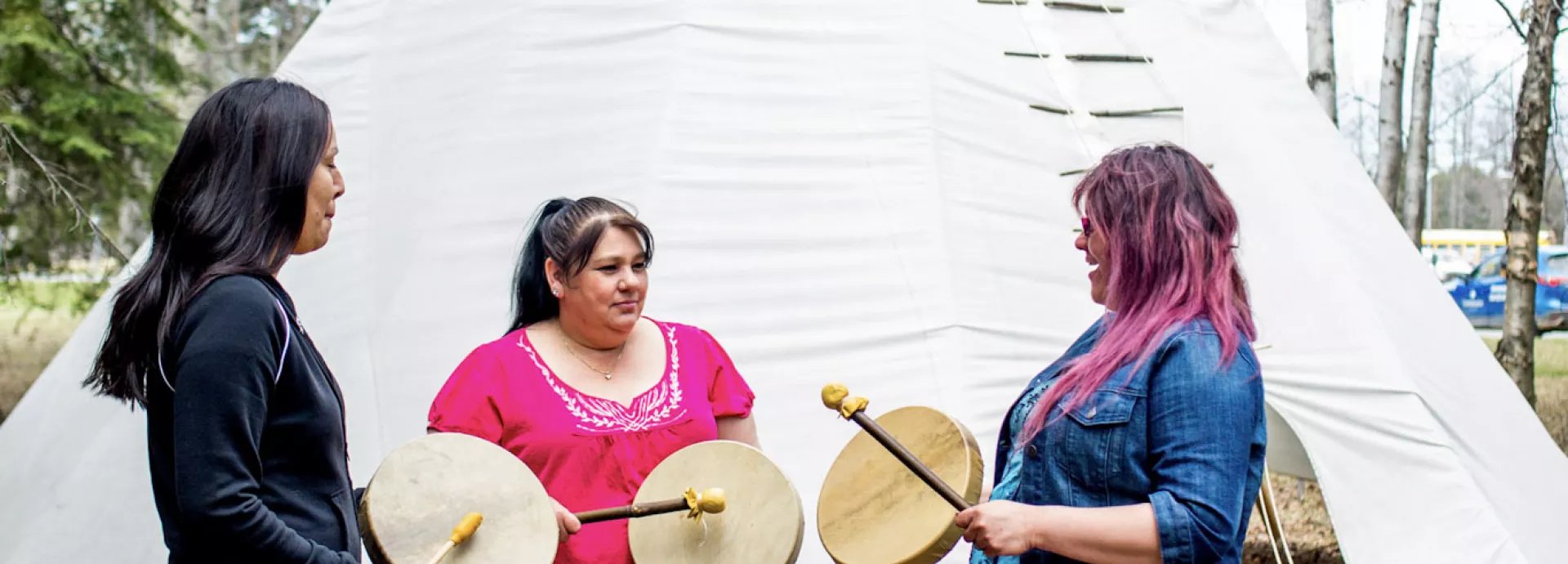
Three Indigenous women holding traditional hand drums outdoors in front of white tent structure

Ontario College Diploma

Indigenous Canadian Relations

The Indigenous Canadian Relations program provides knowledge and understanding of Indigenous-Canadian relations, Indigenous worldviews, and historical contexts. Students develop skills to contribute to informed conversations, build respectful relationships, and support reconciliation between Indigenous and Canadian communities in personal and professional settings.

Program Start Options

IntakeDurationFormatCampusDomesticInternational
9611
Fall
Up to 3 years
1 semester
Full-Time
Online Live
Remote
Domestic students accepted
International students not accepted
Distance Education Program
9611
Fall, Winter, Spring
Up to 3 years
1 semester
Part-Time
Online Live
Remote
Domestic students accepted
International students not accepted
Distance Education Program

Would you like to enhance your knowledge so you are better prepared to contribute to informed conversations regarding Indigenous-Canadian relations in your personal or professional life?

If so, the Indigenous Canadian Relations Certificate may be a perfect option for you.

The Indigenous Canadian Relations program, is a five credit Board of Governors’ certificate, available to professionals, community members and students who have desire to learn more about the history of Indigenous nations with the Canadian state. This flexible educational option allows for a diverse experience. Learners can decide to take courses at their own pace, online or in a classroom setting, with a variety of courses to choose from - perfect for community leaders and professionals already in the workforce. It is also a great option for students, who are completing a college diploma program at Confederation College, and wish to heighten their knowledge base regarding Indigenous issues. It is possible to graduate with a diploma, as well as the Indigenous Canadian Relations certificate!

This certificate will provide you with knowledge regarding Indigenous-Canadian relations and Indigenous worldviews and perspectives, better equipping you to understand the historical context that affects current Indigenous and Canadian relationship building processes.

Top Highlights

  • Gain career-related skills and expertise on Indigenous and Canadian relations
  • Full- or part-time studies available in person or online
  • Add this certificate to a Confederation College diploma

Contact Information

Program Files

Get detailed information about program requirements, courses, and student resources.

This program gave me the knowledge I was missing about Canada’s true history and Indigenous peoples. It’s a powerful, eye-opening experience I believe everyone should have.

TW
Tony Wood
Graduate of 2019 - Student Success Advisor, Confederation College

Admission Requirements

Fall · Fall, Winter, Spring

The following 2 intakes share the same admission requirements:

Fall (9611)Fall, Winter, Spring (9611)

Admission Requirements for Domestic Students

  1. 19 years of age or older or
  2. Ontario Secondary School Diploma (or equivalent) with courses from the College (C), University (U), University/College (U/C), or Open (O) preparation levels with Grade 12 English (E/C/U) Level.
  3. or successful completion of the Mature Student Assessment.
  4. or successful completion of the Canadian Adult Education Credential (CAEC) or General Education Development Test (GED), prior to May 2024.
  5. or appropriate credits from the Academic and Career Entrance (ACE) program - LBS level 5 Communications and LBS level 4 Mathematics.

Admission Requirements for International Students

This intake is not available for international students.

Student Accessibility and Essential Program Requirements

Confederation College is committed to providing an accessible and inclusive learning environment and will provide reasonable accommodations to students with disabilities in accordance with the Ontario Human Rights Code, the Accessibility for Ontarians with Disabilities Act (AODA), and College policy.

Students who require accommodations are encouraged to engage with Student Accessibility Services and are responsible for initiating and participating in the accommodation process. Accommodation is a collaborative process involving the student, Student Accessibility Services, faculty, and the Academic School. Requests for accommodation are considered on an individual basis, and the College will work with students to identify reasonable accommodations that provide equitable access to learning while maintaining the integrity of the program.

Students are expected to demonstrate the essential knowledge, skills, professional behaviours, learning outcomes, and competencies required to successfully complete their program. While the manner in which these requirements are demonstrated may be accommodated where appropriate, the essential requirements themselves must still be achieved.

For programs involving laboratories, field work, clinical placements, aviation environments, trades training, equipment operation, simulations, community placements, or other environments where health and safety are critical, accommodations must also be consistent with applicable legislation, professional standards, licensing requirements, accreditation standards, and workplace safety obligations.

In some circumstances, a requested accommodation may not be reasonable or possible where it would:

  • Fundamentally alter an essential program requirement, competency, or learning outcome.
  • Compromise the health or safety of the student or others.
  • Conflict with provincial or federal legislation.
  • Conflict with the requirements of an external regulatory, licensing, accreditation, or professional body.
  • Prevent the student from demonstrating competencies required for safe and effective professional practice.
Note

Where a particular accommodation cannot be provided, the College will work collaboratively with the student to identify whether an alternative accommodation can appropriately address the student’s disability-related needs while maintaining essential program requirements.

Courses

1 intake

Fall9611

Semester 1

OL 843

Decolonizing History: Indigenous-Canadian Relations

42 hours

This course takes a decolonized approach to examining Canadian history and the relationship between Indigenous peoples, settlers, and the Canadian government from first contact to the present. Focusing on Indigenous perspectives, worldviews, and experiences, it highlights early cooperation and partnerships during the fur trade, the significance of the treaty-making era, and the profound impact of British and early Canadian colonial policies on Indigenous rights, communities, and identity. The course also analyzes the lasting effects of colonization and the ongoing efforts of Indigenous peoples to heal from harm, reclaim their rights, and restore their culture in contemporary Canada. Finally, the course highlights Indigenous resilience, resistance, and resurgence in shaping modern society, deepening understanding of the historical and current dynamics between Indigenous peoples and Canada. This insight is crucial for engaging with the ongoing process of truth and reconciliation in Canada today.

OL 848

Indigenous Identity in Relation to Land

42 hours

In this course, students are engaged in an examination of Indigenous cosmology(s), knowledge(s), and world view(s) as they intertwine with the land. By centering the influence of the land on Indigenous worldviews, and through a self-reflective process, we aim to cultivate a holistic understanding of contemporary perspectives on identity, self-determination, and worldviews. This course will examine Indigenous narratives, oral traditions, language, culture, and storytelling traditions, including the relationships between human beings, the land, and spiritual dimensions. By inviting reflection and introspection, students will gain insights into the complexities of their own cultural backgrounds and their relationships with the land.

OL 856

Role of Self, Communication and Workplace in Decolonizing Systems

42 hours

In this course, an intrapersonal and interpersonal approach to explore and apply strategies for decolonization from an Indigenized perspective has been adopted. The aim of this course is to develop the capacity to move forward individually and collectively toward a future that embraces improved communication, relational space, and community building. This course will also examine the impacts of colonization on individuals, communities, and workplaces while incorporating Indigenous ways of knowing, being, and doing.

OL 859

Indigenous Wellbeing: Decolonized Approach

42 hours

In this course, students will engage in the exploration of key social challenges that impact Indigenous peoples in Canada. The curriculum embraces an Indigenized perspective by interweaving Indigenous knowledge, perspectives, and lived experiences. Emphasis will be placed on analysis of prevention and intervention strategies, while respecting the distinctive spiritual customs and traditions of the Indigenous populations.

Choose one course from this group:

S01

OL 868

Metis in Canada

42 hours

This course introduces learners to the diverse histories, cultures, and contemporary realities of Métis peoples across Turtle Island (North America). While grounding students in the origins and development of Métis communities in what is now Ontario, the course expands its lens to include the rich diversity of Métis experiences across the ‘Motherland’. Students will explore themes of Métis identity, nationhood, governance, resistance, resurgence, and cultural expression through historical and contemporary sources. The course will include oral histories, Indigenous literature, art, and guest presentations from Knowledge Keepers and community leaders. By the end of the course, students will gain a deeper understanding of how Métis communities have shaped and continue to shape Turtle Island, asserting their rights, preserving their cultures, and contributing to the broader Indigenous landscape.

OL 258

Indigenous Peoples

45 hours

This course will increase knowledge and awareness of important issues in the Aboriginal cultures of Canada. The legal status of Aboriginal people will be explored along with Aboriginal rights and self- determination. Other critical issues relating to land claims, justice and social services will be studied. This course includes mandatory group work. We recommend viewing the course schedule immediately upon logging into the course to view course and group work requirements.

OL 842

Indigenous Songs & Stories

45 hours

This online course centers Anishinaabe Gikendaasowin - Anishinaabe Knowledge - by using Anishinaabe songs and stories to support learners in their journey of understanding fundamental concepts in relation to language revitalization and resurgence. The course begins by inquiring into the history of Anishinaabemowin (the Ojibwe language) and forming a beginner`s comprehension of introductory language skills in Anishinaabemowin. Learners will explore their role in maintaining the Anishinaabe stories and songs shared throughout the course. Learners will also build the capacity to engage with knowledge keepers and elders to support the ongoing resurgence of Anishinaabemowin within their respective fields.

OL 847

Truth and Reconciliation

42 hours

In this course, students will gain an understanding of the historical factors that contributed to the creation of Residential Schools, including the history of colonization and the relationship between the government and Indigenous communities. Students will reflect upon and further develop their understanding of the ongoing impact of Residential Schools.

Meet the Program Staff

1 staff member

Careers

Confederation College’s Indigenous Canadian Relations program equips students with in-depth understanding of Indigenous-Canadian relations, making them valuable assets in sectors like community development, education, government, and non-profit organizations. Graduates find roles as Community Liaisons, Program Coordinators, or Advisors on Indigenous Affairs. The program’s comprehensive curriculum ensures a deep appreciation and knowledge of Indigenous perspectives, vital for roles in policymaking, community outreach, and educational roles.

See Career Opportunities

Clicking the button will take you to a detailed dashboard with up-to-date job data tailored to your program, including salary ranges, job titles, and projected demand.

Pathways

Confederation College offers a variety of articulation agreements designed to help you advance your education and career. Whether you're coming to us from another institution or planning your next steps after completing your program, our pathways make your transition seamless and effective.

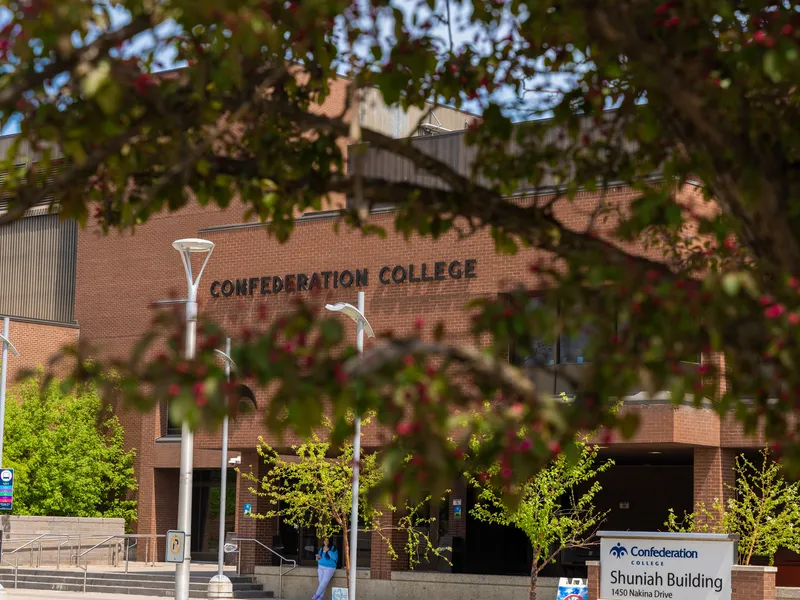
Students at Confederation College

We're here to help

Have questions before you apply?

Not sure if this is the right fit? Our recruitment team can help you navigate admission requirements, program details, and campus life.