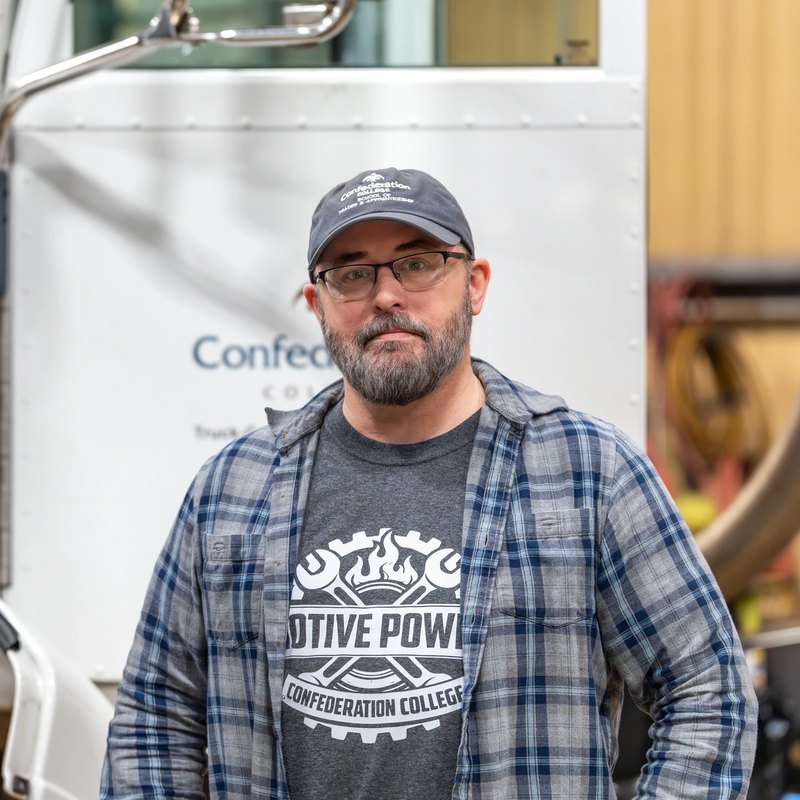
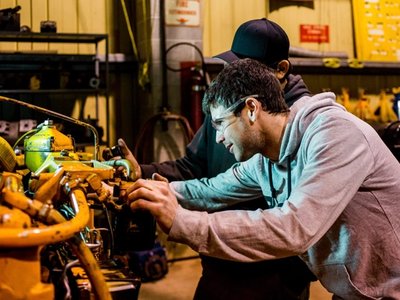
Heavy Duty Equipment Technician apprentices inspecting a transport truck engine

Apprenticeship

Heavy Duty Equipment Technician Apprenticeship

In the Heavy Duty Equipment Technician Apprenticeship program, you will learn how to diagnose and repair complex heavy equipment through hands-on shop training supported by in-class technical instruction.

Program Start Options

IntakeDurationFormatCampusDomesticInternational
421A
Any Time
2–5 years (varies by trade)
Part-Time
In-Person
Thunder Bay
Domestic students accepted
International students not accepted

A Heavy Duty Equipment Technician Apprenticeship is generally trained in areas such as:

  • Specific Trade Practices
  • Engine Systems
  • Fluid Power Systems
  • Electronic Systems
  • Drive Train Systems
  • Fuel Systems

The Heavy Duty Equipment Technician Apprenticeship program at Confederation College offers a comprehensive training pathway for individuals aspiring to become skilled professionals in the heavy-duty equipment and agricultural equipment technician trades. This program is meticulously structured to provide a blend of theoretical knowledge and practical skills necessary for a successful career in this dynamic and evolving field.

Top Highlights

  • Integrated Curriculum: The program encompasses a wide range of essential subjects including Occupational Health and Safety, Engine Systems, Electrical and Electronic Systems, Fluid Power Systems, Drive Train Systems, and Welding Techniques. It covers everything from basic tool handling and safety practices to advanced diagnostics and repair techniques.
  • Balance of Theory and Practice: Apprentices engage in a balanced mix of classroom learning and hands-on training, ensuring a deep understanding of both the theoretical concepts and their practical applications.
  • Industry-Relevant Training: Developed in collaboration with industry experts and stakeholders, the curriculum is aligned with the latest industry standards and practices, ensuring that the skills and knowledge imparted are current and relevant.
  • Safety-First Approach: Emphasizing a culture of safety, the program trains apprentices in best practices for workplace safety, environmental responsibility, and the proper use of personal protective equipment.
  • Skilled Craftsmanship and Problem Solving: The program aims to cultivate high standards of craftsmanship, encouraging apprentices to develop strong problem-solving skills and a keen sense of responsibility towards their trade.
  • Flexibility and Innovation: While adhering to industry standards, the program offers instructors the flexibility to incorporate innovative teaching methodologies and adapt to the unique needs of each apprentice cohort.

Contact Information

Admission Requirements

Any Time

Any Time (421A)

Admission Requirements for Domestic Students

  1. To be eligible for an apprenticeship, you must:
    • Be at least 18 years of age (16 years of age in limited cases)
    • Have legal permission to work in Canada (i.e., have a valid social insurance number)
    • Meet the educational requirements of the trade.
      Grade 12 or equivalent is the generally accepted standard, however, grade 10 or equivalent may be accepted by some sponsors.
    • Have a sponsor located in Ontario. This can be a private employer, association or union.
  2. Apply for an apprenticeship through Skilled Trades Ontario(opens in new window). This step is usually completed when you have received an offer of employment from a sponsor.
  3. After completing the apprenticeship application, a Registered Training Agreement will be drafted by the Ministry of Labour, Immigration, Training and Skills Development (MLITSD). The apprentice and their sponsor will both sign this document, officially recognizing the apprentice to begin the training process through their employer.

Admission Requirements for International Students

This program is not currently available for international students.
To enroll in an apprenticeship program, international students must meet specific criteria, including possessing a valid Social Insurance Number (SIN) and securing a sponsor.

Prerequisites

People who want to become apprentices must apply directly to employers, unions or joint apprenticeship training committees for the trade they are interested in. Most trades require between two and five years of work and training to become certified. During that time apprentices will be notified of offers to attend in-class training at the closest available training facility.

Apprentices are permitted to attend other training facilities within Ontario if they choose by making arrangements with their local Ministry office in advance

Student Accessibility and Essential Program Requirements

Confederation College is committed to providing an accessible and inclusive learning environment and will provide reasonable accommodations to students with disabilities in accordance with the Ontario Human Rights Code, the Accessibility for Ontarians with Disabilities Act (AODA), and College policy.

Students who require accommodations are encouraged to engage with Student Accessibility Services and are responsible for initiating and participating in the accommodation process. Accommodation is a collaborative process involving the student, Student Accessibility Services, faculty, and the Academic School. Requests for accommodation are considered on an individual basis, and the College will work with students to identify reasonable accommodations that provide equitable access to learning while maintaining the integrity of the program.

Students are expected to demonstrate the essential knowledge, skills, professional behaviours, learning outcomes, and competencies required to successfully complete their program. While the manner in which these requirements are demonstrated may be accommodated where appropriate, the essential requirements themselves must still be achieved.

For programs involving laboratories, field work, clinical placements, aviation environments, trades training, equipment operation, simulations, community placements, or other environments where health and safety are critical, accommodations must also be consistent with applicable legislation, professional standards, licensing requirements, accreditation standards, and workplace safety obligations.

In some circumstances, a requested accommodation may not be reasonable or possible where it would:

  • Fundamentally alter an essential program requirement, competency, or learning outcome.
  • Compromise the health or safety of the student or others.
  • Conflict with provincial or federal legislation.
  • Conflict with the requirements of an external regulatory, licensing, accreditation, or professional body.
  • Prevent the student from demonstrating competencies required for safe and effective professional practice.
Note

Where a particular accommodation cannot be provided, the College will work collaboratively with the student to identify whether an alternative accommodation can appropriately address the student’s disability-related needs while maintaining essential program requirements.

Tuition & Fees

The Level 1 fee of $400.00 includes the workbook/print materials fee.

Note

As this program is subject to scheduling changes, please verify the current fee and availability.

Note

Please note that fees are estimated and are subject to change.

Fees shown on this page are for full-time students attending the main Thunder Bay campus for Fall 2026.

Costing for Regional Campuses & Distance Education Students:

If this program is available at Regional Campuses, or to Distance Education students, see the following links for costing information.

Courses

Courses are delivered on a rotating basis according to the number of apprentices in each level.

Please find details about this program on the Skilled Trades Ontario(opens in new window) Website.

Level 1

The Commercial Vehicle and Equipment Level 1 curriculum at Confederation College includes a comprehensive range of subjects designed to provide apprentices with both theoretical knowledge and practical skills in various aspects of heavy-duty equipment technician trade. The program covers several core areas:

  1. Trade Practices:
    • Total of 40 hours, with 24 hours dedicated to theory and 16 hours to practical exercises.
    • Subjects covered include Occupational Health and Safety, Precision Measuring Tools, Fastening Devices and Torquing Procedures, Bearings Seals and Sealants, and Oxy-Fuel Processes.
  2. Occupational Health and Safety:
    • 10 hours in total, comprising 8 hours of theory and 2 hours of practical learning.
    • This subject includes learning about workplace safety, use of protective equipment, fire prevention, environmental protection, and legal responsibilities under various safety acts and regulations​​.
  3. Precision Measuring Tools:
    • 6 hours duration, evenly divided between theory and practical application.
    • It covers the use of precision and non-precision measuring tools, including micrometers, gauges, callipers, and torque wrenches, along with their maintenance and calibration​​.
  4. Fastening Devices and Torquing Procedures:
    • An 8-hour module, split equally between theory and practical.
    • Topics include fastener types and applications, torque procedures, and the impact of various factors on torque and tension​​.
  5. Bearings, Seals, and Sealants:
    • 8 hours long, with 5 hours of theory and 3 hours of practical exercises.
    • This subject covers the fundamentals, types, operation, inspection, and maintenance of bearings, seals, and sealants​​.
  6. Oxy-Fuel Processes:
    • Also an 8-hour subject, with equal emphasis on theory and practical skills.
    • It includes training on the operation, safety, and maintenance of oxyacetylene heating and cutting equipment, as well as practical skills for using this equipment in various tasks​​.

Level 2

The Commercial Vehicle and Equipment Level 2 program at Confederation College is designed to provide apprentices with an advanced level of theoretical knowledge and practical skills in various aspects of heavy-duty equipment and agricultural equipment technician trades. The curriculum is developed in accordance with the Ministry of Training Colleges and Universities (MTCU) Training Standards and is intended to complement on-the-job work experiences. The curriculum includes a balance of theory and practical application, with specific time allocations for each subject area to ensure a comprehensive learning experience.

The Level 2 curriculum covers the following subjects:

  1. Trade Practices:
    • Total of 24 hours, with 11.5 hours dedicated to theory and 12.5 hours to practical exercises.
  2. Fluid Power Systems:
    • Total of 56 hours, with 38 hours for theory and 18 hours for practical exercises.
  3. Engine Systems:
    • Total of 32 hours, with 19 hours for theory and 13 hours for practical exercises.
  4. Electrical Systems:
    • Total of 40 hours, with 29 hours for theory and 11 hours for practical exercises.
  5. Fuel Systems:
    • Total of 32 hours, with 19 hours for theory and 13 hours for practical exercises.
  6. Drive Train Systems:
    • Total of 32 hours, with 18 hours for theory and 14 hours for practical exercises.
  7. Steering, Tires, and Brake Systems:
    • Total of 24 hours, with 17 hours for theory and 7 hours for practical exercises.

Overall, the Level 2 program focuses on enhancing the apprentices' skills and knowledge in a variety of critical areas, including trade practices, fluid power systems, engine systems, electrical systems, fuel systems, drive train systems, and steering, tires, and brake systems. The program's structure ensures that apprentices receive a well-rounded education, combining theoretical learning with practical applications to prepare them for the complexities of the trade.

Each subject area is designed to align with the Ministry of Training Colleges and Universities Apprenticeship Training Standards, and they incorporate both in-class learning outcomes and practical applications. The program also emphasizes safety precautions across all subjects, including the handling of hazardous materials and protective equipment use​​.

Level 3

The Commercial Vehicle and Equipment Level 3 program at Confederation College is designed to provide apprentices with advanced training in the heavy-duty equipment technician trade. This curriculum, developed in line with the Ministry of Training Colleges and Universities (MTCU) Training Standards, aims to prepare apprentices with both theoretical knowledge and practical skills necessary for inspecting, diagnosing, repairing, and servicing increasingly complex equipment.

The Level 3 curriculum covers the following subjects:

  1. Trade Practice:
    • Total of 24 hours, with 8 hours for theory and 16 hours for practical exercises.
  2. Fluid Power Systems:
    • Total of 48 hours, with 30 hours for theory and 18 hours for practical exercises.
  3. Engine Systems:
    • Total of 24 hours, with 16 hours for theory and 8 hours for practical exercises.
  4. Electrical/Electronic Systems:
    • Total of 40 hours, with 23 hours for theory and 17 hours for practical exercises.
  5. Fuel Systems:
    • Total of 40 hours, with 26 hours for theory and 14 hours for practical exercises.
  6. Drive Train Systems:
    • Total of 32 hours, with 16 hours for theory and 16 hours for practical exercises.
  7. Brakes, Track, and Suspension Systems:
    • Total of 32 hours, with 18 hours for theory and 14 hours for practical exercises.

The curriculum is designed to provide flexibility and innovation in teaching while adhering to the subject requirements set by the Industry Committees and Regulations for the Trades. Regular evaluations in both theory and practical applications ensure that apprentices are achieving the expected learning outcomes. The curriculum also emphasizes the importance of safety in all practical activities, aligning with the Occupational Health and Safety Act and other relevant regulations.

Developed in collaboration with industry representatives and several colleges of applied arts and technology, the Level 3 program aims to meet the evolving demands of the trade by reinforcing fundamental skills, enhancing problem-solving abilities, and fostering a sense of craftsmanship and pride in the trade​​.

Meet the Program Staff

1 staff member

Careers

Graduates of the Heavy Duty Equipment Technician Apprenticeship program are well-equipped to embark on a rewarding career path in various sectors. Employment opportunities are diverse and can be found in:

  • Heavy Equipment Maintenance and Repair: Working in repair shops, service centers, or on-site locations maintaining and repairing heavy-duty equipment.
  • Construction and Mining Industries: Handling the maintenance and repair of equipment used in construction and mining operations.
  • Agricultural Sector: Specializing in agricultural machinery, providing essential services to the farming community.
  • Transportation and Logistics: Working with large vehicles and equipment in transportation, ensuring their functionality and safety.
  • Government and Municipal Services: Opportunities in public works departments maintaining and repairing a variety of heavy equipment.
  • Equipment Manufacturing and Sales: Providing technical support, product development insights, and customer service in the equipment manufacturing industry.
  • Self-Employment: Starting their own business offering repair, maintenance, and consultancy services in heavy equipment.

With the comprehensive training received, graduates are not just limited to hands-on technical roles but are also prepared for supervisory and managerial positions within the sector. The evolving nature of this field, coupled with the constant introduction of new technologies, ensures a dynamic and exciting career with opportunities for continual learning and growth.

Pathways

Confederation College offers a variety of articulation agreements designed to help you advance your education and career. Whether you're coming to us from another institution or planning your next steps after completing your program, our pathways make your transition seamless and effective.

Students at Confederation College

We're here to help

Have questions before you apply?

Not sure if this is the right fit? Our recruitment team can help you navigate admission requirements, program details, and campus life.