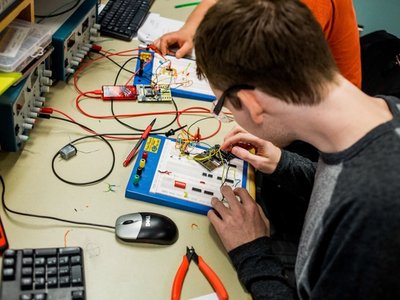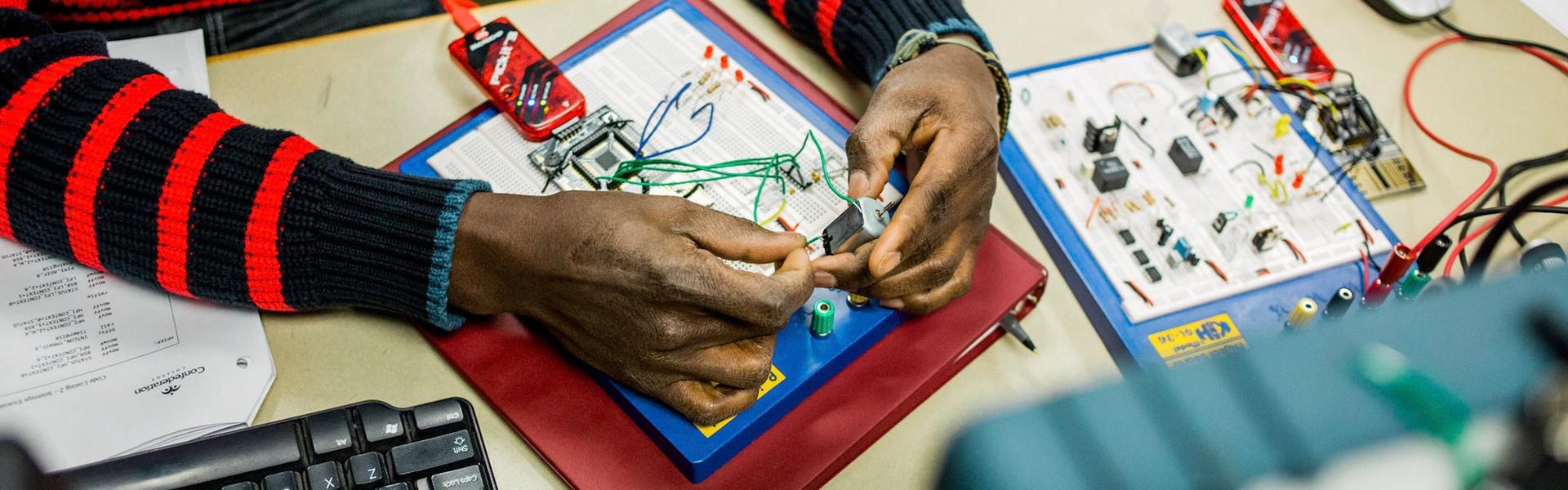
Student assembling circuitry on a breadboard in an electronics lab

Apprenticeship

Electrical Construction and Maintenance Apprenticeship

In the Electrical Construction and Maintenance Apprenticeship program, you will learn how to install and service building electrical systems through hands-on lab work and structured on-the-job training.

Program Start Options

IntakeDurationFormatCampusDomesticInternational
309A
Any Time
2–5 years (varies by trade)
Part-Time
In-Person
Thunder Bay
Domestic students accepted
International students not accepted

The Electrician – Construction and Maintenance (trade code309A) apprenticeship program is a comprehensive training designed to prepare apprentices for a career in various electrical systems settings, such as residential, commercial, institutional, and industrial environments. This program's scope includes:

  1. Scope of Practice: Tasks include laying out, assembling, installing, repairing, maintaining, connecting, and testing electrical fixtures, apparatus, control equipment, and wiring for systems like alarms, communication, lighting, heating, and power. Apprentices also plan installations, work with panel boards, switch boxes, and other electrical devices, and handle electrical conductor enclosures like conduits.
  2. Program Guidelines: The total training duration is 9,000 hours, with 840 hours of in-school training. The program follows a compulsory classification under the Skilled Trades Act 2021, and apprentices must achieve competency in all mandatory skills, complete in-school training as per the curriculum standard, and meet on-the-job hours benchmark.
  3. Skills for Success: The program emphasizes foundational skills crucial for work, learning, and social interaction in a fast-changing world. These skills assist in job acquisition, progression, and transitions, as well as community involvement and learning success.
  4. Standard of Performance: Apprentices are expected to perform all skills in compliance with Occupational Health and Safety legislation, Canadian Electrical Code, manufacturer’s specifications, design specifications, industry standards, job specifications, company policies, and client specifications.
  5. Additional Training and Certifications: Apprentices may opt for additional certifications and training, such as First Aid and CPR, WHMIS, Working at Heights, Lock out and tag out training, CSA Z462 training (including arc flash), Confined Space Awareness, Fire Alarm Certification. These will enhance their skills and safety knowledge.

Electrical – Construction and Maintenance Apprenticeship is generally trained in areas such as:

  • Canadian Electric Code
  • Instrumentation
  • Monitoring and Communications Systems
  • Electrical Theory
  • Prints – Advanced level only
  • Electronics
  • PLC’s

Contact Information

Admission Requirements

Any Time

Any Time (309A)

Admission Requirements for Domestic Students

  1. To be eligible for an apprenticeship, you must:
    • Be at least 18 years of age (16 years of age in limited cases)
    • Have legal permission to work in Canada (i.e., have a valid social insurance number)
    • Meet the educational requirements of the trade.
      Grade 12 or equivalent is the generally accepted standard, however, grade 10 or equivalent may be accepted by some sponsors.
    • Have a sponsor located in Ontario. This can be a private employer, association or union.
  2. Apply for an apprenticeship through Skilled Trades Ontario(opens in new window). This step is usually completed when you have received an offer of employment from a sponsor.
  3. After completing the apprenticeship application, a Registered Training Agreement will be drafted by the Ministry of Labour, Immigration, Training and Skills Development (MLITSD). The apprentice and their sponsor will both sign this document, officially recognizing the apprentice to begin the training process through their employer.

Admission Requirements for International Students

This program is not currently available for international students.
To enroll in an apprenticeship program, international students must meet specific criteria, including possessing a valid Social Insurance Number (SIN) and securing a sponsor.

Prerequisites

People who want to become apprentices must apply directly to employers, unions or joint apprenticeship training committees for the trade they are interested in. Most trades require between two and five years of work and training to become certified. During that time apprentices will be notified of offers to attend in-class training at the closest available training facility.

Apprentices are permitted to attend other training facilities within Ontario if they choose by making arrangements with their local Ministry office in advance

Student Accessibility and Essential Program Requirements

Confederation College is committed to providing an accessible and inclusive learning environment and will provide reasonable accommodations to students with disabilities in accordance with the Ontario Human Rights Code, the Accessibility for Ontarians with Disabilities Act (AODA), and College policy.

Students who require accommodations are encouraged to engage with Student Accessibility Services and are responsible for initiating and participating in the accommodation process. Accommodation is a collaborative process involving the student, Student Accessibility Services, faculty, and the Academic School. Requests for accommodation are considered on an individual basis, and the College will work with students to identify reasonable accommodations that provide equitable access to learning while maintaining the integrity of the program.

Students are expected to demonstrate the essential knowledge, skills, professional behaviours, learning outcomes, and competencies required to successfully complete their program. While the manner in which these requirements are demonstrated may be accommodated where appropriate, the essential requirements themselves must still be achieved.

For programs involving laboratories, field work, clinical placements, aviation environments, trades training, equipment operation, simulations, community placements, or other environments where health and safety are critical, accommodations must also be consistent with applicable legislation, professional standards, licensing requirements, accreditation standards, and workplace safety obligations.

In some circumstances, a requested accommodation may not be reasonable or possible where it would:

  • Fundamentally alter an essential program requirement, competency, or learning outcome.
  • Compromise the health or safety of the student or others.
  • Conflict with provincial or federal legislation.
  • Conflict with the requirements of an external regulatory, licensing, accreditation, or professional body.
  • Prevent the student from demonstrating competencies required for safe and effective professional practice.
Note

Where a particular accommodation cannot be provided, the College will work collaboratively with the student to identify whether an alternative accommodation can appropriately address the student’s disability-related needs while maintaining essential program requirements.

Tuition & Fees

This program focuses on electrical skills for construction and maintenance. The Level 1 fee is $400.00.

Note

Please check for any fee changes before enrolling.

Note

Please note that fees are estimated and are subject to change.

Fees shown on this page are for full-time students attending the main Thunder Bay campus for Fall 2026.

Costing for Regional Campuses & Distance Education Students:

If this program is available at Regional Campuses, or to Distance Education students, see the following links for costing information.

Courses

The Electrician – Construction and Maintenance (309A) program is structured into four levels, each comprising a set of specific courses designed to equip apprentices with comprehensive skills and knowledge in the field of electrical construction and maintenance. Here's a summary of the courses offered at each level:

Level 1 (Common Core)

  1. Communication and Documentation
  2. Introduction to the Canadian Electrical Code (CEC)
  3. Trade Practices
  4. Installation and Maintenance Methods
  5. Electrical Fundamentals
  6. Drawings Standards and Specifications Fundamentals​​.

Level 2 (Common Core)

  1. Electrical Systems
  2. Electronic Fundamentals
  3. Drawings Specifications and Standards Intermediate
  4. Motor Controls and Devices
  5. Communication and Monitoring Systems
  6. Canadian Electrical Code II​​.

Level 3 (Common Core)

  1. Renewable Energy Generating and Storage Systems
  2. Electrical Theory and Applications
  3. PLC Fundamentals
  4. Power Electronics
  5. Drawings Specifications and Standards Advanced
  6. Introduction to Instrumentation
  7. Canadian Electrical Code III​​.

Level 4 (Electrician Construction and Maintenance)

  1. Building Automation Systems (Common Core)
  2. Professionalism and Ethics (Common Core)
  3. Power Conditioning Systems (Common Core)
  4. Advanced Motors and Generators (Common Core)
  5. High Voltage Service and Operation (Common Core)
  6. Speciality Installations (Construction only)
  7. Canadian Electrical Code IV (Construction Only)​​.

These courses are designed to provide a blend of theoretical knowledge and practical skills, ensuring that apprentices are well-prepared for the demands of the electrical construction and maintenance field.

For a complete list of courses and information regarding the Electrical Apprenticeship can be viewed at the Skilled Trades Ontario Website(opens in new window).

Meet the Program Staff

1 staff member

Careers

Upon successful completion of the Electrician – Construction and Maintenance (309A) apprenticeship program, graduates can look forward to a diverse range of employment opportunities in various sectors. This program equips apprentices with the skills and knowledge needed to excel in the electrical trade, opening doors to numerous career paths in both the public and private sectors. Here are some of the key employment areas for program graduates:

  1. Residential and Commercial Construction: Skilled electricians are in high demand for new construction projects, renovations, and maintenance work in residential and commercial buildings.
  2. Industrial Settings: Opportunities in industrial environments, such as manufacturing plants, where maintenance and installation of electrical systems are crucial.
  3. Institutional Environments: Roles in schools, hospitals, and government buildings, focusing on the installation, maintenance, and repair of complex electrical systems.
  4. Utility Companies: Employment with power generation and distribution companies, working on grid systems, substations, and renewable energy projects.
  5. Self-Employment: Many electricians opt to start their own business, providing services directly to clients or as contractors.
  6. Consultancy and Design: For those with a penchant for planning and design, roles in electrical system design and consultancy offer a different career trajectory.
  7. Maintenance and Repair Services: Ongoing opportunities in maintenance departments of various organizations, ensuring the reliability and safety of electrical systems.
  8. Teaching and Training: Experienced electricians can transition into teaching roles in trade schools or apprenticeship programs, sharing their knowledge with the next generation.
  9. Specialized Fields: Specializations in areas such as renewable energy, smart home technology, or high-voltage systems offer unique career opportunities.
  10. Government and Regulatory Bodies: Roles in inspection, compliance, and enforcement of electrical standards and safety regulations.

The program's comprehensive training, which includes foundational skills, practical experience, and adherence to safety and industry standards, ensures that graduates are well-prepared for these diverse career paths. The demand for skilled electricians continues to grow, making this a stable and rewarding career choice.

Pathways

Confederation College offers a variety of articulation agreements designed to help you advance your education and career. Whether you're coming to us from another institution or planning your next steps after completing your program, our pathways make your transition seamless and effective.

Students at Confederation College

We're here to help

Have questions before you apply?

Not sure if this is the right fit? Our recruitment team can help you navigate admission requirements, program details, and campus life.