Mechanical Techniques Program

Ontario College Certificate

Mechanical Techniques

In the Mechanical Techniques program, you will learn how to operate basic machining, welding and design tools through hands‑on labs and projects so you can explore trade skills and find what fits you best.

CIP Code: 47.0303
PGWP Eligible
This program meets the criteria to be Post-Graduation Work Permit (PGWP) eligible as defined by Immigration, Refugees and Citizenship Canada (IRCC).

Note: PGWP eligibility does not guarantee approval. IRCC assesses all applications individually.

Program Start Options

IntakeDurationFormatCampusDomesticInternational
0394
Fall
1 year
2 semesters
Full-Time
In-Person
Thunder Bay
Domestic students accepted
International students not accepted

Find Out Where Your Skills Lie

Confederation College’s Mechanical Techniques certificate program offers a hands-on exploration of various trades, allowing you to discover your aptitude and passion for different skilled trades. It’s the perfect program if you love the idea of learning a trade, but aren’t sure which profession is right for you. This Ontario College Certificate program combines in-class learning with practical demonstrations and hands-on instruction, empowering you to build, design, and create assigned projects right from the first semester. With a focus on mechanical practices, machine shops, welding practices, engineering graphics, and industrial design, you will quickly identify your preferred area of skilled trades.

Top Highlights

  • Seamless Transition: Courses align with the first year of the Mechanical Engineering Technician program, enabling a smooth transfer to Year 2 of that program upon completion of this certificate.
  • Multi-Skills Emphasis: The program emphasizes multi-skills learning, meeting the demands of employers seeking versatile professionals.
  • Practical Learning: A blend of classroom instruction and hands-on learning enhances your skills and prepares you for real-world applications.

Ideal Candidate Profile

  • Mechanically Inclined: Naturally inclined towards working with your hands and machinery.
  • Problem Solver: Possess strong analytical skills to troubleshoot and solve mechanical challenges.
  • Team Player: Able to work effectively both independently and as part of a team.
  • Physically Fit: Capable of handling demanding tasks and working in physically active environments.
  • Detail-Oriented: Appreciate the importance of precision in mechanical practices and projects.

Contact Information

Program Files

Get detailed information about program requirements, courses, and student resources.

The Mechanical Techniques program gave me the skills and training I needed to enter the skilled trades. It directly led to my position at Fairbarn’s Machine Shop.

RP
Rami Pinta
Graduate of 2010 – C.N.C Operator and Machining, Welding – Fabrication Layout, Fairbarn’s Machine Shop

Admission Requirements

Fall

Fall (0394)

Admission Requirements for Domestic Students

  1. Ontario Secondary School Diploma (or equivalent) with courses from the College (C), University (U), University/College (U/C), or Open (O) preparation levels with Grade 12 English (C/U) Level.
  2. or successful completion of the Mature Student Assessment.
  3. or successful completion of the Canadian Adult Education Credential (CAEC) or General Education Development Test (GED), prior to May 2024.
  4. or appropriate credits from the Academic and Career Entrance program (ACE).

Other Courses Required

  1. Grade 11 Mathematics (M or U) or Grade 12 Mathematics (C or U), or equivalent, or ACE Core Math (UM602)

Admission Requirements for International Students

  1. A high school/senior secondary diploma with a grade 12 math credit
    Original transcripts as well as a notarized, translated copy must be provided where applicable
  2. English Proficiency
    Academic IELTS: overall 6.0, with no bands lower than 5.5.
    Click here for more information

Alternative Pathways

Applicants who do not possess the Math requirement might consider our Pre-Technology-Trades program, which will provide the necessary preparation to enter a technology program.

Student Accessibility and Essential Program Requirements

Confederation College is committed to providing an accessible and inclusive learning environment and will provide reasonable accommodations to students with disabilities in accordance with the Ontario Human Rights Code, the Accessibility for Ontarians with Disabilities Act (AODA), and College policy.

Students who require accommodations are encouraged to engage with Student Accessibility Services and are responsible for initiating and participating in the accommodation process. Accommodation is a collaborative process involving the student, Student Accessibility Services, faculty, and the Academic School. Requests for accommodation are considered on an individual basis, and the College will work with students to identify reasonable accommodations that provide equitable access to learning while maintaining the integrity of the program.

Students are expected to demonstrate the essential knowledge, skills, professional behaviours, learning outcomes, and competencies required to successfully complete their program. While the manner in which these requirements are demonstrated may be accommodated where appropriate, the essential requirements themselves must still be achieved.

For programs involving laboratories, field work, clinical placements, aviation environments, trades training, equipment operation, simulations, community placements, or other environments where health and safety are critical, accommodations must also be consistent with applicable legislation, professional standards, licensing requirements, accreditation standards, and workplace safety obligations.

In some circumstances, a requested accommodation may not be reasonable or possible where it would:

  • Fundamentally alter an essential program requirement, competency, or learning outcome.
  • Compromise the health or safety of the student or others.
  • Conflict with provincial or federal legislation.
  • Conflict with the requirements of an external regulatory, licensing, accreditation, or professional body.
  • Prevent the student from demonstrating competencies required for safe and effective professional practice.
Note

Where a particular accommodation cannot be provided, the College will work collaboratively with the student to identify whether an alternative accommodation can appropriately address the student’s disability-related needs while maintaining essential program requirements.


Tuition & Fees

Fees for Domestic StudentsProgram Code: 0394

Year 1
Total: $5,125.00
Fee Breakdown
Academic Fees
Total Tuition Fees:$2,740.00
College Service Fee:$863.00
Health Fee:$305.00
Bus Fee:$332.00
$4,240.00
Program Fees
Tools:$100.00
Boots / Uniform:$100.00
Exam Fees, Certifications, Licenses, Apprentice or Business Registration:$85.00
Books & Supplies:$600.00
$885.00

Fees for International StudentsProgram Code: 0394

Year 1
Total: $19,471.25
Fee Breakdown
Academic Fees
Total Tuition Fees:$15,614.00
College Service Fee:$863.00
Health Fee:$652.25
Bus Fee:$332.00
$17,461.25
Program Fees
Tools:$100.00
Boots / Uniform:$100.00
Exam Fees, Certifications, Licenses, Apprentice or Business Registration:$85.00
Books & Supplies:$600.00
$885.00
Ancillary Fees
Municipal Levy:$75.00
Student Fees:$300.00
Recovery Fee:$750.00
$1,125.00
Note

Please note that fees are estimated and are subject to change.

Fees shown on this page are for full-time students attending the main Thunder Bay campus for Fall 2026.

Costing for Regional Campuses & Distance Education Students:

If this program is available at Regional Campuses, or to Distance Education students, see the following links for costing information.

Courses

1 intake

Fall0394

Semester 1

MX 111

Engineering Graphics

42 hours

This course is designed to provide students with basic fundamentals of drafting and related numerical applications, line work, scales, orthographic projections, dimensioning, blueprint reading, drawing interpretation, using both hand and CAD techniques.

MX 121

Mechanical Practices

42 hours

The student will demonstrate safe and proper use of hand and power tools such as drill presses and grinding machines. The learner will be exposed to safe hoisting and rigging, layout methods, fasteners, the evolution of tools (with an emphasis to Northern Ontario) and rope use and care. Trade calculations and relevant shop projects will be included.

MX 141

Welding Practices I

42 hours

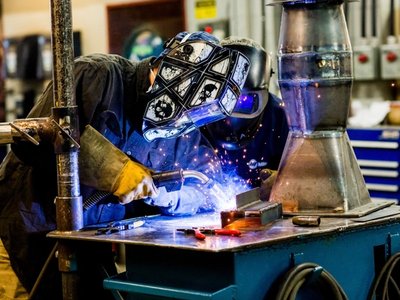
Students are introduced to safe soldering methods and welding procedures. Oxyacetylene, manual arc welding and electrode selections are covered. Types and applications of structural steels, pipes, tubing, weld layouts, and fastening techniques used in flat and horizontal welding for both manual arc welding and gas metal arc welding are discussed and practiced.

CS 050

College Writing

42 hours

In this course, students will be introduced to academic writing styles with a thematic focus on current issues. This course will help students to express themselves clearly and correctly in written form. Students will critically analyse assigned readings and express their thoughts. The course will also focus on the development of an academic paper utilizing the APA style of documentation.

MC 165

Microsoft Office

28 hours

In this course, engineering technology students will be introduced to Microsoft Excel and Microsoft Word. Students will develop skills in creating polished, professional documents, format data, process numbers with formulas, or present data to find patterns of any other information that can be laid out in a grid. The course also familiarizes students with the college's data systems, including email, Blackboard, and the Local Area Network (LAN), using Windows 11 as the operating environment.

MA 170

Technology Math I

56 hours

In this introductory course, students will gain proficiency in fundamental mathematical concepts and apply problem-solving skills required in technology programs. Course content includes fractions review, algebra fundamentals, unit conversions, algebraic operations & equations, proportion & variation, factoring, algebraic fractions, functions & graphs, systems of linear equations, geometry, trigonometry, and vectors.

MX 132

Machine Shop 1 - Theory

14 hours

This course is designed to supply theory and background to the Machine Shop 1 practical course. Students will learn trade calculations, theory, safety, and operation. Using measuring tools, layout tools, drill press’, bandsaws, and metal lathes will be covered.

MX 133

Machine Shop 1 - Practical

42 hours

In this course machine shop safety and procedures will be applied. Students will learn to take precise measurements with the appropriate equipment, apply trade calculations, use layout tools and techniques while learning the use of the drill press, bandsaws, and lathe.

MX 110

Applied Physics I

28 hours

This course is designed to develop an understanding of fundamental concepts and applications in basic mechanics. After successful completion of this course, the student will be able to perform unit conversions and solve problems involving motion, forces, work, and energy. Vectors will be introduced at a conceptual level.

Semester 2

MX 261

Power Transmission I

42 hours

This subject allows the student to understand basic installation blueprints for machinery layout, leveling and coupling alignment. Students will be able to apply mathematical concepts relative to layout methods, identify couplings, shafts and keys, and examine the various types of fasteners, various types of bearings, lubrication and seals.

MX 271

Industrial Design I

42 hours

The goal of this course is to teach students how to use CAD, specifically SolidWorks to build parametric models of parts and assemblies. Production drawings and drawing standards will be introduced.

MX 241

Welding Practices II

42 hours

The student is introduced to safe welding procedures in manual arc welding methods, application and selection of electrodes for position welding, identification of ferrous and non-ferrous metals, steel numbering system, types and uses of sheet and structural steels, uses of various fastening methods used in steel and sheet metal fabrication, techniques in vertical position. Students will also be introduced to gas metal arc welding procedures in a fabrication set-up.

MX 210

Applied Physics II

28 hours

This course is a continuation of MX110 and is designed to develop a further understanding of concepts and applications in basic mechanics. After successful completion of this course, the student will be able to solve problems involving vectors using right-angle trigonometry, momentum, concurrent and parallel forces, torque, rotational motion, and simple machines.

MX 251

Introduction to Electricity

42 hours

This course is designed to introduce and develop basic knowledge of Electrical Theory and safe practices. It presents an overview of electrical instruments, devices, principles, operation, theory, and controls used in industry.

MX 232

Machine Shop 2 - Theory

14 hours

This course is designed to supply theory and background to the Machine Shop 2 practical course. Students will learn threading, milling, dividing and indexing, and grinding theory. They will gain materials knowledge, calibrations, and an introduction to sampling and quality assurance.

MX 233

Machine Shop 2 - Practical

42 hours

In this course machine shop safety and procedures will be applied. Students will learn to cut threads, how to use the milling machine, dividing and indexing, and grinding.

MA 270

Technology Math II

56 hours

In this course, students will continue to review and sharpen their proficiency in mathematical concepts and problem-solving skills necessary in technology programs. Course content includes radian applications, complex numbers, sine & cosine graphs, trigonometric identities & equations, factoring & algebraic fractions, quadratic equations, exponents, operations & equations with radicals, systems of equations, and logarithms.

SY 066

Sociology of Community: The Indigenous Context

42 hours

This course will provide students with an introduction to the history of colonization of Indigenous communities in Canada. Contemporary Indigenous community issues within Northwestern Ontario (NWO) and Canada will be examined. Students will explore the unique socio-political relationships between Canada and Indigenous peoples with an emphasis on colonial, legal and political issues. With a broader understanding of the context of colonization, students will analyze contemporary relationships and efforts towards renewed relationships and reconciliation.

Learning Outcomes

The graduate has reliably demonstrated the ability to:

  1. Complete all work in compliance with current legislation, standards, regulations and guidelines.
  2. Contribute to the application of quality control and quality assurance procedures to meet organizational standards and requirements.
  3. Comply with current health and safety legislation, as well as organizational practices and procedures.
  4. Support sustainability best practices in workplaces.
  5. Use current and emerging technologies to support the implementation of manufacturing projects.
  6. Troubleshoot and solve mechanical problems by applying mathematics and fundamentals of mechanics.
  7. Contribute to the interpretation and preparation of mechanical drawings and other related technical documents.
  8. Perform routine technical measurements accurately using appropriate instruments and equipment.
  9. Assist in manufacturing, assembling, maintaining and repairing mechanical components according to required specifications.
  10. Select, use and maintain machinery, tools and equipment for the installation, manufacturing and repair of basic mechanical components.

Meet the Program Staff

3 staff members

Careers

Graduates of the Mechanical Techniques program embark on entry-level positions in various trades, including:

  • Industrial Mechanic (Millwright)
  • Machinist
  • Pipe Fitting
  • Plumbing
See Career Opportunities

Clicking the button will take you to a detailed dashboard with up-to-date job data tailored to your program, including salary ranges, job titles, and projected demand.

Pathways

Confederation College offers a variety of articulation agreements designed to help you advance your education and career. Whether you're coming to us from another institution or planning your next steps after completing your program, our pathways make your transition seamless and effective.

Students at Confederation College

We're here to help

Have questions before you apply?

Not sure if this is the right fit? Our recruitment team can help you navigate admission requirements, program details, and campus life.