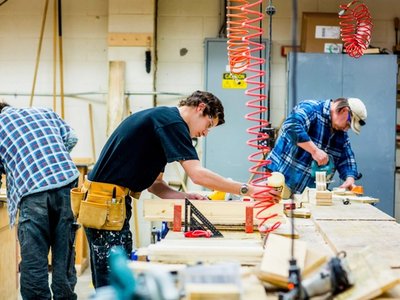
In the General Carpenter Apprenticeship program, you will learn how to construct and finish building projects through hands-on training in framing, formwork, and finishing techniques.
The General Carpenter Apprenticeship Program (trade code 403A General Carpenter) at Confederation College, a leading carpenter school in Ontario, offers a comprehensive carpentry apprenticeship. This program is designed for individuals aiming to excel as carpenter apprentices, providing essential skills in the following 5 areas:
Exterior Finishing
Formwork and Foundations
Framing
Finishing
Interior Finishing
The curriculum integrates practical experience with theoretical knowledge, ensuring apprentices are well-equipped for the carpentry trade. This carpentry training program emphasizes safety, environmental protection, and hands-on learning, making it an ideal choice for those pursuing a career in this dynamic field.
Top Highlights
Competency Analysis Profile: This is the foundation of the program, ensuring that all necessary competencies are covered.
Skill Sets: Apprentices will learn and master a range of skills:
Protect Self and Others
Operate Tools and Equipment
Establish Building Procedures
Prepare Site for Building
Execute Form Work
Frame Floors and Walls
Frame Roofs and Ceilings
Construct Heavy Framing
Build Stairs
Install Doors, Frames, and Hardware
Install Windows
Install Exterior Finishing Materials
Install Finished Materials to Walls and Ceilings
Install Interior Finishing Materials and Hardware
Perform Landscape and Site Work
Perform Renovations
Erect and Dismantle Scaffolds
Cut and Weld Mild Steel
Protect the Environment
Roles and Responsibilities: Clear guidance on the roles and responsibilities of the apprentice, sponsor/employer, and supervisor/trainer.
Important Directions: Detailed instructions for both apprentices and those responsible for their training.
Skill Set Completion Form: Used to track and verify the apprentice's competency in various skill sets.
Ideal Candidate Profile
This program is ideal for individuals seeking a comprehensive apprenticeship in carpentry, providing them with the skills and knowledge needed to succeed in various construction and carpentry roles
Be at least 18 years of age (16 years of age in limited cases)
Have legal permission to work in Canada (i.e., have a valid social insurance number)
Meet the educational requirements of the trade. Grade 12 or equivalent is the generally accepted standard, however, grade 10 or equivalent may be accepted by some sponsors.
Have a sponsor located in Ontario. This can be a private employer, association or union.
Apply for an apprenticeship through Skilled Trades Ontario(opens in new window). This step is usually completed when you have received an offer of employment from a sponsor.
After completing the apprenticeship application, a Registered Training Agreement will be drafted by the Ministry of Labour, Immigration, Training and Skills Development (MLITSD). The apprentice and their sponsor will both sign this document, officially recognizing the apprentice to begin the training process through their employer.
Admission Requirements for International Students
This program is not currently available for international students. To enroll in an apprenticeship program, international students must meet specific criteria, including possessing a valid Social Insurance Number (SIN) and securing a sponsor.
Prerequisites
People who want to become apprentices must apply directly to employers, unions or joint apprenticeship training committees for the trade they are interested in. Most trades require between two and five years of work and training to become certified. During that time apprentices will be notified of offers to attend in-class training at the closest available training facility.
Apprentices are permitted to attend other training facilities within Ontario if they choose by making arrangements with their local Ministry office in advance
Tuition & Fees
Offering practical carpentry skills, the Level 1 fee for this program is $400.00.
Note
Be aware that fees may change, and it is recommended to verify the latest fees before enrolling.
Note
Please note that fees are estimated and are subject to change.
Fees shown on this page are for full-time students attending the main Thunder Bay campus for Fall 2026.
Costing for Regional Campuses & Distance Education Students:
If this program is available at Regional Campuses, or to Distance Education students, see the following links for costing information.
The graduate has reliably demonstrated the ability to:
The aim of the program is to equip apprentices with the skills, knowledge, and competencies required to excel in the carpentry profession. With a strong focus on practical skills, safety, and environmental protection, the program prepares individuals for the diverse demands of the carpentry trade.
Graduates of the General Carpenter Apprentice program at Confederation College have a world of opportunities awaiting them. The program equips apprentices with the essential skills and knowledge to thrive in various sectors of the construction industry.
Diverse Career Paths
Residential Construction: Opportunities range from building and renovating homes to working on interior and exterior finishes.
Commercial Construction: Skilled carpenters are in demand for constructing office buildings, shopping centers, and other commercial projects.
Industrial Construction: Engage in large-scale construction projects, including factories and industrial facilities.
Specialty Trades: Specialize in areas such as framework, roofing, or finishing work.
Self-Employment: Many carpenters leverage their skills to start their own businesses, offering a range of carpentry services.
Competitive Job Market
High Demand: Carpenters are consistently in high demand due to ongoing construction projects and the need for skilled labor in both urban and rural areas.
Advancement Opportunities: Apprentices can advance to supervisory roles, project management, or even business ownership.
Continuous Learning: The field of carpentry allows for continuous skill enhancement and specialization in various sub-trades.
Supportive Career Development
Confederation College provides support and resources for apprentices, helping them to connect with potential employers and navigate the job market.
Networking opportunities with industry professionals and alumni.
Join the Community of Skilled Carpenters
Start your journey with the General Carpenter Apprentice program and become a part of a skilled, dynamic, and essential workforce that shapes our built environment. Your skills will not only build structures but also contribute to the development of communities and industries.
Clicking the button will take you to a detailed dashboard with up-to-date job data tailored to your program, including salary ranges, job titles, and projected demand.
Pathways
Confederation College offers a variety of articulation agreements designed to help you advance your education and career. Whether you're coming to us from another institution or planning your next steps after completing your program, our pathways make your transition seamless and effective.
Student Accessibility and Essential Program Requirements
Confederation College is committed to providing an accessible and inclusive learning environment and will provide reasonable accommodations to students with disabilities in accordance with the Ontario Human Rights Code, the Accessibility for Ontarians with Disabilities Act (AODA), and College policy.
Students who require accommodations are encouraged to engage with Student Accessibility Services and are responsible for initiating and participating in the accommodation process. Accommodation is a collaborative process involving the student, Student Accessibility Services, faculty, and the Academic School. Requests for accommodation are considered on an individual basis, and the College will work with students to identify reasonable accommodations that provide equitable access to learning while maintaining the integrity of the program.
Students are expected to demonstrate the essential knowledge, skills, professional behaviours, learning outcomes, and competencies required to successfully complete their program. While the manner in which these requirements are demonstrated may be accommodated where appropriate, the essential requirements themselves must still be achieved.
For programs involving laboratories, field work, clinical placements, aviation environments, trades training, equipment operation, simulations, community placements, or other environments where health and safety are critical, accommodations must also be consistent with applicable legislation, professional standards, licensing requirements, accreditation standards, and workplace safety obligations.
In some circumstances, a requested accommodation may not be reasonable or possible where it would:
Fundamentally alter an essential program requirement, competency, or learning outcome.
Compromise the health or safety of the student or others.
Conflict with provincial or federal legislation.
Conflict with the requirements of an external regulatory, licensing, accreditation, or professional body.
Prevent the student from demonstrating competencies required for safe and effective professional practice.
Note
Where a particular accommodation cannot be provided, the College will work collaboratively with the student to identify whether an alternative accommodation can appropriately address the student’s disability-related needs while maintaining essential program requirements.
We use cookies to analyze site traffic and measure how our advertising performs. By accepting, you consent to the use of analytics and advertising cookies. See our privacy policy.