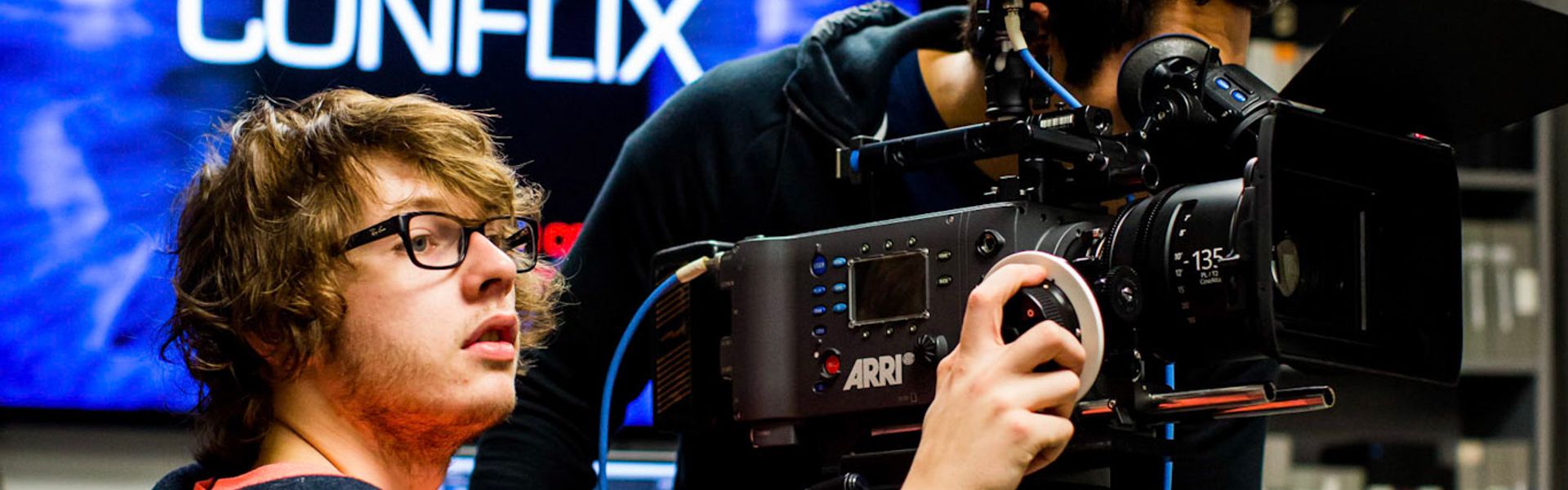
Student adjusts a professional video camera on a tripod in a studio with a “CONFLIX” screen in the background.

Ontario College Diploma

Film Production

In the Film Production program, you will learn how to direct and complete professional-quality films through hands-on projects using industry-standard cameras, editing suites, and studio spaces.

CIP Code: 50.0602

Program Start Options

IntakeDurationFormatCampusDomesticInternational
0116
Fall
2 years
4 semesters
Full-Time
In-Person
Thunder Bay
Domestic students accepted
International students accepted

What do Avengers End Game, Dune, Bullet Train, and Star Trek all have in common? Grads of the Confederation College Film Production program (Conflix) worked on these productions. You could join this impressive list!

Confederation College's two-year diploma program in film production offers a comprehensive film school that covers virtually every aspect of filmmaking. From directing and screenwriting to cinematography and editing, our program provides a solid foundation in film theory and practical skills. Conflix is a leader in North America for training the next generation of film graduates.

With a high teacher-to-student ratio and the latest equipment, you receive more instruction from industry-experienced faculty and better access to gear than many film schools in Canada. Our experiential learning approach ensures you'll learn by doing: write, plan, direct, shoot, edit, mix, colour grade, and deliver your final cut. You'll create up to four student films during the program, starting immediately in your first year. You will have 24/7 access to state-of-the-art facilities and equipment such as the industry-heralded Arri Alexa and Arri Amira cameras, professional editing labs, a soundstage, and a green screen stage for virtual production techniques.

Find your people. Create your vision. Make a difference.

Top Highlights

  • Every student gets to direct their films with a full crew, making our program an excellent film directing school.
  • The program supplies all the film equipment, so students do not need to rent any gear to make their films.
  • Access to state-of-the-art production facilities 24/7, including editing labs and sets.
  • Year-end film festival allows students to showcase their work on the big screen in our Dibaajimogamig theatre space, featuring a 4K screen and surround sound, so the community has a chance to see your film and provide valuable experience for film festivals and screenings.
  • Fourth-semester students travel to Toronto to learn more about the film business and meet past grads, experiencing the world of film production university.
  • Find out more & see student film projects at conflix.com(opens in new window).

Ideal Candidate Profile

  • Passionate about movies, storytelling, music and the arts.
  • Willing to work hard to see their name in the credits of an Oscar-winning film, dynamic and exciting music videos, award-winning documentaries, and engaging social storytelling.
  • A keen interest in directing, screenwriting, cinematography, or sound.
  • Eager to learn hands-on in a collaborative environment with other aspiring artists.
  • Creative, detail-oriented, and a strong desire to work in the film industry, whether in Hollywood or independent film production.

Check out Conflix: The Podcast, available on all major streaming services.

Conflix Logo

Contact Information

Program Files

Get detailed information about program requirements, courses, and student resources.

Admission Requirements

Fall

Fall (0116)

Admission Requirements for Domestic Students

  1. Ontario Secondary School Diploma (or equivalent) with courses from the College (C), University (U), University/College (U/C), or Open (O) preparation levels with Grade 12 English (C/U) Level.
  2. or successful completion of the Mature Student Assessment.
  3. or successful completion of the Canadian Adult Education Credential (CAEC) or General Education Development Test (GED), prior to May 2024.
  4. or appropriate credits from the Academic and Career Entrance program (ACE)

Admission Requirements for International Students

  1. A high school/senior secondary diploma
    Original transcripts as well as a notarized, translated copy must be provided where applicable
  2. English Proficiency
    Academic IELTS: overall 6.0, with no bands lower than 5.5.
    Click here for more information

Student Accessibility and Essential Program Requirements

Confederation College is committed to providing an accessible and inclusive learning environment and will provide reasonable accommodations to students with disabilities in accordance with the Ontario Human Rights Code, the Accessibility for Ontarians with Disabilities Act (AODA), and College policy.

Students who require accommodations are encouraged to engage with Student Accessibility Services and are responsible for initiating and participating in the accommodation process. Accommodation is a collaborative process involving the student, Student Accessibility Services, faculty, and the Academic School. Requests for accommodation are considered on an individual basis, and the College will work with students to identify reasonable accommodations that provide equitable access to learning while maintaining the integrity of the program.

Students are expected to demonstrate the essential knowledge, skills, professional behaviours, learning outcomes, and competencies required to successfully complete their program. While the manner in which these requirements are demonstrated may be accommodated where appropriate, the essential requirements themselves must still be achieved.

For programs involving laboratories, field work, clinical placements, aviation environments, trades training, equipment operation, simulations, community placements, or other environments where health and safety are critical, accommodations must also be consistent with applicable legislation, professional standards, licensing requirements, accreditation standards, and workplace safety obligations.

In some circumstances, a requested accommodation may not be reasonable or possible where it would:

  • Fundamentally alter an essential program requirement, competency, or learning outcome.
  • Compromise the health or safety of the student or others.
  • Conflict with provincial or federal legislation.
  • Conflict with the requirements of an external regulatory, licensing, accreditation, or professional body.
  • Prevent the student from demonstrating competencies required for safe and effective professional practice.
Note

Where a particular accommodation cannot be provided, the College will work collaboratively with the student to identify whether an alternative accommodation can appropriately address the student’s disability-related needs while maintaining essential program requirements.

Tuition & Fees

Fees for Domestic StudentsProgram Code: 0116

Year 1
Total: $6,807.00
Fee Breakdown
Academic Fees
Total Tuition Fees:$3,782.00
Tuition Related Fees:$1,200.00
College Service Fee:$863.00
Health Fee:$305.00
Bus Fee:$332.00
$6,482.00
Program Fees
College Supplies:$75.00
Books & Supplies:$250.00
$325.00
Year 2
Total: $6,997.00
Fee Breakdown
Academic Fees
Total Tuition Fees:$3,782.00
Tuition Related Fees:$1,200.00
College Service Fee:$853.00
Health Fee:$305.00
Bus Fee:$332.00
$6,472.00
Program Fees
Field Trip Fee:$400.00
College Supplies:$75.00
Books & Supplies:$50.00
$525.00

Fees for International StudentsProgram Code: 0116

Year 1
Total: $21,779.25
Fee Breakdown
Academic Fees
Total Tuition Fees:$17,282.00
Tuition Related Fees:$1,200.00
College Service Fee:$863.00
Health Fee:$652.25
Bus Fee:$332.00
$20,329.25
Program Fees
College Supplies:$75.00
Books & Supplies:$250.00
$325.00
Ancillary Fees
Municipal Levy:$75.00
Student Fees:$300.00
Recovery Fee:$750.00
$1,125.00
Year 2
Total: $21,969.25
Fee Breakdown
Academic Fees
Total Tuition Fees:$17,282.00
Tuition Related Fees:$1,200.00
College Service Fee:$853.00
Health Fee:$652.25
Bus Fee:$332.00
$20,319.25
Program Fees
Field Trip Fee:$400.00
College Supplies:$75.00
Books & Supplies:$50.00
$525.00
Ancillary Fees
Municipal Levy:$75.00
Student Fees:$300.00
Recovery Fee:$750.00
$1,125.00
Note

Please note that fees are estimated and are subject to change.

Fees shown on this page are for full-time students attending the main Thunder Bay campus for Fall 2026.

Costing for Regional Campuses & Distance Education Students:

If this program is available at Regional Campuses, or to Distance Education students, see the following links for costing information.

Courses

1 intake

Fall0116

Semester 1

FP 161

Filmmaking I: Shooting the 1st Film

42 hours

In this course, students will get the basic knowledge they need to shoot their first film. Students will learn about light, optics, composition and the science behind the moving image using both classic and modern films as examples. In addition, time and space, the psychology of film and storytelling techniques and methods are covered. Film conventions and film style with reference to modern filmmakers are also explored. Film making culture, vocabulary and tradition are emphasized as a foundation of film theory.

FP 162

Cameras and Lighting

42 hours

In FP 162, students will work in groups and as individuals as they take a hands-on approach to develop shooting and lighting strategies for their first dramatic, silent film project. Students will learn the correct and safe handling of basic movie equipment which includes; cameras, lenses, camera supports, light fixtures, lighting bulbs, light stands, light controlling instruments, dollies, dolly tracks, electrical cords, camera and lighting filters, light meters, and various other miscellaneous items.

FP 163

Producing and Directing I

42 hours

In this course, students will learn how to produce and direct movies by making their very own film right away. Together with the faculty/producer, students will prepare for their first productions by pitching an idea, planning for the shoot and building a small crew. Storyboards, script breakdown, hiring procedures, location scouting, permits and budgets are all covered. Students will also become engaged in all stages of production, including basic directing techniques and using professional protocols and methods.

FP 164

Intro to Post Production

42 hours

Editing is directing a film for the second time. Students will learn how to manipulate time and space by editing their own films plus professionally shot footage. Not only are students in this course introduced to the broad concepts of classical editing techniques and methods, they will get the hands-on experience necessary to understand the tools and technical aspects of editing. The artistic and creative realm of editing is also explored and developed.

FP 165

Photography

42 hours

Basic compositional concepts, lenses and manipulation of the image with computers are introduced. Students will use digital cameras and the Photoshop platform to complete assignments and explore visual design.

HU 119

The History of Movies

42 hours

Movies have been with us for over a century and each subsequent generation of filmmakers has left their mark on the style, form and structure of film. There is much we can learn from old films. In The History of Movies, students will explore great films that still resonate with us today. In this course, students will discuss the importance of movies and how films reflect, and even influence, the popular culture and history of the era they are created. Students will explore the timeframe from when the first moving image was invented to the blockbusters of the modern era.

CS 050

College Writing

42 hours

In this course, students will be introduced to academic writing styles with a thematic focus on current issues. This course will help students to express themselves clearly and correctly in written form. Students will critically analyse assigned readings and express their thoughts. The course will also focus on the development of an academic paper utilizing the APA style of documentation.

Semester 2

FP 261

Filmmaking II: Shooting the 2nd Film

42 hours

In this course, students prepare to shoot their second film. Scenes and sequences are developed for a more sophisticated shooting and editing experience. Sound, as an additional and vital storytelling element, is introduced. Theories of sound, recording and microphones, along with more varied shooting strategies are explored.

FP 262

Cinematography and Sound

42 hours

In FP 262 – Cinematography and Sound, students will learn how to use a variety of more sophisticated movie equipment, such as higher end movie cameras, location sound recorders, various types of microphones and more advanced production equipment. In this primarily hands-on course, movie equipment is used and demonstrated in classes and workshops and then used by the students to make their Thesis film. Students must manage a larger crew and take on numerous other crew positions.

FP 263

Producing and Directing II

42 hours

Students, together with their faculty/producer, will prepare film productions with a greater emphasis on production planning. Students will learn to utilize aspects such as storyboards, location scouting and using props and wardrobe for this longer narrative film. The end product involves the construction of a film through all stages of production using professional protocols and methods.

FP 264

Film and Sound Editing

42 hours

Students will employ more advanced editing techniques to the films they have shot. Sound editing and mixing is introduced. Balance and rhythm will be covered and used by students to tell their stories. Music and sound effects, as tools for dynamic and emotional emphasis, are also introduced.

FP 267

Scriptwriting I

42 hours

In this course, students will learn the basics of script writing and classical storytelling by writing their own scripts, which they will actually shoot as short films. Story concepts, character development, plot and story progression are all explored. Students will write log lines, treatments, character sketches and screenplays utilizing industry standard formatting.

FP 268

Acting and Casting

42 hours

A bad performance and poor casting can ruin the most carefully composed and executed film, so a rudimentary understanding of the director's journey is required and fundamental to the success of any film project. This includes, understanding the needs of the actor and the techniques available when directing the actor. Also, many careers in film production that are not directing careers will nonetheless involve working with actors in some capacity.

FP 270

Art Direction and Production Design

42 hours

Art Direction and Production Design will introduce students to the basics of these two distinct, yet complimentary professions. Locations, storyboards, props, set dressing and construction will all be studied from the perspective of the filmmaker. A historical appreciation of the craft will also be explored. Upon completion, students will be able to demonstrate a working knowledge of all facets of production design.

FP 369

Film Business

42 hours

Students will be introduced to various budgeting and scheduling models that are an integral part of the film production process and industry. Students will learn techniques for estimating and constructing budgets, as well as for developing realistic schedules. The business side of film production will be introduced, with an emphasis placed on set etiquette, contracts, movie marketing, legal terms and the complex world of financing.

Semester 3

FP 361

Filmmaking III: Shooting the Thesis Film

42 hours

This course centers on the shooting of the third film. Our advanced production theory course continues to develop the film maker's individual point of view. Schedules, budgets, locations and planning protocols are all combined to develop a broader technical understanding of the film production process. Ideas that unify a film - visual design, sound design and the use of the motif along with compound shots are also developed.

FP 362

Cinematography & Grip Equipment

42 hours

Advanced production supports further development of the film maker's skills. This includes learning more about radio microphones, digital sound recorders, the professional Arri Alexa and Amira, plus smaller specialized lighting instruments and complex gaffer equipment.

FP 363

Producing and Directing III

42 hours

Students are introduced to larger crews with more attention to planning, continuity, performances and effective use of locations for the production of a more advanced thesis film. Industry standard documentation is utilized as part of the standard professional film production protocol.

FP 364

Advanced Editing & Digital Special Effects

42 hours

Shot selection, timing and arrangement are all skills required for good editing. These skills will be explored utilizing action sequences and dialogue sequences in this project-based course. Shooting for editing as a concept will also be explored as well as the entire post production workflow from start to finish. Keying, compositing, tracking and matchmoving and other digital special effects techniques are all introduced and developed for the second year thesis film.

FP 367

Scriptwriting II

42 hours

This course reinforces but also expands on the basics from FP 267. Thinking skills used to generate ideas for a film are explored. Pitching a story idea is introduced and finding ways to incorporate symbolism and visual metaphors to develop a motif are developed. Where stories originate will be explored through an examination of myths and legends from a variety of traditions. Feature films will be used to deconstruct and learn the three act structure and the structure of films in general.

FP 370

Advanced Production Design

42 hours

Advanced Production Design will allow students to gain hands-on experience with many of the elements of this diverse trade. Students will develop a full understanding of a films on-screen elements such as props, set design, wardrobe, make-up, and physical special effects, as well as visual motifs and style. The student will also have an opportunity to apply this understanding in the creating of a film.

FP 266

Introduction to Documentary Filmmaking

42 hours

Students will learn about the basic techniques and aesthetics behind the design and production of documentary, commercial and industrial films. The use of camera, lighting and sound in the interview will be stressed. Students will demonstrate proficiency with technical equipment and employ these skills on two short non-fiction productions. Different types of documentary films will be analyzed in class and critical writing skills developed.

42 hours

Semester 4

FP 461

Production Theory IV

42 hours

Students in the final semester of the Film Production Program will continue to produce their thesis film projects and act in several crew capacities with their classmates. In addition, students will explore and develop a wider experience with music, as it relates to scoring films. The students will also host ‘Film Night’ in April, including fundraising, promotion, box office and advertising components.

FP 463

Producing and Directing IV

42 hours

Through regular production meetings and set visits, students gain relevant experience completing their advanced thesis film from pre-production to mastering up to cinema standards. A class trip to a major production centre is planned and the information gathered helps guide students closer to their career goals.

FP 464

Sound Design & Audio Mixing

42 hours

Dialogue editing, additional dialogue recording (ADR), foley, sound recording, mixing and mastering are all explored in this course. The selection, creation and proper use of music and sound effects is also thoroughly examined and integrated with a hands-on approach. Software includes ProTools and Logic Pro X, but traditional mixing boards, microphones and the techniques are also explored. The physics of sound, plus audio compression, audio effects and all the technical aspects of audio are woven together with the art of sound design to complement the filmmaker's vision with dynamic sound for maximum impact.

FP 469

Freelancing

42 hours

Students will prepare themselves to compete in a 'freelance' or 'contract' world after graduation. As such, issues of funding sources, taxes, networking, mentoring and proposal writing are key aspects of building a career. Students must also understand traditional job seeking skills such as interviewing and resumes.

FP 468

Colour Correction and Grading

42 hours

Students will be individually supervised and instructed on how to use Davinci Resolve to colour grade their films from start to finish. Not only will students work on their very own films, they will gain industry-level experiences using many examples from many sources. Using multiple tools such as, curves, colour wheels, power windows, qualifiers, nodes, and scopes, students will learn to create Hollywood grade results. While colour grading is mainly practical in its application, the artistic side will also be explored by creatively using and developing various looks and exploring different LUT’s. In addition to the hands on approach to colour using software, the intellectual and emotional aspects of colour and colour psychology will be explored and implemented into various projects.

42 hours

Learning Outcomes

The graduate has reliably demonstrated the ability to:

  1. Employ a Fine Arts perspective in the creation of film.
  2. Participate as a craftsperson on film and video productions.
  3. Construct a project through all stages of pre-production, production, postproduction and distribution using professional film and video production protocols and methods.
  4. Apply technical skills in cinematography, photography, production, sound recording and postproduction.
  5. Perform all work in compliance with film industry operating procedures, regulations and safety requirements.
  6. Use current and emerging technologies in the creation of film production projects.
  7. Apply basic business principles to film production practices.
  8. Work co-operatively in film and video productions.
  9. Apply universal themes, conflict, character, and story ideas to produce a screenplay.

Meet the Program Staff

3 staff members

Careers

Graduates of our filmmaking degree program go on to a variety of positions, including:

  • Production Assistant
  • Editing Assistant
  • Camera Assistant
  • Sound Assistant
  • Director
  • Writer
  • Editor
  • Director of Cinematography
  • Sound Designer
  • Art Director
  • Producer
  • Grip

Many of our graduates are freelance (self-employed) and/or establish their own production companies, with some even making their mark in Hollywood. This showcases the success of our filmmaking college's alumni.

See Career Opportunities

Clicking the button will take you to a detailed dashboard with up-to-date job data tailored to your program, including salary ranges, job titles, and projected demand.

Pathways

Confederation College offers a variety of articulation agreements designed to help you advance your education and career. Whether you're coming to us from another institution or planning your next steps after completing your program, our pathways make your transition seamless and effective.

Pathway Out — Credits recognized by another institution

University of New Brunswick — Bachelor of Applied Management (BAM)

Graduates from eligible 2-year or 3-year diploma programs at Confederation College can apply to enter the third year of the Bachelor of Applied Management at the University of New Brunswick, with a minimum 70% program average. Additional courses may be required.

Minimum Admission Average
70% overall program average
Entry Point
Year 3 of a 4-year degree

Institution: University of New Brunswick, Saint John, NB

Agreement Type: Memorandum of Understanding

Graduates of eligible diploma programs at Confederation College may be considered for advanced standing in the Bachelor of Applied Management (BAM).

Eligibility Requirements:

  • Completion of a 2-year (four-semester) or 3-year (six-semester) diploma program
  • Minimum overall program average of 70%

Transfer Details:

  • Eligible students may enter Year 3 of the 4-year BAM program
  • Additional courses may be required depending on the applicant’s academic background

Program Notes:

  • Eligible Confederation College programs are outlined in Appendix A of the Memorandum of Understanding
  • Students should consult the contact person for full details and program-specific requirements

Contacts

Students at Confederation College

We're here to help

Have questions before you apply?

Not sure if this is the right fit? Our recruitment team can help you navigate admission requirements, program details, and campus life.