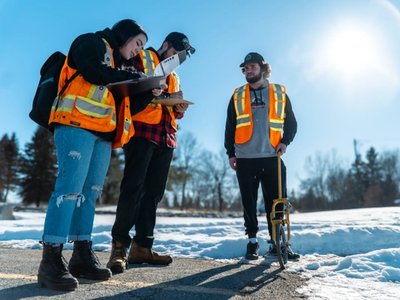
Student taking ground measurements with a tape measure during fieldwork

Ontario College Advanced Diploma

Civil Engineering Technology

This three-year program prepares students to work as civil engineering technologists contributing to community infrastructure and development. Graduates gain expertise in designing, constructing, and managing essential systems including water infrastructure, transportation networks, and buildings using modern industry technologies like CAD, BIM, and GIS.Retry

CIP Code: 15.0201

Program Start Options

IntakeDurationFormatCampusDomesticInternational
0321
Fall
3 years
6 semesters
Full-Time
In-Person
Thunder Bay
Domestic students accepted
International students accepted

Help Build Tomorrow’s Cities!

A Civil Engineering Technologist plays a key role in the health, safety, and economic well-being of our communities. As a graduate of our three-year program (one additional year after graduating from our Civil Engineering Technician program), you will gain advanced knowledge in the design, construction, and operation of water, storm, and sanitary systems, roads, railways, bridges, and buildings. At Confederation College, our small class sizes mean you will get great practical hands-on experience with current technology used in the industry today, including Computer-Aided-Drafting (CAD), Building Information Modelling (BIM), Geographic Information Systems (GIS), and Surveying.

If you have good math skills, a logical mind, and the desire to build upon the world around you, the Civil Engineering Technology program will give you the tools you need to succeed.

Top Highlights

  • Up-to-Date Technology: Program is aligned with the latest industry technology.
  • Work Experience: Planned work experience plus optional co-op placements provide field experience.
  • Diverse Career Opportunities: Work in fields like city building, maintenance, mining, roads, highways, rail, and specialty projects worldwide.
  • Further Education: Continue on to a university degree through articulation agreements.
  • Continue on to a university degree through articulation agreements

Ideal Candidate Profile

  • Analytical: Enjoy solving complex problems with logical solutions
  • Detail-Oriented: Capable of managing intricate details in projects
  • Innovative: Eager to apply creative solutions to engineering challenges
  • Team-Oriented: Ready to collaborate with diverse groups
  • Ambitious: Interested in advancing your career in civil engineering

Contact Information

Confederation College offered a supportive, balanced, and challenging education that prepared me to perform at a high level and succeed in the workplace.

CH
Cory Halvorsen
Graduate of 1999 - Manager - Parks and Open Spaces, City of Thunder Bay

Confederation College students and grads are intelligent, driven, and well-prepared to take on real-world challenges. They continue to build a strong foundation for careers in engineering technology.

DO
Doug Otto
Vice president, TBT Engineering Limited

Admission Requirements

Fall

Fall (0321)

Admission Requirements for Domestic Students

1. Entry to First Year

Applicants entering the first year must meet the same admission requirements as the Civil Engineering Technician program.

Domestic Students
  • Ontario Secondary School Diploma (or equivalent) with:
    • Grade 12 English (C or U)
    • Courses from the College (C), University (U), University/College (U/C), or Open (O) levels
  • or successful completion of one of the following:
    • Mature Student Assessment
    • Canadian Adult Education Credential (CAEC) or General Education Development Test (GED), prior to May 2024
    • Academic and Career Entrance (ACE) program
Required Mathematics
  • Grade 11 Mathematics (M or U), or
  • Grade 12 Mathematics (C or U), or
  • Equivalent, or
  • ACE Core Math (UM602)

2. Entry to Third Year (Advanced Standing)

Applicants may be admitted directly into the third year with advanced standing.

Requirement:
  • Successful completion of a two-year Civil Engineering Technician diploma (or equivalent)

Additional transcript review may be required to confirm eligibility.

Admission Requirements for International Students

Entry to First Year

  • High school/senior secondary diploma (or equivalent) with a Grade 12 math credit
  • Original transcripts and notarized English translations (if required)

English Proficiency

  • Academic IELTS: overall 6.0, with no band lower than 5.5, or equivalent

Entry to Third Year (Advanced Standing)

  • Successful completion of a two-year Civil Engineering Technician diploma (or equivalent)
  • Transcripts will be assessed to determine eligibility for advanced standing

Student Accessibility and Essential Program Requirements

Confederation College is committed to providing an accessible and inclusive learning environment and will provide reasonable accommodations to students with disabilities in accordance with the Ontario Human Rights Code, the Accessibility for Ontarians with Disabilities Act (AODA), and College policy.

Students who require accommodations are encouraged to engage with Student Accessibility Services and are responsible for initiating and participating in the accommodation process. Accommodation is a collaborative process involving the student, Student Accessibility Services, faculty, and the Academic School. Requests for accommodation are considered on an individual basis, and the College will work with students to identify reasonable accommodations that provide equitable access to learning while maintaining the integrity of the program.

Students are expected to demonstrate the essential knowledge, skills, professional behaviours, learning outcomes, and competencies required to successfully complete their program. While the manner in which these requirements are demonstrated may be accommodated where appropriate, the essential requirements themselves must still be achieved.

For programs involving laboratories, field work, clinical placements, aviation environments, trades training, equipment operation, simulations, community placements, or other environments where health and safety are critical, accommodations must also be consistent with applicable legislation, professional standards, licensing requirements, accreditation standards, and workplace safety obligations.

In some circumstances, a requested accommodation may not be reasonable or possible where it would:

  • Fundamentally alter an essential program requirement, competency, or learning outcome.
  • Compromise the health or safety of the student or others.
  • Conflict with provincial or federal legislation.
  • Conflict with the requirements of an external regulatory, licensing, accreditation, or professional body.
  • Prevent the student from demonstrating competencies required for safe and effective professional practice.
Note

Where a particular accommodation cannot be provided, the College will work collaboratively with the student to identify whether an alternative accommodation can appropriately address the student’s disability-related needs while maintaining essential program requirements.


Tuition & Fees

Fees for Domestic StudentsProgram Code: 0321

Year 3
Total: $4,860.00
Fee Breakdown
Academic Fees
Total Tuition Fees:$2,740.00
College Service Fee:$853.00
Health Fee:$305.00
Bus Fee:$332.00
$4,230.00
Program Fees
Exam Fees, Certifications, Licenses, Apprentice or Business Registration:$130.00
Books & Supplies:$500.00
$630.00

Fees for International StudentsProgram Code: 0321

Year 3
Total: $19,206.25
Fee Breakdown
Academic Fees
Total Tuition Fees:$15,614.00
College Service Fee:$853.00
Health Fee:$652.25
Bus Fee:$332.00
$17,451.25
Program Fees
Exam Fees, Certifications, Licenses, Apprentice or Business Registration:$130.00
Books & Supplies:$500.00
$630.00
Ancillary Fees
Municipal Levy:$75.00
Student Fees:$300.00
Recovery Fee:$750.00
$1,125.00
Note

Please note that fees are estimated and are subject to change.

Fees shown on this page are for full-time students attending the main Thunder Bay campus for Fall 2026.

Costing for Regional Campuses & Distance Education Students:

If this program is available at Regional Campuses, or to Distance Education students, see the following links for costing information.

Courses

1 intake

Fall0321

Semester 1

CE 125

Construction Materials and Methods

42 hours

A study of materials, methods and safety practices of residential and commercial construction. The student will learn to distinguish and explain approved methods for the installation of materials as they relate to residential and commercial construction.

CE 130

Introductory Surveying

42 hours

This course is designed to introduce the students to the tools, calculations, and methods of surveying as related to civil and environmental engineering. Students will use steel tape, automatic level, laser level, electronic theodolite, and the total station to measure and layout design features.

CE 140

Basic Drafting

42 hours

This course introduces learners to the fundamentals of manual drafting and computer-aided drafting (AutoCAD).  Topics include types of construction drawings, the use of drawing instruments, lettering,  linework, scales, dimensioning, applied geometry, orthographic projection, sectional views, and pictorial drawing.  Learners develop fundamental drafting skills through the preparation and reproduction of construction drawings and apply the same drafting principles, standards, and conventions using introductory AutoCAD software.

CS 050

College Writing

42 hours

In this course, students will be introduced to academic writing styles with a thematic focus on current issues. This course will help students to express themselves clearly and correctly in written form. Students will critically analyse assigned readings and express their thoughts. The course will also focus on the development of an academic paper utilizing the APA style of documentation.

CE 110

Statics I

42 hours

This is the introductory course in structural mechanics. The course begins with a study of systems of units used in the Architectural and Civil Engineering fields. It then moves on to introduce the mathematical techniques needed to analyze forces as vectors. Finally, students will learn how to determine the forces acting on simple structures in static equilibrium.

MA 133

Mathematics I

70 hours

This introductory technical mathematics course provides a review of arithmetic fundamentals and aims to sharpen students' basic mathematical skills. Students will have the opportunity to further develop mathematical problem solving techniques as applied to the different technical areas. After successful completion of this course, the student will be able to solve application problems involving numeracy, measurement and units, basic algebra, geometry, trigonometry and vectors.

MC 165

Microsoft Office

28 hours

In this course, engineering technology students will be introduced to Microsoft Excel and Microsoft Word. Students will develop skills in creating polished, professional documents, format data, process numbers with formulas, or present data to find patterns of any other information that can be laid out in a grid. The course also familiarizes students with the college's data systems, including email, Blackboard, and the Local Area Network (LAN), using Windows 11 as the operating environment.

Semester 2

CS 219

Communications for Technology

42 hours

This course emphasizes the importance of oral and written communication in an industrial and business setting. In Communications for Technology, students will work on independent and group projects and apply problem-solving techniques to develop both their individual and team building skills. Students will apply computer-technology and a variety of resources for researching, writing and presenting technical data into a clear and concise format.

MA 231

Mathematics II

42 hours

This mathematics course continues from where its prerequisite, MA133, ends. Much of the content continues to review further fundamental concepts and skills necessary for a wide range of technology programs. Topics covered include: complex numbers, radian measure, sine and cosine graphs, trigonometric identities and equations, special algebraic products and factoring, algebraic fractions, quadratic equations, exponents, radicals, and exponential and logarithmic functions.

CE 200

Occupational Health & Safety

28 hours

This course is designed to introduce students to the culture and legislative requirements of workplace safety in the construction industry. Students will be introduced to the basic concepts of industrial safety as well as mandatory legislation compliance

CE 240

Construction Drawing with CAD

70 hours

An introduction to the preparation and interpretation of various types of technical drawings. The student will apply basic drafting techniques to develop and interpret working drawings using appropriate drawing standards and conventions. This course introduces the application of AutoCAD to create computer aided drafting (CAD) drawings related to the civil engineering discipline.

CE 230

Advanced Surveying (Field School)

42 hours

This course will introduce the student to the application of the total station; field data capture requirements, interfacing with a computer, and production of a topographical drawing using Auto Desk's Civil 3D software. An introduction to Geographical Information System (GIS) and Global Positioning Systems (GPS) is also presented. This course is offered as a Spring Field School immediately upon the completion of the second semester in order that students may bring these skills to their first summer of employment in the program

CE 210

Statics II

42 hours

In this second course in structural mechanics, students will build on their fundamental skills to solve for reactions and analyze internal forces in simple structures such as trusses and beams. They will then be introduced to the typical forces and factors applied to structures in Limit States Design. The course will wrap up with the study of tributary areas and the transfer of loads through a structure.

Choose one course from this group:

S01

SY 066

Sociology of Community: The Indigenous Context

42 hours

This course will provide students with an introduction to the history of colonization of Indigenous communities in Canada. Contemporary Indigenous community issues within Northwestern Ontario (NWO) and Canada will be examined. Students will explore the unique socio-political relationships between Canada and Indigenous peoples with an emphasis on colonial, legal and political issues. With a broader understanding of the context of colonization, students will analyze contemporary relationships and efforts towards renewed relationships and reconciliation.

LV 109

Indigenous Identity in Relation to Land

42 hours

This course will require students to experience and explore Indigenous cosmology(s), knowledge(s) and world view(s) as it relates to the land. The influence of land on Indigenous worldview(s) will provide a way of understanding contemporary perspectives of identity and self determination. In addition, students will be encouraged to examine and locate their own identity and world view in relation to these concepts.

Semester 3

CE 350

Soil Mechanics I

42 hours

This course is designed as a practical introduction to the study of soil mechanics. The student will gain knowledge of the characteristics of soil deposits and grain-size analysis, phase relationships, soil classification, and flow of water in soils and effective stresses.

CE 310

Strength of Materials

42 hours

This course introduces students to the internal effect of systems of forces acting on rigid bodies and is a prerequisite course for further studies in structural design. It includes demonstration labs investigating the stresses and strains on wood, steel, aluminum and concrete during strength testing.

CE 335

Construction Planning

42 hours

This course covers the theories and principles of estimating and quantity survey techniques. Students will learn how to interpret construction drawings and specifications to perform quantity takeoffs and move through the bidding procedure for a completed tender. The role of software in this process will be explored. The student will also look at planning in terms of bonds, insurance, tracking, job costing, and execution of construction projects.

CE 345

Geomatics

42 hours

This course will reinforce total station and RTK GNSS field data collection and explore related software. Technologies such as aerial or ground LIDAR scanning, drone-based aerial imagery, cloud data analysis, and RTK GNSS integration with sensor measurements like aquatic sonar measurements will be explored.

CE 355

Computer Applications in Civil Engineering

42 hours

The students will receive hands-on experience using AutoCAD's Civil 3D. Students will learn the basics of drawing set up and point management. Sample data will be used to generate topographic surfaces used as the basis of development design. The course will culminate with the use of topographic data to calculate volumes of excavation or stockpiles.

CE 235

Construction Management I

42 hours

In this course, students will learn how a successful construction project is managed and administered from concept, through design and construction, to closeout. The course will cover stakeholders, types of contracts, contract documents, labour relations, negotiations and job site records. Project scheduling, including Gantt charts, critical path method and Microsoft Project will be included

42 hours

Semester 4

CE 401

Work Experience

42 hours

During the work experience, the student will have the opportunity to apply his/her theory and practical skills in a working environment, and be exposed to the standard professional operating practices in the civil engineering discipline.

CE 425

Materials Testing

42 hours

This course helps to prepare students for a position in the field of quality control/assurance by giving hands on experience with testing methods not covered in other courses. The course also reinforces concepts addressed in other core courses that do/did not include the laboratory test methods.

CE 411

Steel Design

42 hours

This introductory course in structural steel design introduces the students to structural steel products, and basic structural steel design in accordance with the requirements of CAN/CSA-S16.1 M 'Limit States Design of Steel Structures'. Topics will include steel and composite beams, columns and tension members.

CE 412

Concrete Design

42 hours

Students will learn the theory of reinforced concrete's behaviour. They will learn to design flexural members including beams, one way slabs and walls. Design is in accordance with CSA CAN3 A23,3M. Students will be introduced to cutting edge technologies in the reinforcement and retrofitting of concrete structures.

CE 320

Hydraulics

42 hours

This course is designed as a practical introduction to the study of fluid mechanics as it applies to Civil Engineering Technology. The student will gain knowledge of the properties of fluids, hydrostatics, buoyancy and relative equilibrium of liquids, and pressure flow. Commercial software will be used to assess and investigate orifices and weirs, pressure flow and pressure piping systems.

CE 515

Highway Construction

42 hours

This course focuses on the topic of the structural design and evaluation of pavements. Attention will be paid to the various materials used to make up the pavement structure. A detailed assessment will be made of the Ontario Provincial Standard (OPS) Specifications and Drawings as used in the preparation of contracts.

EN 015

Professional Practice

28 hours

This course is designed to prepare students to successfully write the Ontario Association of Certified Engineering Technicians and Technologists (OACETT) Professional Practice Examination (PPE), required for certification for engineering technicians and technologists by this professional certifying body. The basics of the association's structure, contract law, ethics, and professional practice will be examined. The student assessment will include practice examinations similar to OACETT's PPE.

42 hours

Semester 5

CE 540

Building Information Modelling

42 hours

Building on previous drafting courses in the program, students will receive hands-on experience using AutoCAD's Revit. Learning to apply intelligent 3D model-based processes to efficiently plan, design, construct, manage and record land development projects and infrastructure.

CE 510

Structural Detailing & Inspection

42 hours

The focus of this course is the design, detailing and inspection of steel and concrete connections. The course will focus on the design of bearing connections for steel and issues of anchorage, bond and development length for concrete. Through these design efforts and consideration of construction tolerances, the student will be prepared for a position involving the inspection of steel and concrete construction.

CE 512

Structural Analysis

42 hours

This course is an extension of course CE210 and CE310. It deals with the analysis of loads, forces and deflections of indeterminate structures. Several classical methods of analysis are studied. The students are then introduced to structural analysis computer programs.

CE 603

Water & Waste Management

42 hours

This course will introduce the student to various techniques used to address environmental concerns. These will include: water treatment, waste water treatment, on-site sewage disposal, groundwater movement and supplies, landfill design and monitoring, and watershed management.

CE 415

Road Design

42 hours

The evolving field of road design evaluates the movement of people and cargo in various capacities. In this course, students will evaluate road alignment, traffic demands and intersection design to meet current demands and future projections. Through the blend of design debriefing, applied activities and current computerized techniques, students will gain knowledge, skills and project experience related to transportation design.

CE 420

Hydrology

42 hours

The student will study the nature of gravity flow in pipes, open channels and culverts using computer techniques. This will be based upon the principles of the hydrological cycle to determine flood/design flows. As part of these studies, students will consider the effects of this flow on erosion and sediment and storm water quantities and quality.

CE 450

Soils Mechanics II

42 hours

This course is designed as a continuation of Soil Mechanics CE350. The student will gain knowledge of methods of determining subsurface stresses, of consolidation theory and testing, of calculating settlement of structures, of shear strength theory and testing, and of pressures and forces on retaining walls.

Semester 6

CE 604

Data Management & Quality Control

42 hours

This course introduces students to the principles and techniques of quality control and quality assurance. It will use the basics of probability and statistics to gain an understanding into the intricacies of data and sampling and the use of control charts. The course will make significant use of spreadsheet software to track, analyze and present quality related data.

CE 650

Foundation Design

42 hours

This course introduces the student to procedures involved in assessing the stability of structures on and in the supporting soil, as well as the stability of soil structures themselves. The student will use the principles of soil mechanics to apply the theoretical-empirical approach to stability analysis.

CE 606

Asset Management & Tech Report

42 hours

This course will introduce the students to the principles of effective management of Civil Engineering Infrastructure. Students will learn the principles of asset assessment, performance modeling, maintenance and rehabilitation. Students will prepare a written report in accordance with OACETT Technology Report Guidelines.

CE 610

Structural Project

42 hours

In this course students will use the knowledge gained in previously taken and concurrent structural design and analysis courses to design and prepare working drawings and shop drawings for a small structure.

CE 501

Geographic Information Systems

42 hours

This course will introduce the student to the use of geographic information systems (GIS) and their use as repositories of data used in Civil Engineering planning and design. Data to be studied will include geological, zoning and planning information as well as satellite imagery and municipal infrastructure.

CE 503

Environmental Sustainability

42 hours

This course focuses on the legal, ethical and moral issues associated with Civil Engineering and its impacts on the environment. A close examination will be made of the environmental assessment process including the socio/economic effects. Students will also review official plan and zoning controls from the perspective of their efforts to protect natural heritage resources.

CE 518

Municipal Design Specs & Contracts

42 hours

In this course the student will be presented with an overview of the following areas of study: legislation relating to municipal engineering, development policies and procedures, storm and sanitary sewer design and water distribution system design. Students will use software to calculate system capacities.

Learning Outcomes

The graduate has reliably demonstrated the ability to:

  1. Develop and use strategies to enhance professional growth and ongoing learning in the civil engineering field.
  2. Comply with workplace health and safety practices and procedures in accordance with current legislation and regulations.
  3. Complete duties and monitor that work is performed in compliance with contractual obligations, applicable laws, standards, bylaws, codes and ethical practices in the civil engineering field.
  4. Promote and carry out sustainable practices in accordance with contract documents, industry standards and environmental legislative requirements.
  5. Facilitate the collaboration and interaction among the project team and project stakeholders to support civil engineering projects.
  6. Collect, process, analyze and coordinate technical data to produce written and graphical project-related documents.
  7. Use industry-specific electronic and digital technologies to support civil engineering projects.
  8. Participate in the design and modeling phase of civil engineering projects by applying engineering concepts, technical mathematics and principles of science to the review, production and/or modification of project plans.
  9. Contribute to the scheduling and coordination and cost estimation of civil engineering projects and monitor their progression by applying principles of construction project management.
  10. Coordinate and perform quality control testing and evaluate equipment, materials and methods used in the implementation and completion of civil engineering projects.
  11. Apply teamwork, leadership, supervision and interpersonal skills when working individually or within multidisciplinary teams to complete civil engineering projects.

Meet the Program Staff

2 staff members

Careers

As a qualified Civil Engineering Technologist, numerous career paths are available, including:

  • Project Planning and Design
  • Testing Soils, Concrete, and Other Construction Materials
  • Cost Estimating
  • Construction Inspection and Supervision
  • Contract Administration
  • Management and Infrastructure Maintenance
  • Restoration and Repair

Graduates find employment with consultants, contractors, and government at municipal, provincial, and federal levels. With experience, advancement to management positions is common. Employment opportunities are available locally, regionally, and globally.

See Career Opportunities

Clicking the button will take you to a detailed dashboard with up-to-date job data tailored to your program, including salary ranges, job titles, and projected demand.

Pathways

Confederation College offers a variety of articulation agreements designed to help you advance your education and career. Whether you're coming to us from another institution or planning your next steps after completing your program, our pathways make your transition seamless and effective.

Graduates of the Civil Engineering Technology program may have the opportunity to continue their studies through a degree pathway with Lakehead University.

Pathway Out — Credits recognized by another institution

University of New Brunswick — Bachelor of Applied Management (BAM)

Graduates from eligible 2-year or 3-year diploma programs at Confederation College can apply to enter the third year of the Bachelor of Applied Management at the University of New Brunswick, with a minimum 70% program average. Additional courses may be required.

Minimum Admission Average
70% overall program average
Entry Point
Year 3 of a 4-year degree

Institution: University of New Brunswick, Saint John, NB

Agreement Type: Memorandum of Understanding

Graduates of eligible diploma programs at Confederation College may be considered for advanced standing in the Bachelor of Applied Management (BAM).

Eligibility Requirements:

  • Completion of a 2-year (four-semester) or 3-year (six-semester) diploma program
  • Minimum overall program average of 70%

Transfer Details:

  • Eligible students may enter Year 3 of the 4-year BAM program
  • Additional courses may be required depending on the applicant’s academic background

Program Notes:

  • Eligible Confederation College programs are outlined in Appendix A of the Memorandum of Understanding
  • Students should consult the contact person for full details and program-specific requirements

Contacts

Students at Confederation College

We're here to help

Have questions before you apply?

Not sure if this is the right fit? Our recruitment team can help you navigate admission requirements, program details, and campus life.