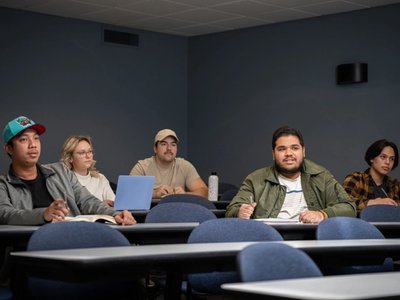
In the Business – Accounting program, you will learn how to record and analyze financial data through hands-on accounting exercises and real-world case studies.
A Future You Can Count On: Building Your Path in Accounting
Do you have strong people skills and a love of logic and reasoning? The Business - Accounting program at Confederation College is designed for students eager to develop the skills and knowledge necessary for an entry-level accounting position. This two-year program begins with a common Business first year, earning you a certificate in Business Fundamentals upon successful completion.
In your second year, you'll gain a solid foundation in accounting, preparing you to either continue your studies or enter the workforce. Graduates also have the option to complete an additional year in the Business Administration - Accounting program for further advancement.
Top Highlights
Prepares you for a career in all areas of business, particularly in the small business enterprise sector
Option to complete an additional year in the Business Administration – Accounting program
Training for positions in both the private and public sectors
Ideal Candidate Profile
Detail-Oriented: Enjoy working with numbers and financial data
Logical: Possess strong analytical and problem-solving skills
Organized: Able to manage multiple tasks and deadlines effectively
Communicative: Capable of conveying financial information clearly
Ambitious: Interested in pursuing further education or career advancement
Bonus Credential Opportunity
Upon successful completion of the first year of this diploma program, you would qualify to also receive a one-year Business Fundamentals certificate.
For more information please contact your Program Coordinator.
Get detailed information about program requirements, courses, and student resources.
Confederation College gave me the tools to succeed from day one. The care and professionalism of the faculty, along with hands-on learning, helped me launch my own bookkeeping business right after graduation.
JG
Justin Gomes
Graduate of 2020 – Bookkeeping Entrepreneur, Self Employed Bookkeeping Business
I wasn’t sure I’d do well in college, but finding something I loved made all the difference. With hard work and support from instructors, I graduated with honours and landed a job before even finishing the program.
BM
Brittany McNee
Graduate of 2013 – Accountant, Sunset Country Travel Association
The following 4 intakes share the same admission requirements:
Fall (0206)Winter (0260)Fall (0206)Winter (0260)
Admission Requirements for Domestic Students
Ontario Secondary School Diploma (or equivalent) with courses from the College (C), University (U), University/College (U/C), or Open (O) preparation levels with Grade 12 English (C/U) Level.
or successful completion of the Mature Student Assessment.
or successful completion of the Canadian Adult Education Credential (CAEC) or General Education Development Test (GED), prior to May 2024.
or appropriate credits from the Academic and Career Entrance program (ACE).
Organizations depend on the effective management of its human resources to achieve optimum results. In this course, you will learn how proper recruitment/selection strategies and training and development methods maintain an organization's competitive advantage. The integral role of job design and analysis in affecting compensation management and performance appraisal decisions will be examined. You will investigate a variety of employment, and health and safety laws as they relate to managing a diverse workforce. In addition, the fundamental principles of the union-management framework will be explored.
In this course, students will be provided an overview of the decisions that face Marketers in today's fast-paced and competitive business environment. Students will become acquainted with current Canadian marketing concepts, terminology and practices, examine strategies to apply them to contemporary marketing situations, and gain an understanding of how they affect an organization's profitability. This is a highly interactive course where students will participate in a variety of hands-on practical activities and projects to immerse themselves in the fundamentals of marketing.
In this course, students will be introduced to academic writing styles with a thematic focus on current issues. This course will help students to express themselves clearly and correctly in written form. Students will critically analyse assigned readings and express their thoughts. The course will also focus on the development of an academic paper utilizing the APA style of documentation.
In this course, students will be introduced to the accounting cycle and the preparation of financial statements. Topics include: preparing journal entries to record transactions and adjustments; preparing worksheets; preparing financial statements; accounting for merchandising activities; and valuing inventory.
In this course, students will be introduced to business in Canada, focusing on introductory topics for those interested in employment in a business management role. Topics of study will include the relationships between the areas of finance, human resources, marketing, and operations within an organization, business ethics and social responsibility, management concepts and practices, and an exploration of the entrepreneurial spirit.
In this course, students will begin with a review of basic arithmetic and algebraic manipulations, continuing with the following topics: ratios and proportions, percentages and the percentage formula, discounts, mark-ups and markdowns, payroll scenarios, break-even analysis and simple interest.
Students will apply accounting principles to select assets and liabilities as well as the capital/equity transactions involving individuals, partnerships, and corporations. In addition, students will learn the purpose and compute common types of financial statement analysis.
In this course, students will discuss small-scale economic phenomena. Students will examine the behaviours of individuals, households, firms, industries, and resource owners. Further, they will review the explanations for such things as prices and output of firms, and the choices of consumers in buying goods and services. Finally, they will examine technological change, costs, competitions and adjustments of markets to new conditions.
In this course, students will enhance their writing skills to produce routine workplace correspondence in a business setting. Students will be exposed to handling instant messaging and texting professionally. They will also prepare different types of informal reports and business documents. Students will combine collaborative methods with advanced research, written and oral skills to produce and present an infographic.
This course builds on the foundation of Introduction to Marketing. Students will continue to examine current Canadian material on marketing and determine strategies for developing new products and services that are consistent with evolving marketing needs and principles of sustainability. Students will apply their knowledge in producing a marketing plan where they will set marketing objectives, develop a marketing mix and select marketing channels while examining the elements of integrated marketing communications and the communication process. Budgetary considerations will be taken into account and evaluation criteria identified. Students will also contribute to the development of pricing strategies and participate in conducting market research to provide information needed to make marketing decisions. The further development of analytical marketing skills will be emphasized through the use of problems and case studies. This is a highly interactive course where students will continue to participate in a variety of hands-on practical activities and projects to immerse themselves in the fundamentals of marketing.
In this course, students will develop their skills and understanding of business mathematics involving interest calculations, compound interest, annuities, loan financing, bonds and investment decision making.
In this course, students will assess the impacts of human behaviour on organizational performance through the study of personal values and perceptions, motivational techniques, effective utilization of teamwork, conflict resolution options, negotiation processes, leadership styles, approaches to decision making, options for organizational structure, and change management. Students will learn to predict potential impacts of human resources policies and practices on employee behaviour as well as recommend management practices to effectively address specific employee behaviours.
In this course, students will have exposure to a comprehensive windows-based financial spreadsheet package to enhance their problem solving abilities. The package used will be Microsoft Excel for Windows. The student will use this as a tool to prepare calculations, reports, and presentations which are commonly performed in the modern office.
In this course, students will acquire a comprehensive overview of topics and concepts in financial accounting at an intermediate level of complexity. They will learn about the accounting standards and conceptual framework for private and publicly accountable enterprises by completing, identifying and applying the proper presentation and disclosure requirements for financial statements under IFRS and ASPE (with a primary focus on ASPE). Students will focus on the asset section of the balance sheet and examine such topics as cash and receivables, inventory, investments, property, plant, and equipment, intangible assets, and goodwill.
In this course, students will be introduced to management accounting, a form of accounting used by managers to plan, control, and make decisions regarding operations. Among others, topics will include analysis of cost behaviour, cost-volume-profit analysis, product costing, budgeting, and relevant costs for decision making.
In this course, students will discuss large-scale economic phenomena. Students will examine the behaviours of individual nations in a global economics context. Further, they will review the explanations for such things as prices and output in aggregate for an entire economy. Finally, they will examine technological change, money and banking, and international trade.
Students will develop the necessary mathematical skills for conducting descriptive and inferential statistical analyses with business applications. Topics will include data description and presentation, probability, probability distributions, sampling distributions, estimation, hypothesis testing, regression and correlation.
In this course, students will: utilize Sage 50 to complete introductory bookkeeping, prepare supporting working papers, and create general purpose financial statements.
In this course, students will learn the core concepts and use of computer-based information systems in management and accounting. The knowledge acquired will allow students to make informed decisions about the application of information technology.
In this course, students will acquire a basic working knowledge of the Canadian income tax system as it applies to individuals. Students will become familiar with theoretical concepts and technical rules in the Income Tax Act and put them to use in practical ways throughout the course including the preparation of personal income tax returns.
In this course, students will continue with intermediate level topics and concepts in financial accounting relating to the financial statement elements that were not examined in the pre-requisite course: AC331. Students will focus on shareholders’ equity, earnings per share, leases, pensions, liabilities, complex financial instruments, income taxes, accounting changes, and other measurement and disclosure issues. The students will be required to identify and apply the proper disclosure requirements for financial statements under IFRS and ASPE (with a primary focus on ASPE). Public Sector Accounting Standards will also be introduced.
This course presents a practical study of Canadian business law. In this course, students will learn the fundamentals of the Canadian legal system and how legal disputes are resolved within it. Students will expand their understanding of key areas in business law, including tort law, contract law, employment law, labour law and property law, and apply their knowledge through a series of legal case studies.
In this course, students will examine the goals and objectives of financial management with an emphasis on decision making. Students will evaluate data to prepare estimates, apply working capital management techniques, evaluate sources of short-term financing, calculate value and rate of return, and calculate the cost of capital.
In this course, students will be introduced to the accounting cycle and the preparation of financial statements. Topics include: preparing journal entries to record transactions and adjustments; preparing worksheets; preparing financial statements; accounting for merchandising activities; and valuing inventory.
In this course, students will be introduced to academic writing styles with a thematic focus on current issues. This course will help students to express themselves clearly and correctly in written form. Students will critically analyse assigned readings and express their thoughts. The course will also focus on the development of an academic paper utilizing the APA style of documentation.
In this course, students will be introduced to business in Canada, focusing on introductory topics for those interested in employment in a business management role. Topics of study will include the relationships between the areas of finance, human resources, marketing, and operations within an organization, business ethics and social responsibility, management concepts and practices, and an exploration of the entrepreneurial spirit.
Organizations depend on the effective management of its human resources to achieve optimum results. In this course, you will learn how proper recruitment/selection strategies and training and development methods maintain an organization's competitive advantage. The integral role of job design and analysis in affecting compensation management and performance appraisal decisions will be examined. You will investigate a variety of employment, and health and safety laws as they relate to managing a diverse workforce. In addition, the fundamental principles of the union-management framework will be explored.
In this course, students will begin with a review of basic arithmetic and algebraic manipulations, continuing with the following topics: ratios and proportions, percentages and the percentage formula, discounts, mark-ups and markdowns, payroll scenarios, break-even analysis and simple interest.
In this course, students will be provided an overview of the decisions that face Marketers in today's fast-paced and competitive business environment. Students will become acquainted with current Canadian marketing concepts, terminology and practices, examine strategies to apply them to contemporary marketing situations, and gain an understanding of how they affect an organization's profitability. This is a highly interactive course where students will participate in a variety of hands-on practical activities and projects to immerse themselves in the fundamentals of marketing.
Students will apply accounting principles to select assets and liabilities as well as the capital/equity transactions involving individuals, partnerships, and corporations. In addition, students will learn the purpose and compute common types of financial statement analysis.
In this course, students will enhance their writing skills to produce routine workplace correspondence in a business setting. Students will be exposed to handling instant messaging and texting professionally. They will also prepare different types of informal reports and business documents. Students will combine collaborative methods with advanced research, written and oral skills to produce and present an infographic.
In this course, students will discuss small-scale economic phenomena. Students will examine the behaviours of individuals, households, firms, industries, and resource owners. Further, they will review the explanations for such things as prices and output of firms, and the choices of consumers in buying goods and services. Finally, they will examine technological change, costs, competitions and adjustments of markets to new conditions.
In this course, students will develop their skills and understanding of business mathematics involving interest calculations, compound interest, annuities, loan financing, bonds and investment decision making.
This course builds on the foundation of Introduction to Marketing. Students will continue to examine current Canadian material on marketing and determine strategies for developing new products and services that are consistent with evolving marketing needs and principles of sustainability. Students will apply their knowledge in producing a marketing plan where they will set marketing objectives, develop a marketing mix and select marketing channels while examining the elements of integrated marketing communications and the communication process. Budgetary considerations will be taken into account and evaluation criteria identified. Students will also contribute to the development of pricing strategies and participate in conducting market research to provide information needed to make marketing decisions. The further development of analytical marketing skills will be emphasized through the use of problems and case studies. This is a highly interactive course where students will continue to participate in a variety of hands-on practical activities and projects to immerse themselves in the fundamentals of marketing.
In this course, students will assess the impacts of human behaviour on organizational performance through the study of personal values and perceptions, motivational techniques, effective utilization of teamwork, conflict resolution options, negotiation processes, leadership styles, approaches to decision making, options for organizational structure, and change management. Students will learn to predict potential impacts of human resources policies and practices on employee behaviour as well as recommend management practices to effectively address specific employee behaviours.
In this course, students will have exposure to a comprehensive windows-based financial spreadsheet package to enhance their problem solving abilities. The package used will be Microsoft Excel for Windows. The student will use this as a tool to prepare calculations, reports, and presentations which are commonly performed in the modern office.
In this course, students will acquire a comprehensive overview of topics and concepts in financial accounting at an intermediate level of complexity. They will learn about the accounting standards and conceptual framework for private and publicly accountable enterprises by completing, identifying and applying the proper presentation and disclosure requirements for financial statements under IFRS and ASPE (with a primary focus on ASPE). Students will focus on the asset section of the balance sheet and examine such topics as cash and receivables, inventory, investments, property, plant, and equipment, intangible assets, and goodwill.
In this course, students will be introduced to management accounting, a form of accounting used by managers to plan, control, and make decisions regarding operations. Among others, topics will include analysis of cost behaviour, cost-volume-profit analysis, product costing, budgeting, and relevant costs for decision making.
In this course, students will discuss large-scale economic phenomena. Students will examine the behaviours of individual nations in a global economics context. Further, they will review the explanations for such things as prices and output in aggregate for an entire economy. Finally, they will examine technological change, money and banking, and international trade.
Students will develop the necessary mathematical skills for conducting descriptive and inferential statistical analyses with business applications. Topics will include data description and presentation, probability, probability distributions, sampling distributions, estimation, hypothesis testing, regression and correlation.
In this course, students will: utilize Sage 50 to complete introductory bookkeeping, prepare supporting working papers, and create general purpose financial statements.
In this course, students will examine the goals and objectives of financial management with an emphasis on decision making. Students will evaluate data to prepare estimates, apply working capital management techniques, evaluate sources of short-term financing, calculate value and rate of return, and calculate the cost of capital.
In this course, students will continue with intermediate level topics and concepts in financial accounting relating to the financial statement elements that were not examined in the pre-requisite course: AC331. Students will focus on shareholders’ equity, earnings per share, leases, pensions, liabilities, complex financial instruments, income taxes, accounting changes, and other measurement and disclosure issues. The students will be required to identify and apply the proper disclosure requirements for financial statements under IFRS and ASPE (with a primary focus on ASPE). Public Sector Accounting Standards will also be introduced.
In this course, students will learn the core concepts and use of computer-based information systems in management and accounting. The knowledge acquired will allow students to make informed decisions about the application of information technology.
In this course, students will acquire a basic working knowledge of the Canadian income tax system as it applies to individuals. Students will become familiar with theoretical concepts and technical rules in the Income Tax Act and put them to use in practical ways throughout the course including the preparation of personal income tax returns.
This course presents a practical study of Canadian business law. In this course, students will learn the fundamentals of the Canadian legal system and how legal disputes are resolved within it. Students will expand their understanding of key areas in business law, including tort law, contract law, employment law, labour law and property law, and apply their knowledge through a series of legal case studies.
The graduate has reliably demonstrated the ability to:
Record financial transactions in compliance with Canadian Generally Accepted Accounting Principles for sole proprietorships, partnerships, private enterprises, publicly accountable enterprises and non-profit organizations.
Prepare and present financial statements, reports and other documents in compliance with Canadian Generally Accepted Accounting Principles for sole proprietorships, partnerships and private enterprises.
Contribute to recurring decision-making by applying fundamental management accounting concepts.
Prepare individuals’ income tax returns and basic tax planning in compliance with relevant legislation and regulations.
Analyze organizational structures, the interdependence of functional areas and the impact those relationships can have on financial performance.
Analyze, within a Canadian context, the impact of economic variables, legislation, ethics, technological advances and the environment on an organization’s operations.
Outline the elements of an organization’s internal control system and risk management.
Contribute to recurring decision-making by applying fundamental financial management concepts.
Meet the Program Staff
5 staff members
Prof.Alain Gosselin
MBA, CPA, CGA
Professor and Program Coordinator – Accounting Programs
Clicking the button will take you to a detailed dashboard with up-to-date job data tailored to your program, including salary ranges, job titles, and projected demand.
Pathways
Confederation College offers a variety of articulation agreements designed to help you advance your education and career. Whether you're coming to us from another institution or planning your next steps after completing your program, our pathways make your transition seamless and effective.
Pathway Out — Credits recognized by another institution
Cambrian College — College to College Transfer within the Business programs
Students enrolled in participating Business programs may transfer between participating colleges and receive transfer credits for successfully completed courses in the same program.
Entry Point
Transfer into the same program at another participating college.
Participating Institutions
Cambrian College — Sudbury, Ontario
Northern College — Timmins, Ontario
Agreement Type: Articulation
A student registered at one of the participating colleges in one of the specified programs who wishes to transfer to the same program at another participating college will be granted transfer credits equal to the number of courses successfully completed.
Okanagan College — Bachelor of Business Administration (BBA) degree
Qualified graduates of Confederation College Business and Business Administration programs may receive block transfer credit toward the Bachelor of Business Administration degree at Okanagan College, with entry into either the third or fourth year depending on the completed credential.
Minimum Admission Average
Minimum grade average of 67% and appropriate prerequisite qualifications.
Entry Point
Year 3 or Year 4
Institution: Okanagan School of Business
Agreement Type: MOU - Block Transfer Agreement
Okanagan College agrees to facilitate a block transfer to qualified graduates of Confederation College’s two-year Business diploma programs in Accounting, Marketing, and Human Resources to enter the third year of the Bachelor of Business Administration (BBA) degree program.
Successful completion of a Business diploma program with a minimum grade average of 67% or greater and appropriate prerequisite qualifications will receive:
60-credit (20-course) block transfer into the third year of the 120-credit (40-course) Bachelor of Business Administration (BBA) degree program
Okanagan College also agrees to facilitate a block transfer to qualified graduates of Confederation College’s three-year Business Administration advanced diploma programs in Accounting, Marketing, and Human Resources to enter the fourth year of the Bachelor of Business Administration (BBA) degree program.
Successful completion of a Business Administration advanced diploma program with a minimum grade average of 67% or greater and appropriate prerequisite qualifications will receive:
90-credit (30-course) block transfer into the fourth year of the 120-credit (40-course) Bachelor of Business Administration (BBA) degree program
Eligible Confederation College Programs
Business and Business Administration Programs (Accounting, Human Resources, and Marketing)
Royal Roads University — Bachelor of Administration in Sustainability and International Business degree
Graduates of eligible Confederation College Business programs may qualify for full block transfer into the third year of Royal Roads University’s Bachelor of Administration in Sustainability and International Business degree, subject to admission requirements and space availability.
Minimum Admission Average
Minimum “B” (3.00/4.33) Grade Point Average.
Entry Point
Year 3
Institution: Royal Roads University, Victoria, British Columbia
Agreement Type: Memorandum of Understanding
Royal Roads University has agreed to facilitate the block transfer of students from Confederation College with appropriate prerequisite qualifications into the third year of the Bachelor of Administration in Sustainability and International Business degree.
Applicants who meet the stated requirements will be eligible for admission into Royal Roads University with full block transfer, provided all other entrance criteria are met and space remains available in the program.
Eligible Confederation College Programs
Business
Business - Accounting
Business Administration - Accounting
Business - Human Resources
Business Administration - Human Resources
Business - Marketing
Business Administration - Marketing
Entrance to all programs at Royal Roads University is on a competitive basis.
Royal Roads University — Bachelor of Commerce in Entrepreneurial Management degree
Graduates of eligible Confederation College Business programs may qualify for full block transfer into the third year of Royal Roads University’s Bachelor of Commerce in Entrepreneurial Management degree, subject to admission requirements and space availability.
Minimum Admission Average
Minimum “B” (3.00/4.33) Grade Point Average.
Entry Point
Year 3
Institution: Royal Roads University, Victoria, British Columbia
Agreement Type: Memorandum of Understanding
Royal Roads University has agreed to facilitate the block transfer of students from Confederation College with appropriate prerequisite qualifications into the third year of the Bachelor of Commerce in Entrepreneurial Management degree.
Applicants who meet the stated requirements will be eligible for admission into Royal Roads University with full block transfer, provided all other entrance criteria are met and space remains available in the program.
Eligible Confederation College Programs
Business
Business - Accounting
Business Administration - Accounting
Business - Human Resources
Business Administration - Human Resources
Business - Marketing
Business Administration - Marketing
Additional prerequisites may be required according to the program admission requirements listed by Royal Roads University.
Entrance to all programs at Royal Roads University is on a competitive basis.
University of New Brunswick — Bachelor of Applied Management (BAM)
Graduates from eligible 2-year or 3-year diploma programs at Confederation College can apply to enter the third year of the Bachelor of Applied Management at the University of New Brunswick, with a minimum 70% program average. Additional courses may be required.
Minimum Admission Average
70% overall program average
Entry Point
Year 3 of a 4-year degree
Institution: University of New Brunswick, Saint John, NB
Agreement Type: Memorandum of Understanding
Graduates of eligible diploma programs at Confederation College may be considered for advanced standing in the Bachelor of Applied Management (BAM).
Eligibility Requirements:
Completion of a 2-year (four-semester) or 3-year (six-semester) diploma program
Minimum overall program average of 70%
Transfer Details:
Eligible students may enter Year 3 of the 4-year BAM program
Additional courses may be required depending on the applicant’s academic background
Program Notes:
Eligible Confederation College programs are outlined in Appendix A of the Memorandum of Understanding
Students should consult the contact person for full details and program-specific requirements
Student Accessibility and Essential Program Requirements
Confederation College is committed to providing an accessible and inclusive learning environment and will provide reasonable accommodations to students with disabilities in accordance with the Ontario Human Rights Code, the Accessibility for Ontarians with Disabilities Act (AODA), and College policy.
Students who require accommodations are encouraged to engage with Student Accessibility Services and are responsible for initiating and participating in the accommodation process. Accommodation is a collaborative process involving the student, Student Accessibility Services, faculty, and the Academic School. Requests for accommodation are considered on an individual basis, and the College will work with students to identify reasonable accommodations that provide equitable access to learning while maintaining the integrity of the program.
Students are expected to demonstrate the essential knowledge, skills, professional behaviours, learning outcomes, and competencies required to successfully complete their program. While the manner in which these requirements are demonstrated may be accommodated where appropriate, the essential requirements themselves must still be achieved.
For programs involving laboratories, field work, clinical placements, aviation environments, trades training, equipment operation, simulations, community placements, or other environments where health and safety are critical, accommodations must also be consistent with applicable legislation, professional standards, licensing requirements, accreditation standards, and workplace safety obligations.
In some circumstances, a requested accommodation may not be reasonable or possible where it would:
Fundamentally alter an essential program requirement, competency, or learning outcome.
Compromise the health or safety of the student or others.
Conflict with provincial or federal legislation.
Conflict with the requirements of an external regulatory, licensing, accreditation, or professional body.
Prevent the student from demonstrating competencies required for safe and effective professional practice.
Note
Where a particular accommodation cannot be provided, the College will work collaboratively with the student to identify whether an alternative accommodation can appropriately address the student’s disability-related needs while maintaining essential program requirements.